Match the approaches of Human Geography and its features.
|
Human Geography Approaches |
Broad features |
|
(A) Areal differentiation |
(I) Understanding the parts to understand the whole |
|
(B) Spatial Organization |
(II) Understanding each local context in its own right |
|
(C) Regional analysis |
(III) Identify mappable patterns |
|
(D) Post-modernism |
(IV) Uniqueness of a region and cause of differences |
Choose the correct answer from the options given below:
Answer & explanation
Correct answer: option 3
The correct answer is Option (3) → (A)-(IV), (B)-(III), (C)-(I), (D)-(II)
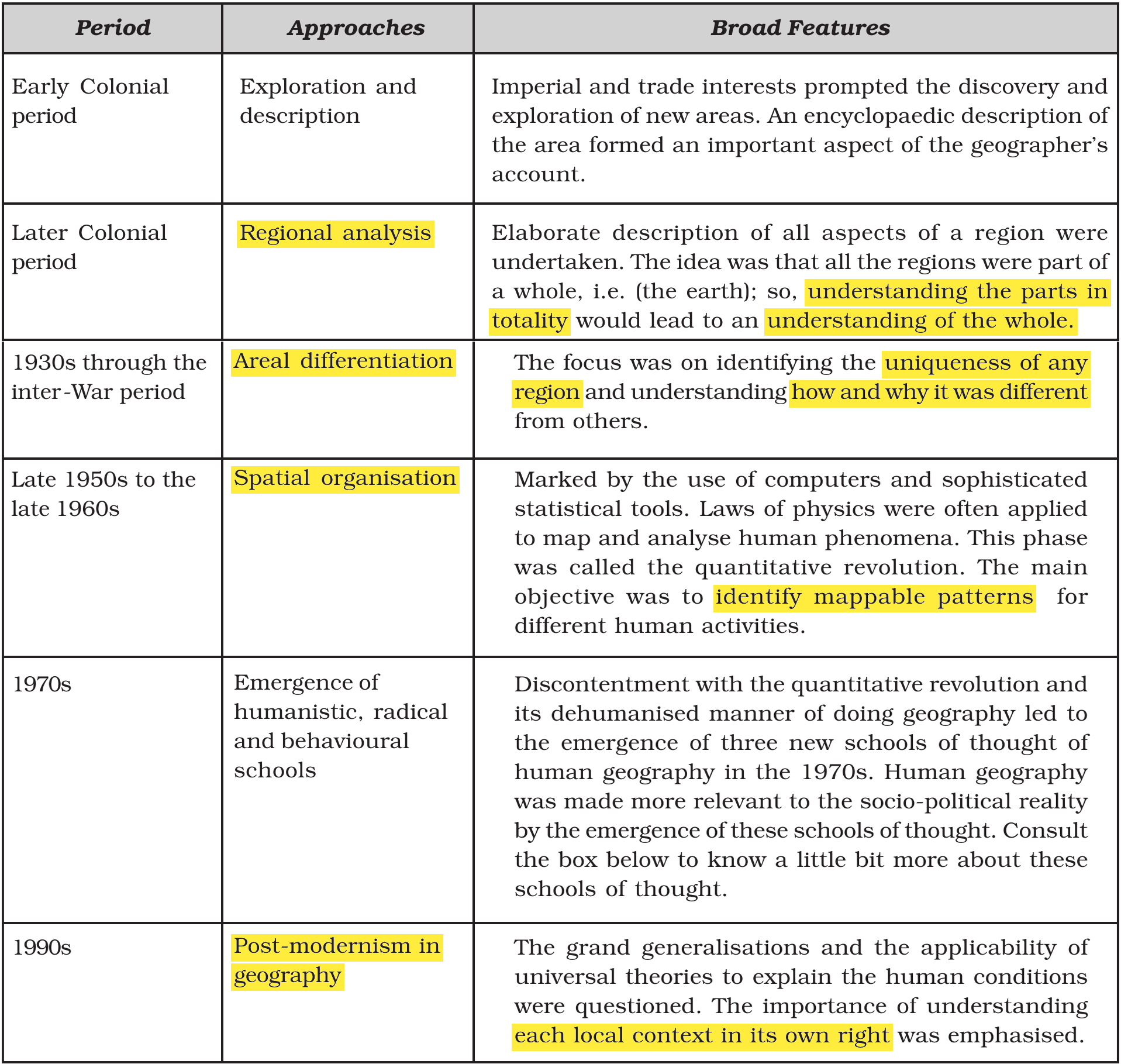
(A) Areal differentiation — this matches (IV) Uniqueness of a region and cause of differences. This phase tried to find what is unique about each region and how and why it was different from others.
(B) Spatial Organization — this matches (III) Identify mappable patterns. Using computers and statistical tools, this phase (the quantitative revolution) tried to identify mappable patterns of human activities.
(C) Regional analysis — this matches (I) Understanding the parts to understand the whole. All regions were seen as parts of a whole (the earth), so understanding the parts in totality would lead to understanding the whole.
(D) Post-modernism — this matches (II) Understanding each local context in its own right. Post-modernism questioned grand generalisations and stressed each local context in its own right.
NCERT (2026-27):
Table 1.1: Broad Stages and Thrust of Human Geography |