
Which of the following functions is the stirred-tank bioreactor designed for?
Answer & explanation
Correct answer: option 2
The correct answer is Option (2) → Availability of oxygen throughout the bioreactor
A stirred-tank bioreactor is usually cylindrical or has a curved base so that its contents mix well. Its stirrer gives even mixing and makes oxygen available throughout the vessel, which the cells need for growth. Air can also be bubbled through the reactor for the same purpose.
Option (1) Ensuring anaerobic conditions in the culture vessel — Incorrect. The stirrer and the oxygen delivery system are there to supply oxygen. They work against anaerobic conditions, not for them.
Option (2) Availability of oxygen throughout the bioreactor — Correct. Even mixing by the stirrer, along with air bubbled in, keeps oxygen available to the cells in every part of the bioreactor.
Option (3) Addition of preservatives to the product — Incorrect. Formulation with suitable preservatives is part of the processing of the product, which happens after the biosynthetic stage.
Option (4) Purification of the product — Incorrect. Separation and purification of the product make up downstream processing. This is done after the product has been made in the bioreactor.
NCERT Extract:
Obtaining the Foreign Gene Product – “… A stirred-tank reactor is usually cylindrical or with a curved base to facilitate the mixing of the reactor contents. The stirrer facilitates even mixing and oxygen availability throughout the bioreactor. Alternatively air can be bubbled through the reactor. If you look at the figure closely you will see that the bioreactor has an agitator system, an oxygen delivery system and a foam control system, a temperature control system, pH control system and sampling ports so that small volumes of the culture can be withdrawn periodically.”
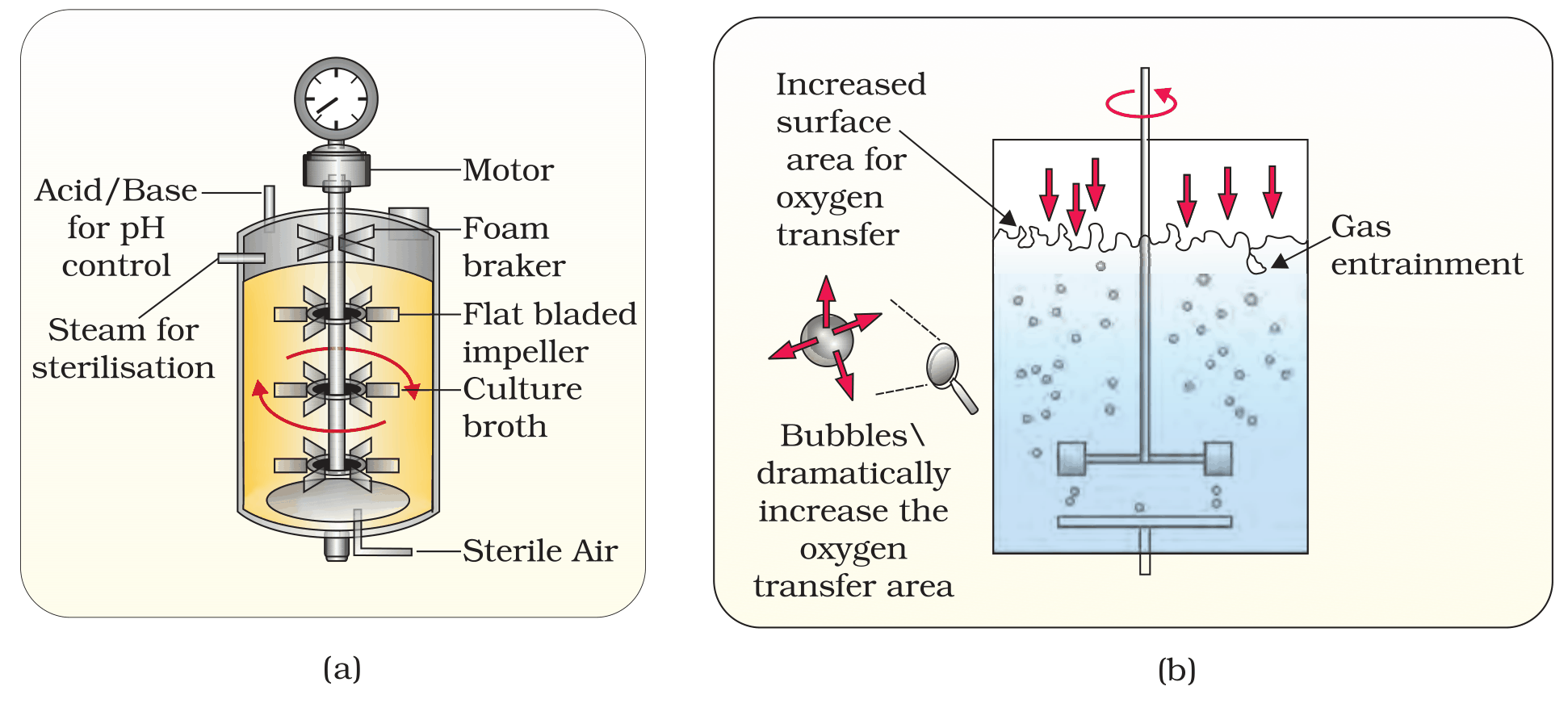
Figure 9.7 (a) Simple stirred-tank bioreactor; (b) Sparged stirred-tank bioreactor through which sterile air bubbles are sparged