Match List-I with List-II
| List-I | List-II |
| (A) TVC | (I) AVC × quantity |
| (B) SAC | (II) AVC + AFC |
| (C) TC | (III) TVC + TFC |
| (D) LRMC | (IV) (TC at \( q_1 \) units) - (TC at \( q_1 \) - 1 units) |
Choose the correct answer from the options given below:
Answer & explanation
Correct answer: option 1
The correct answer is Option (1) → (A)-(I), (B)-(II), (C)-(III), (D)-(IV)
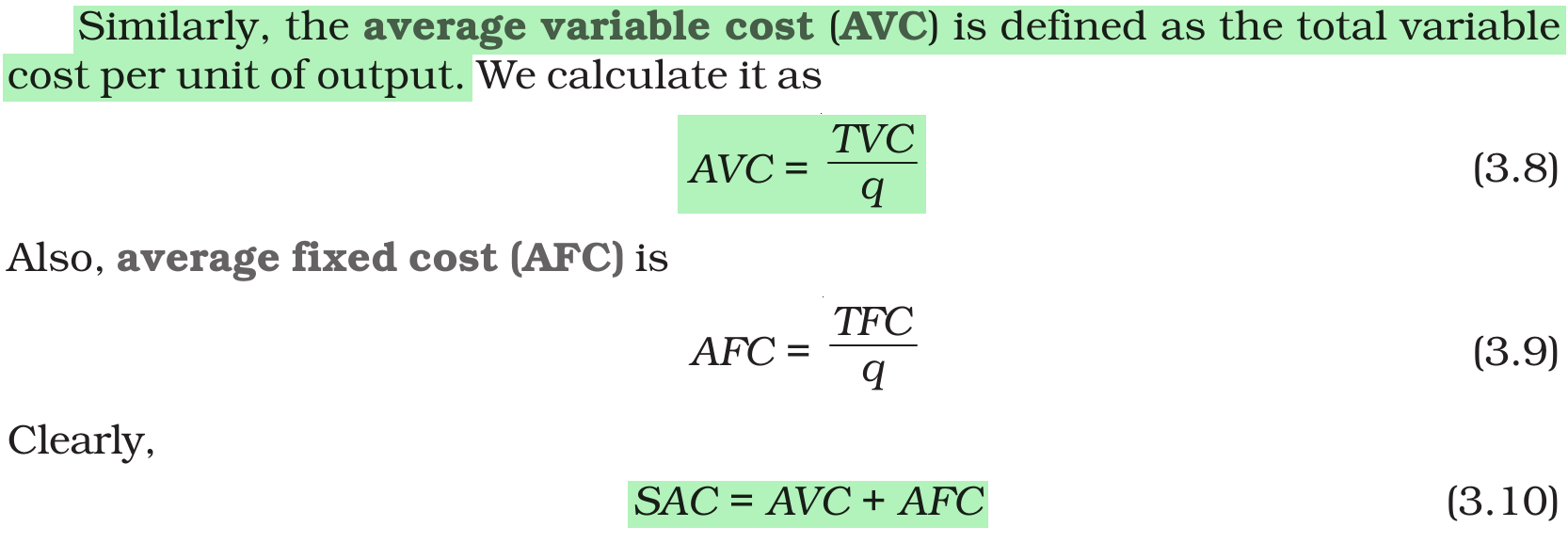
A firm’s cost measures are linked by a few simple relations. A total is the average multiplied by quantity, and a marginal cost is the change in total cost from one more unit.
| List-I | List-II | Reason |
|---|---|---|
| (A) TVC | (I) AVC × quantity | Average variable cost (AVC) is total variable cost per unit. So AVC times quantity gives back total variable cost. |
| (B) SAC | (II) AVC + AFC | Short run average cost is total cost per unit. So it is average variable cost plus average fixed cost. |
| (C) TC | (III) TVC + TFC | Total cost is the sum of total variable cost and total fixed cost. |
| (D) LRMC | (IV) (TC at \( q_1 \) units) - (TC at \( q_1 \) - 1 units) | Long run marginal cost is the change in total cost when output rises by one unit. |
NCERT (2026-27): “3.7.1 Short Run Costs We have previously discussed the short run and the long run. In the short run, some of the factors of production cannot be varied, and therefore, remain fixed. The cost that a firm incurs to employ these fixed inputs is called the total fixed cost (TFC). … To produce any required level of output, the firm, in the short run, can adjust only variable inputs. Accordingly, the cost that a firm incurs to employ these variable inputs is called the total variable cost (TVC). Adding the fixed and the variable costs, we get the total cost (TC) of a firm
|