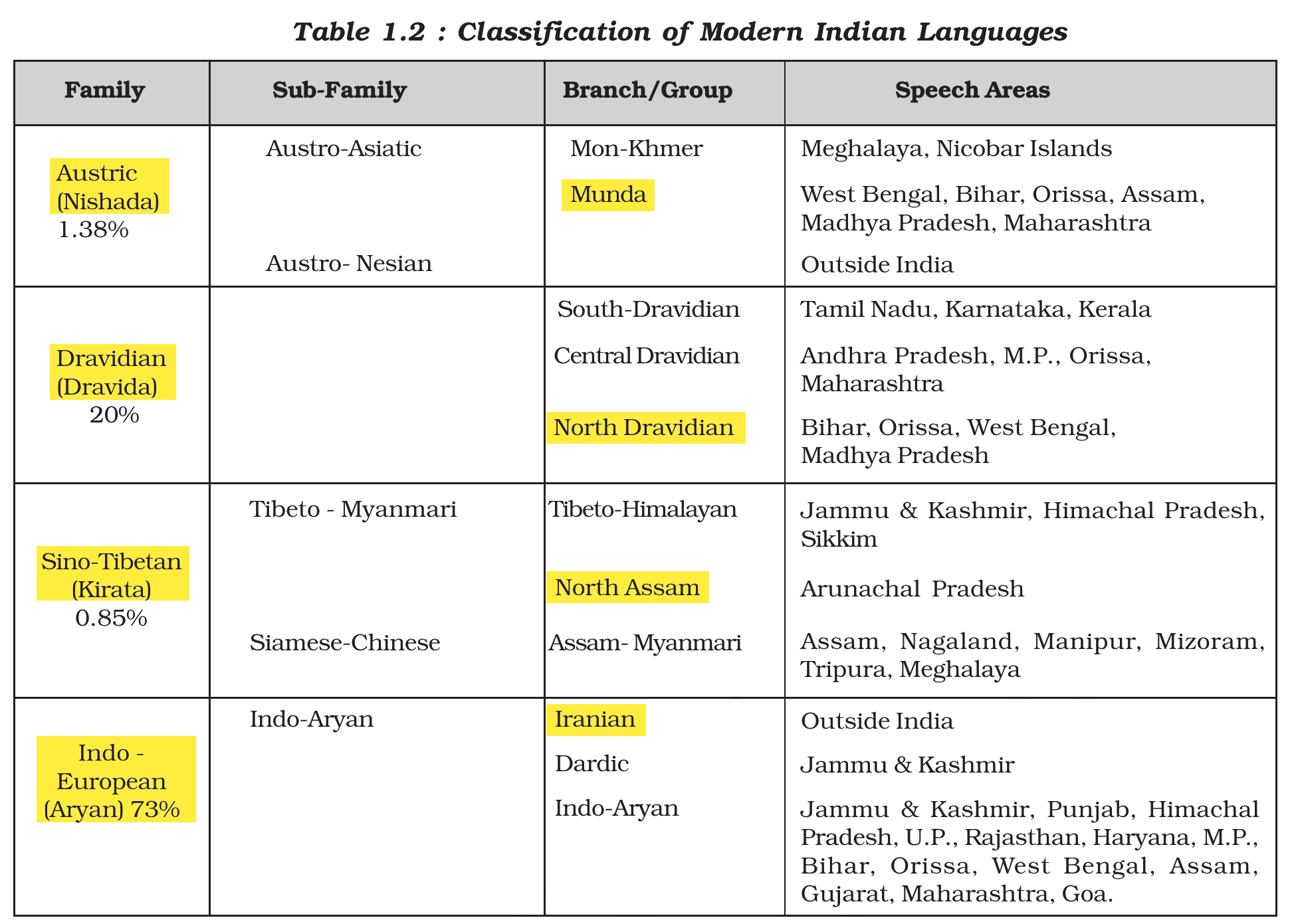
Match List-I with List-II
| List-I (Linguistic family) | List-II (Branch/Group) | ||
| (A) | Indo-European (Aryan) | (I) | Iranian |
| (B) | Sino-Tibetan (Kirata) | (II) | Munda |
| (C) | Austric (Nishada) | (III) | North Assam |
| (D) | Dravidian (Dravida) | (IV) | North Dravidian |
Choose the correct answer from the options given below:
Answer & explanation
Correct answer: option 2
The correct answer is Option (2) → (A)-(I), (B)-(III), (C)-(II), (D)-(IV)
(A) Indo-European (Aryan) — this matches (I) Iranian. Iranian is a branch of its Indo-Aryan sub-family.
(B) Sino-Tibetan (Kirata) — this matches (III) North Assam. North Assam is a branch of its Tibeto-Myanmari sub-family.
(C) Austric (Nishada) — this matches (II) Munda. Munda is a branch of its Austro-Asiatic sub-family.
(D) Dravidian (Dravida) — this matches (IV) North Dravidian.
NCERT (2026-27): “Linguistic Classification … The speakers of major Indian languages belong to four language families, which have their sub-families and branches or groups. This can be better understood from Table 1.2.”
|