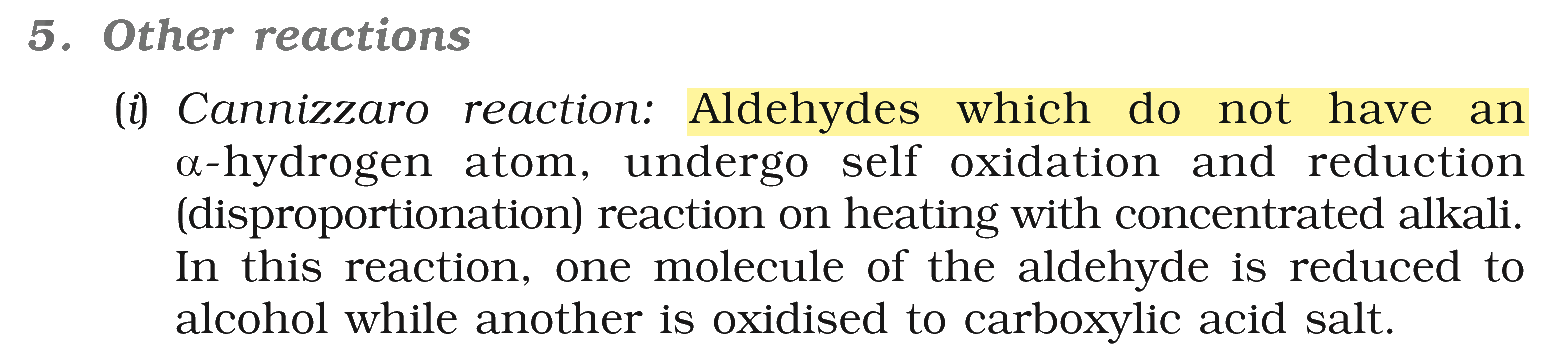
Which of the following reaction products [P] gives Cannizzaro reaction?
A. 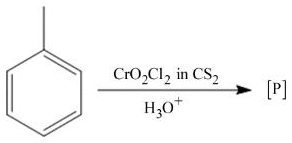
B. 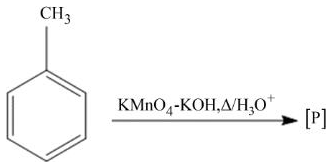
C. 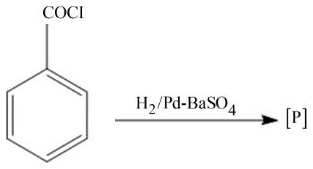
D. 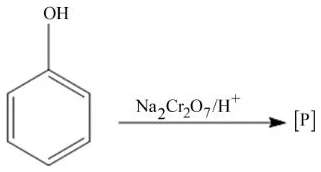
Choose the correct answer from the options given below:
Answer & explanation
Correct answer: option 3
The correct answer is Option (3) → A and C only
The Cannizzaro reaction is given by aldehydes that have no α-hydrogen. Heated with concentrated alkali, one molecule is reduced to the alcohol and another is oxidised to the salt of the acid:
\( \displaystyle \ce{2C6H5CHO + NaOH -> C6H5CH2OH + C6H5COONa} \)
So each product [P] must be checked: is it an aldehyde, and does it lack α-hydrogens?
(A) Toluene with \( \ce{CrO2Cl2} \) in \( \ce{CS2} \), then \( \ce{H3O^{+}} \) — Correct. This is the Étard reaction: chromyl chloride oxidises the methyl group only as far as the aldehyde. Benzaldehyde has no α-hydrogen.
\( \displaystyle \ce{C6H5CH3} \xrightarrow[\ce{H3O+}]{\ce{CrO2Cl2}\text{ in }\ce{CS2}} \ce{C6H5CHO} \)
(B) Toluene with \( \ce{KMnO4-KOH} \), Δ, then \( \ce{H3O^{+}} \) — Incorrect. Alkaline permanganate oxidises the side chain all the way to benzoic acid, which is not an aldehyde.
\( \displaystyle \ce{C6H5CH3} \xrightarrow[\text{(ii) }\ce{H3O+}]{\text{(i) }\ce{KMnO4}-\ce{KOH}, \Delta} \ce{C6H5COOH} \)
(C) Benzoyl chloride with \( \ce{H2} \)/\( \ce{Pd-BaSO4} \) — Correct. This is the Rosenmund reduction: the poisoned catalyst stops the reduction at the aldehyde, giving benzaldehyde.
\( \displaystyle \ce{C6H5COCl} \xrightarrow{\ce{H2}/\ce{Pd}-\ce{BaSO4}} \ce{C6H5CHO + HCl} \)
(D) Phenol with \( \ce{Na2Cr2O7} \)/\( \ce{H^{+}} \) — Incorrect. Acidified dichromate oxidises phenol to benzoquinone, a diketone, not an aldehyde.
\( \displaystyle \ce{C6H5OH + 2[O]} \xrightarrow{\ce{Na2Cr2O7}/\ce{H+}} \ce{C6H4O2 + H2O} \)
NCERT (2026-27 edition):
Other Reactions