
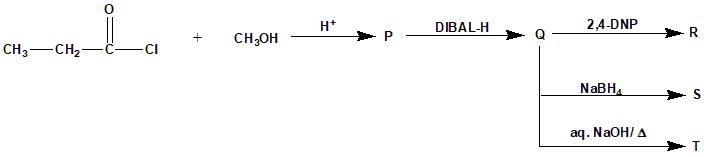
Predict \(P, Q, R, S\) and \(T\) in correct sequence:
Choose the correct answer from the options given below:
Answer & explanation
Correct answer: option 4
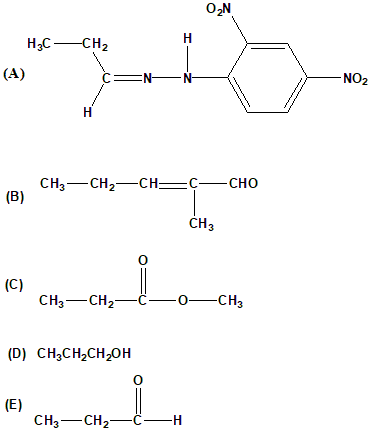
The correct answer is Option (4) → (C), (E), (A), (D), (B)
Each step of the scheme acts on the product of the step before it; Q, the aldehyde, is the starting point of the last three steps.
P — (C) methyl propanoate. Propanoyl chloride reacts with methanol to give the ester.
\( \ce{CH3CH2COCl + CH3OH} \xrightarrow{\ce{H+}} \ce{CH3CH2COOCH3 + HCl} \)
Q — (E) propanal. DIBAL-H reduces an ester only as far as the aldehyde.
\( \ce{CH3CH2COOCH3} \xrightarrow[\text{(ii) }\ce{H2O}]{\text{(i) DIBAL-H}} \ce{CH3CH2CHO + CH3OH} \)
R — (A) propanal 2,4-dinitrophenylhydrazone. The aldehyde condenses with 2,4-DNP, losing water, to give the hydrazone.
\( \ce{CH3CH2CHO + H2N-NH-C6H3(NO2)2 -> CH3CH2CH=N-NH-C6H3(NO2)2 + H2O} \)
S — (D) propan-1-ol. \( \ce{NaBH4} \) reduces the aldehyde to the primary alcohol.
\( \ce{CH3CH2CHO} \xrightarrow{\ce{NaBH4}} \ce{CH3CH2CH2OH} \)
T — (B) 2-methylpent-2-enal. Propanal has α-hydrogens, so aqueous NaOH brings about aldol condensation; on heating the aldol loses water.
\( \ce{2CH3CH2CHO} \xrightarrow[\Delta]{\text{aq. NaOH}} \ce{CH3CH2CH=C(CH3)CHO + H2O} \)
NCERT (2026-27 edition):
From Nitriles and Esters – “Nitriles are reduced to corresponding imine with stannous chloride in the presence of hydrochloric acid, which on hydrolysis give corresponding aldehyde. … This reaction is called Stephen reaction. Alternatively, nitriles are selectively reduced by diisobutylaluminium hydride, (DIBAL-H) to imines followed by hydrolysis to aldehydes. … Similarly, esters are also reduced to aldehydes with DIBAL-H.”
Note: The same/similar question has been asked in different years by NTA as per the details given below:
| 2026 | 2025 | 2024 | 2023 | 2022 |
|---|---|---|---|---|
| – | – | – | 30-05 S2 30-05 S1 | – |