
CUETMOCK
  • Pricing
  • Mentors
Log inStart freeStart free mocks→

First test, then trust

Try a free CUET mock test.

Join 5,00,000+ students who rehearsed exam day on the exact NTA screen before sitting CUET. On the web and on Android.

Start free mocks →Get the Android app
CUETMOCK

India's #1 CUET Mock Test Platform. Original NCERT-based questions on the exact NTA exam screen — trusted by 5,00,000+ students since CUET 2022.

Get it onGoogle PlayScan to download the CUETMOCK app

Mock tests

  • CUET mock test series
  • Commerce mocks
  • Humanities (Arts) mocks
  • Science mocks
  • Languages & GAT mocks
  • Free practice questions
  • Pricing

Resources

  • CUET exam guide
  • CUET syllabus
  • Universities accepting CUET
  • Expert blogs
  • News & notifications
  • Webinars & counselling
  • CUET score calculator
  • How we estimate your rank
  • FAQs

Company

  • About us
  • Our leadership & team
  • Our toppers
  • Mentors
  • For schools
  • Contact us
  • Terms
  • Privacy
  • Refund policy

Talk to us

+91 7696 6630 56info@cuetmock.comWhatsApp us

Our other platforms

  • JEE Mock — For IIT-JEE aspirants
  • NEET Mock — For NEET aspirants

Newsletter

Exam updates, study material and offers — no spam.

© 2026 NYC Ventures Pvt. Ltd.

701-702, Royal Business Park, Zirakpur, Punjab - 140603

  • Terms of use
  • Privacy policy
  • Refund policy
  • Contact us

iCUETMOCK is an independent preparation platform, not affiliated with the National Testing Agency (NTA). Always check exam details on the official NTA website.

  • Home
  • Mock tests
  • CUET guide
  • Pricing
  • Log in
Home/Practice questions/Chemistry
ChemistryPhysical: Electro Chemistry

When the cell reaction in a voltaic cell is reversed by reversing the…

When the cell reaction in a voltaic cell is reversed by reversing the direction of the electron flow, the voltaic cell is changed into

Answer & explanation+

Correct answer: option 2

The correct answer is Option (2) → an electrolytic cell

  • A voltaic (galvanic) cell uses a spontaneous reaction to produce electricity; an electrolytic cell uses electricity from outside to drive a non-spontaneous reaction. In the Daniell cell (1.1 V), an opposing external voltage above 1.1 V reverses the electron flow, and with it the cell reaction:

        \( \displaystyle \ce{Zn^2+(aq) + Cu(s) -> Zn(s) + Cu^2+(aq)} \)

  • Zinc is now deposited and copper dissolves. Electrical energy is being used to carry out a non-spontaneous reaction, so the device works as an electrolytic cell.

Why the other options are incorrect

Option (1) a reversible cell — Incorrect.

  • “Reversible” describes a cell whose reaction can be driven back by an opposing voltage, as the Daniell cell is.

  • It is not a new kind of cell; while the reaction runs backwards, the device is working as an electrolytic cell.

Option (3) a concentration cell — Incorrect. A concentration cell has the same electrode in solutions of different concentration. Reversing the electron flow does not change the electrodes or the solutions.

Option (4) a fuel cell — Incorrect. A fuel cell is a galvanic cell that converts the energy of combustion of fuels such as hydrogen directly into electrical energy. It produces electricity; it does not use it.

NCERT (2026-27 edition):
2.1 Electrochemical Cells – “If an external opposite potential is applied in the galvanic cell [Fig. 2.2(a)] and increased slowly, we find that the reaction continues to take place till the opposing voltage reaches the value 1.1 V [Fig. 2.2(b)] when, the reaction stops altogether and no current flows through the cell. Any further increase in the external potential again starts the reaction but in the opposite direction [Fig. 2.2(c)]. It now functions as an electrolytic cell, a device for using electrical energy to carry non-spontaneous chemical reactions.”
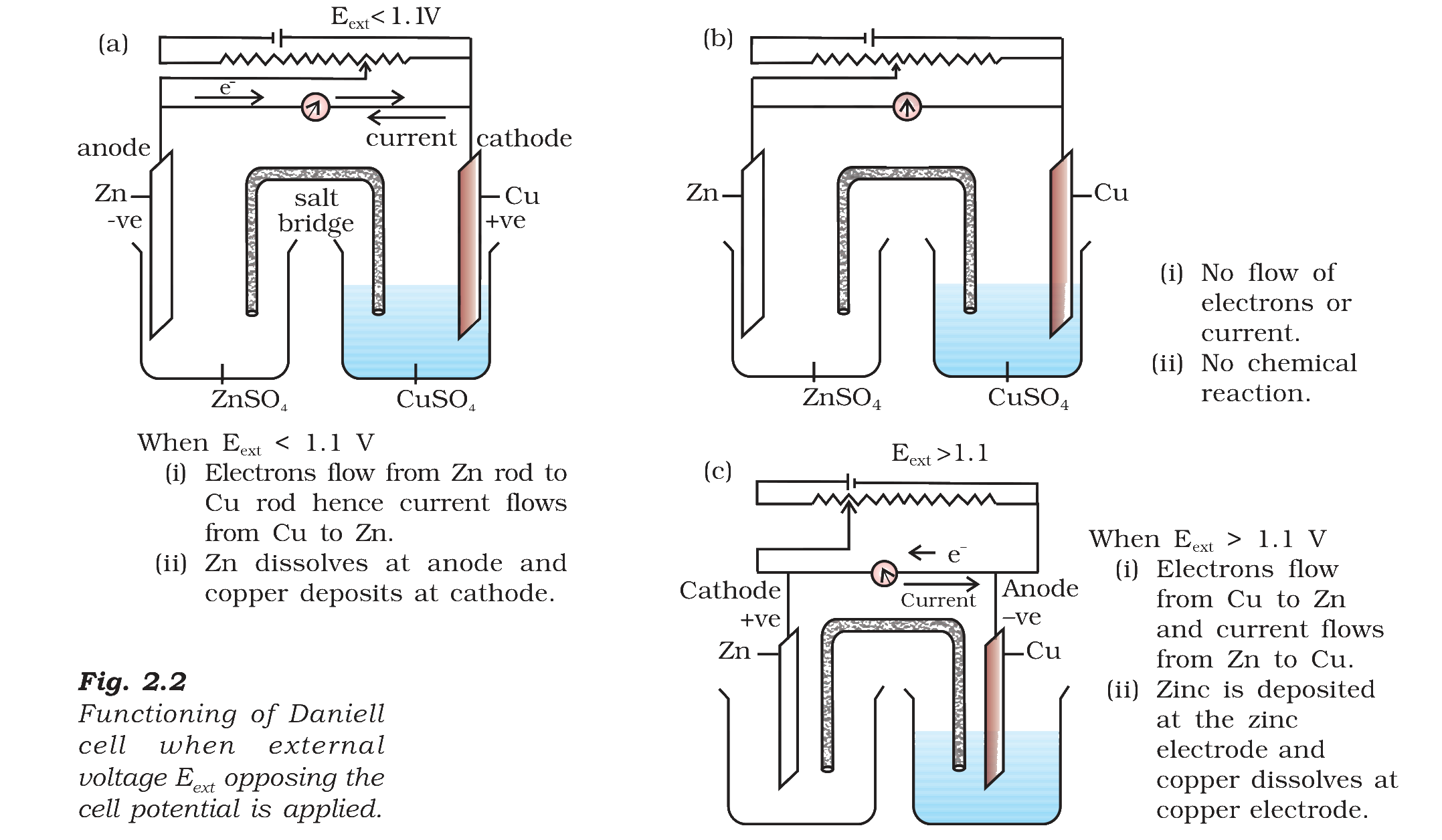
Fig. 2.2

Advertisement

Practise more on Physical: Electro Chemistry

Chapter-wise mocks on the real NTA exam screen, with solutions and your rank. Your first mocks are free.

Start free mocks →

Advertisement

Next questions

  1. When the government is trying to sell its share in several public sector companies, it is known as _______.Sociology · Social Change and Development in India: Change and Development in industrial Society
  2. (x^2(x-4)^2)/((x+4)^2-4 x) ÷ (≤ft(x^2-4 x)^3)/((x+4)^2) × (64-x^3)/(16-x^2) is equal toGeneral Aptitude Test · Quantitative Reasoning
  3. About one-fourth of the total cropped area in the country is under _________ cultivation.Geography · India-People and Economy: Land resources and Agriculture
  4. Silk Route connected which of the following?Geography · Fundamentals of Human Geography: International Trade
  5. If a - 1/(a - 5) = 10 Then find , (a - 5)3 - 1/((a - 5)^3)General Aptitude Test · Quantitative Reasoning
  6. Which type of debentures does not carry a specific rate of interest?Accountancy Part A · Issue and Redemption of Debentures
  7. Which of the following statements is correct in reference to the only two occasions when a single state succeeded in gaining preponderance…Political Science · Contemporary World Politics: US Hegemony in World Politics
  8. Which of these is equal to ∫ e^x log 5 e^x dx, where C is the constant of integration?Maths. Section B1 · Indefinite Integration
  9. If x : y = 3 : 4, then (4x + 3y) : (4x – y) = ?General Aptitude Test · Numerical Ability
  10. Which of the following Public Sector Undertaking (PSU) has been granted the status of 'Maharatna' by the Government ?Economics · Indian Economic Development: Liberalisation, Privatisation and Globalisation - An Appraisal