The idea of one-party dominance in India is rooted in-
Answer & explanation
Correct answer: option 4
The correct answer is Option (4) → The absence of strong alternative political parties
Option (1) Presence of strong opposition. — Incorrect. One-party dominance means that one party keeps winning while no other party can take its place. A strong opposition would be able to defeat the ruling party at the polls, so its presence would end dominance, not cause it.
Option (2) Authoritarian tendencies. — Incorrect. In some countries the dominance of one party was ensured by compromising democracy: the constitution permits only one party, or legal and military measures keep others out. What distinguished the Congress in India was that its dominance happened under democratic conditions.
Option (3) Subversion of democratic ethics — Incorrect. Subverting democracy would mean winning power by unfair means. In India many parties contested free and fair elections, and the Congress still won election after election, so its dominance did not rest on undermining democracy.
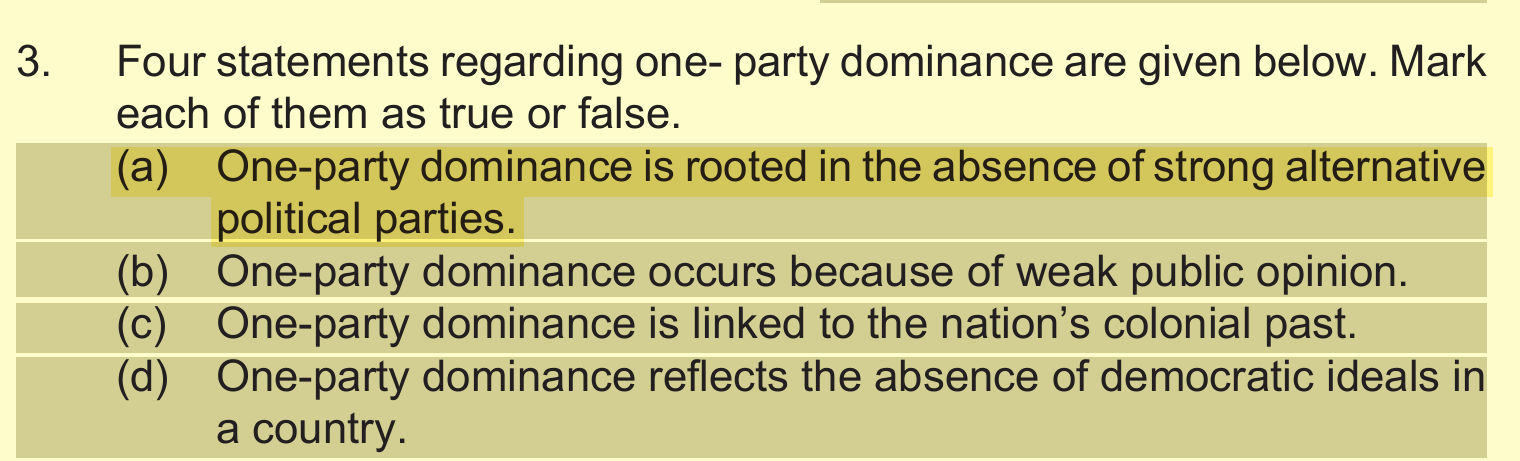
Option (4) The absence of strong alternative political parties — Correct. One-party dominance is rooted in the absence of strong alternative political parties: other parties contested, but none was strong enough to replace the Congress.
Tip: Option (4) is statement (a) of a true-or-false exercise at the end of the chapter. NTA picks questions even from the exercises, so work through them too.
NCERT (2025-26): “Nature of Congress dominance … In the rest of the cases the dominance of one party was ensured by compromising democracy. In some countries like China, Cuba and Syria the constitution permits only a single party to rule the country. Some others like Myanmar, Belarus, Egypt, and Eritrea are effectively one-party states due to legal and military measures. Until a few years ago, Mexico, South Korea and Taiwan were also effectively one-party dominant states. What distinguished the dominance of the Congress party in India from all these cases was it happened under democratic conditions. Many parties contested elections in conditions of free and fair elections and yet the Congress managed to win election after election.…”
|