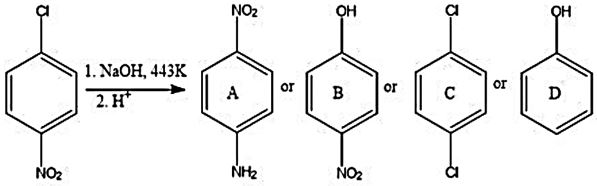
The product in the following reaction is
Answer & explanation
Correct answer: option 2
The correct answer is Option (2) → B
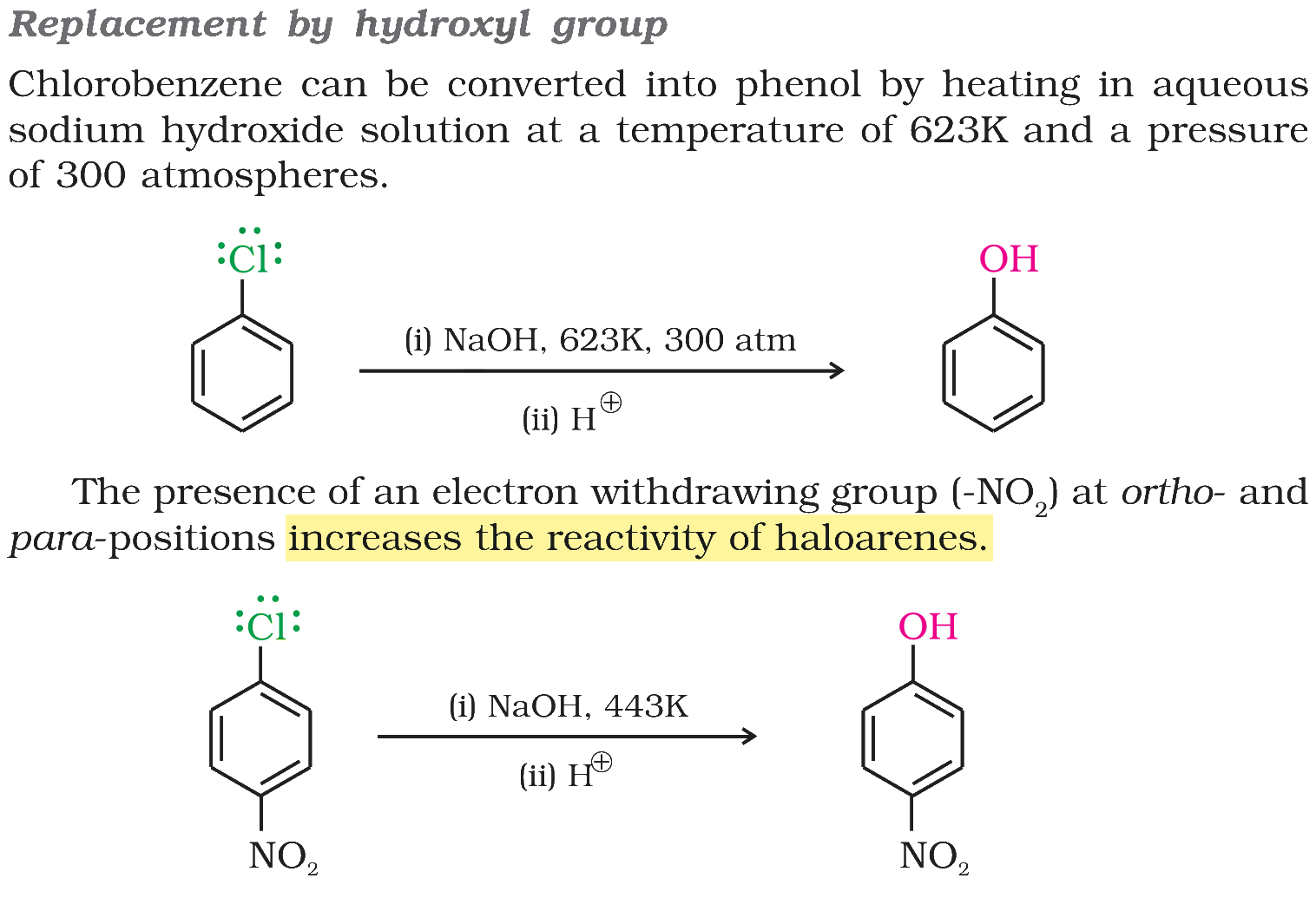
Haloarenes resist nucleophilic substitution: chlorobenzene is converted to phenol only with aqueous NaOH at 623 K and 300 atm. An electron-withdrawing –NO2 group at the ortho or para position makes the reaction much easier. It pulls electron density out of the ring, which helps the hydroxide ion attack the carbon carrying the chlorine, and it stabilises the negatively charged intermediate by resonance. So 1-chloro-4-nitrobenzene reacts at 443 K, and acidification gives the phenol:
\( \displaystyle p\text{-}\ce{ClC6H4NO2} \xrightarrow[\text{(ii) }\ce{H+}]{\text{(i) NaOH, 443 K}} p\text{-}\ce{HOC6H4NO2} \)
Only the chlorine is replaced; the nitro group stays. The product is 4-nitrophenol, structure B.
Why the other options are incorrect
Option (1) A — Incorrect. 4-Nitroaniline would need ammonia as the nucleophile, not hydroxide.
Option (3) C — Incorrect. 1,4-Dichlorobenzene has the nitro group replaced by chlorine; NaOH supplies no chlorine and does not attack the nitro group.
Option (4) D — Incorrect. Phenol would mean the loss of the nitro group as well; hydroxide replaces only the halogen.
NCERT (2026-27 edition):
Replacement by Hydroxyl Group