
CUETMOCK
  • Pricing
  • Mentors
Log inStart freeStart free mocks→

First test, then trust

Try a free CUET mock test.

Join 5,00,000+ students who rehearsed exam day on the exact NTA screen before sitting CUET. On the web and on Android.

Start free mocks →Get the Android app
CUETMOCK

India's #1 CUET Mock Test Platform. Original NCERT-based questions on the exact NTA exam screen — trusted by 5,00,000+ students since CUET 2022.

Get it onGoogle PlayScan to download the CUETMOCK app

Mock tests

  • CUET mock test series
  • Browse all papers
  • Commerce mocks
  • Humanities (Arts) mocks
  • Science mocks
  • Languages & GAT mocks
  • Free practice questions
  • Pricing

Resources

  • CUET exam guide
  • CUET syllabus
  • Universities accepting CUET
  • Expert blogs
  • News & notifications
  • Webinars & counselling
  • CUET score calculator
  • How we estimate your rank
  • FAQs

Company

  • About us
  • Our leadership & team
  • Our toppers
  • Mentors
  • For schools
  • Contact us
  • Terms
  • Privacy
  • Refund policy

Talk to us

+91 7696 6630 56info@cuetmock.comWhatsApp us

Our other platforms

  • JEE Mock — For IIT-JEE aspirants
  • NEET Mock — For NEET aspirants

Newsletter

Exam updates, study material and offers — no spam.

© 2026 NYC Ventures Pvt. Ltd.

701-702, Royal Business Park, Zirakpur, Punjab - 140603

  • Terms of use
  • Privacy policy
  • Refund policy
  • Contact us

iCUETMOCK is an independent preparation platform, not affiliated with the National Testing Agency (NTA). Always check exam details on the official NTA website.

  • Home
  • Mock tests
  • CUET guide
  • Pricing
  • Log in
Home/Practice questions/Maths. Section B1
Maths. Section B1Application of Integrals

Find the area bounded by the ellipse (x^2)/(a^2) + (y^2)/(b^2) = 1 an…

Find the area bounded by the ellipse $\frac{x^2}{a^2} + \frac{y^2}{b^2} = 1$ and the ordinates $x = 0$ and $x = ae$, where, $b^2 = a^2(1 - e^2)$ and $e < 1$.

Answer & explanation+

Correct answer: option 1

The correct answer is Option (1) → $ab (\sin^{-1} e + e\sqrt{1 - e^2})$

The required area of the region $BOB'RFSB$ is enclosed by the ellipse and the lines $x = 0$ and $x = ae$.
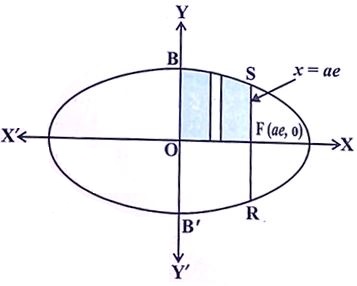
Note that the area of the region $BOB'RFSB$

$= 2 \int\limits_{0}^{ae} y \, dx = 2 \frac{b}{a} \int_{0}^{ae} \sqrt{a^2 - x^2} \, dx$

$= \frac{2b}{a} \left[ \frac{x}{2} \sqrt{a^2 - x^2} + \frac{a^2}{2} \sin^{-1} \frac{x}{a} \right]_{0}^{ae}$

$= \frac{2b}{2a} \left[ ae \sqrt{a^2 - a^2 e^2} + a^2 \sin^{-1} e \right]$

$= ab \left[ e \sqrt{1 - e^2} + \sin^{-1} e \right]$

Advertisement

Practise more on Application of Integrals

Chapter-wise mocks on the real NTA exam screen, with solutions and your rank. Your first mocks are free.

Start free mocks →

Advertisement

Next questions

  1. Trans-Canadian Railway line was constructed in which of the following years?Geography · Fundamentals of Human Geography: Transport and Communication
  2. The sepoy mutiny broke out on 10 May 1857 at:History · Modern India: Rebels and the Raj
  3. How many rectangles are there in the given figure?General Aptitude Test · Verbal Reasoning
  4. What happens when aldehydes are treated with alcohols in the presence of anhydrous acids?Chemistry · Organic: Aldehydes, Ketones and Carboxylic Acids
  5. Read the paragraph given below which is an account of a foreign traveller who had visited India. This account is of his visit to Kashmir. I…History · Medieval India: Through the Eyes of Travellers
  6. If A alone can complete a work in 20 days and B alone can complete the same in 30 days following statement(s) is/are correct? I. Ratio of e…General Aptitude Test · Numerical Ability
  7. Which of the following is the last step in the planning process?Business Studies · Planning
  8. What is the difference between the mean and the median of the following data: 5, 7, 8, 13, 12, 14, 9, 2, 26, 10 ?General Aptitude Test · Numerical Ability
  9. The current I flowing in the circuit is:Physics · Current Electricity
  10. The Cartesian equation of the passing through the point (1, -3, 2) and parallel to the line r = (2+λ)i + λj + (2λ-1)k isMaths. Section B1 · Three-dimensional Geometry