Answer questions from the passage below:
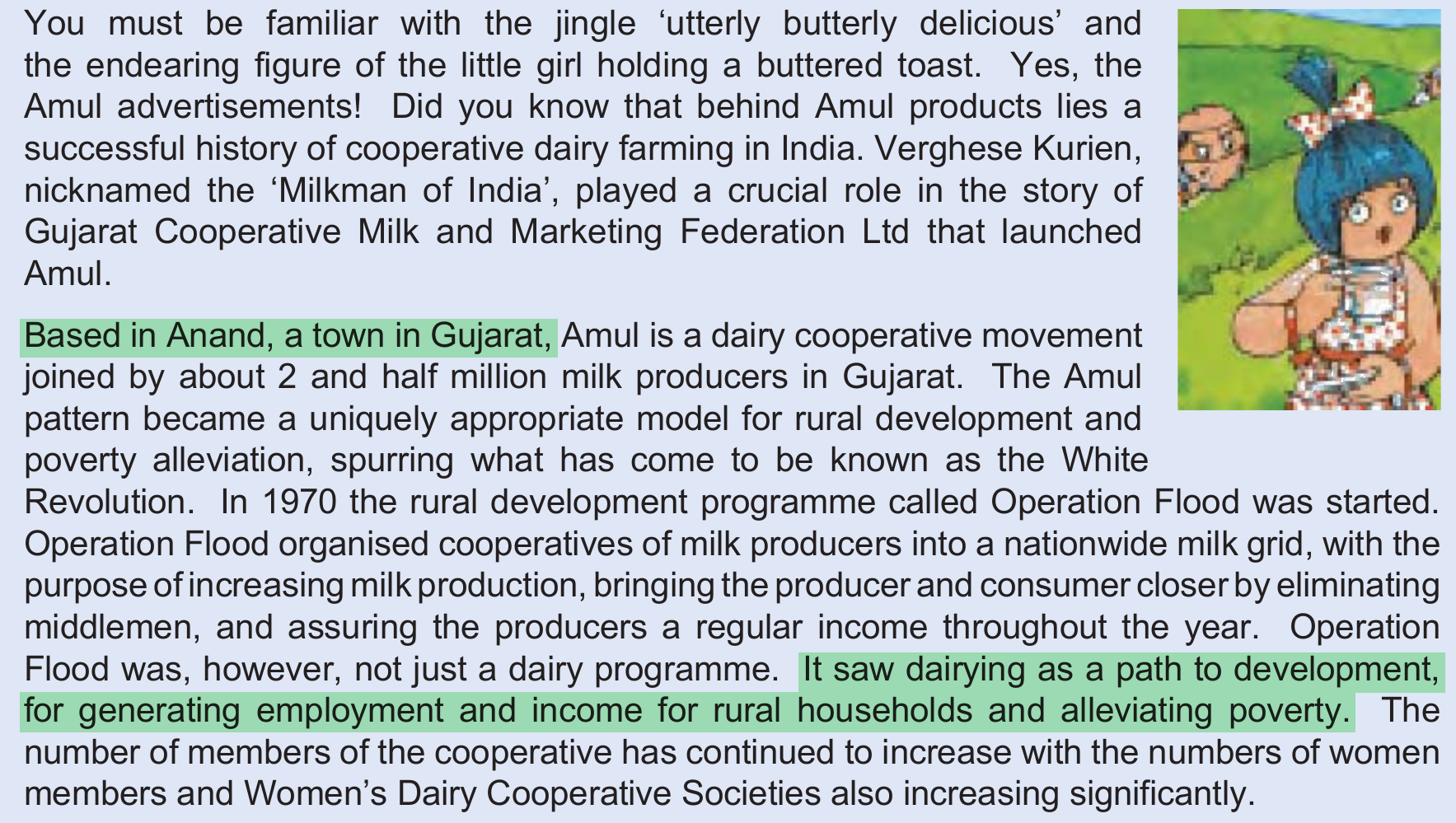
Based in Anand, a town in Gujarat, Amul is a dairy cooperative movement joined by about two and half million milk producers in Gujarat. The Amul pattern became a uniquely appropriate model for rural development and poverty alleviation, spurring what has come to be known as the White Revolution. In 1970, the rural development programme called Operation Flood was started. Operation Flood organized cooperatives of milk producers into a nationwide milk grid, with the purpose of increasing milk production, bringing the producer and consumer closer by eliminating middlemen, and assuring the producers a regular income throughout the year. Operation Flood was, however, not just a dairy programme. It saw dairying as a path to development, for generating employment and income for rural households and alleviating poverty. The number of members of the cooperative has continued to increase with the numbers of women members and Women's Dairy Cooperative Societies are also increasing significantly.
Which of the following mode was adopted for the rural development programme in Anand?
Answer & explanation
Correct answer: option 3
The correct answer is Option (3) → Dairy as a path to development.
Operation Flood, which grew out of the Amul cooperative at Anand, saw dairying as a path to development, for generating employment and income for rural households and alleviating poverty.
Note: The box ‘Fast Forward: The White Revolution’ of the chapter ‘Politics of Planned Development’ was there in the pre-rationalised NCERT; this portion is not in the 2023-24 and 2025-26 editions or the NCERT book (2026-27), though the chapter is still there.
NCERT (Pre-rationalised): Politics in India since Independence — Chapter 3: Politics of Planned Development
|