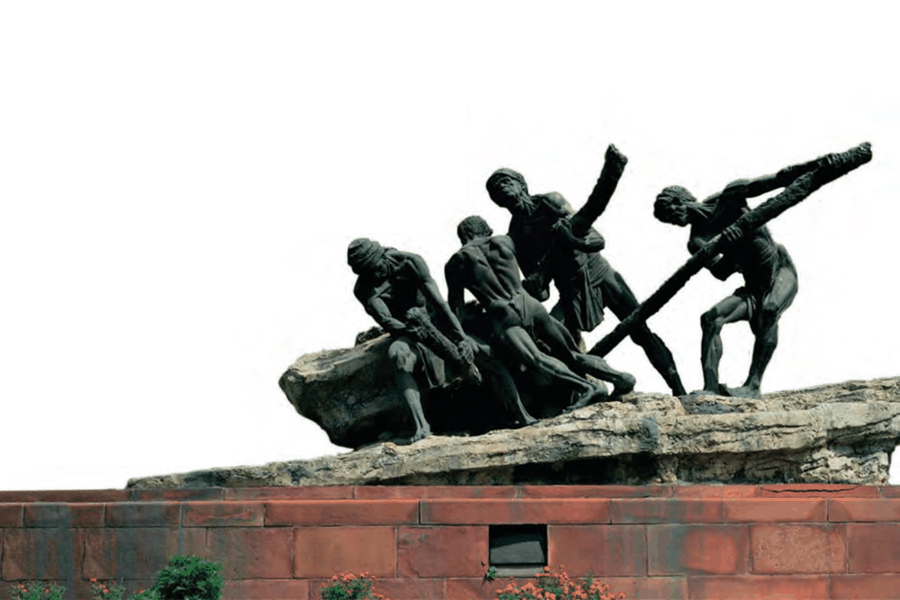
Observe the image and answer the following question.
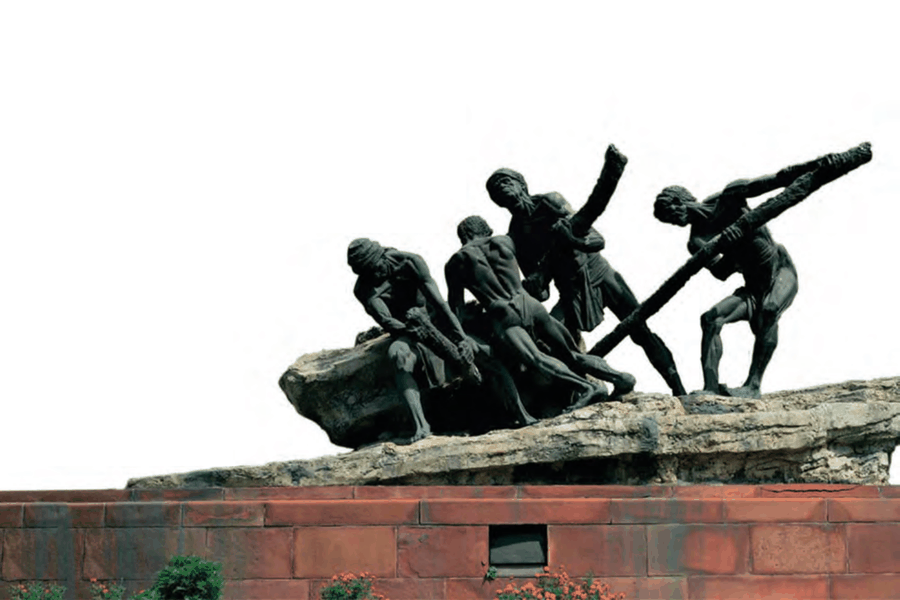
In this open-air bronze at Marina Beach, Chennai, what did Debi Prasad Roy Chowdhury love to dwell on?
Answer & explanation
Correct answer: option 3
The correct answer is Option (3) → Strong musculature, revealing the bones, veins and flesh
Option (1) Stick-like figures shown in flat rhythmical planes — Incorrect. This is said of Amarnath Sahgal’s bronze Cries Un-heard, whose three figures are stick-like and shown in flat rhythmical planes. It does not fit the muscular men of this group.
Option (2) Linear silhouettes instead of an emphasis on three-dimensionality — Incorrect. This is said of P. V. Janakiram’s copper Ganesha, conceived in linear silhouettes. Roy Chowdhury dwelt on the bodies of his men instead.
Option (3) Strong musculature, revealing the bones, veins and flesh — Correct. The work is Triumph of Labour. Roy Chowdhury loved to dwell on the strong musculature of his figures.
Option (4) A face with an inward expression and protruding lips — Incorrect. This is said of Mrinalini Mukherjee’s fibre Vanshri, a single figure with an inward expression, not a group in bronze.
NCERT (2026-27): “Triumph of Labour This is an open air large-scale sculpture in bronze made by Debi Prasad Roy Chowdhury (1899–1975). It was installed at Marina Beach, Chennai, on the eve of the Republic Day in 1959. … Chowdhury loved to dwell on the strong musculature of his workers, revealing their bones, veins, flesh, etc. He portrayed the extreme physical effort of loosening a massive, immovable rock. …”
|