Consider the following statements about the limitations of controlling:
(A) Sometimes controlling turns out to be a costly affair, especially in case of small organisations.
(B) Employees resist control because they see it as a restriction on their earnings.
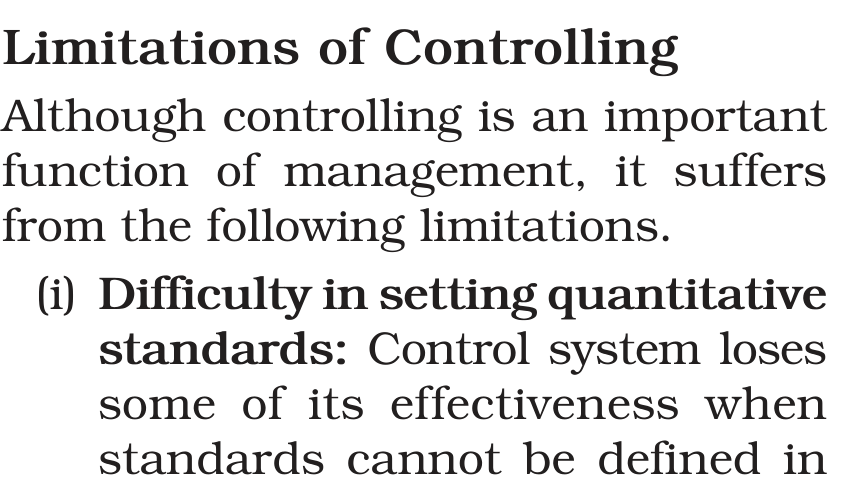
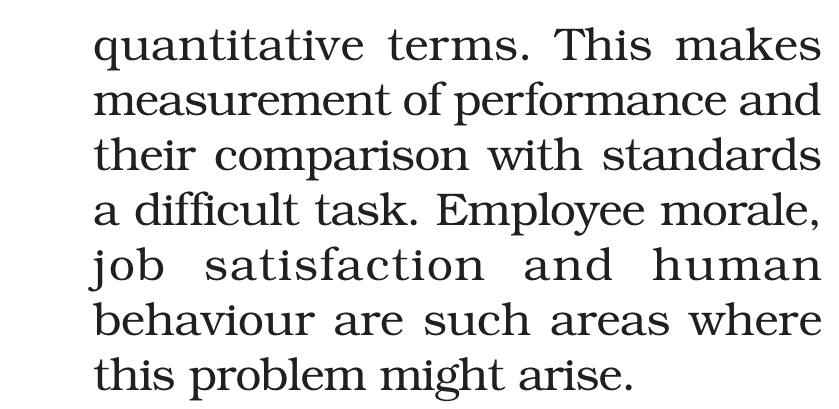
(C) It is not always possible for the management to set quantitative standards of performance.
(D) Employee morale, job satisfaction and sales volume are areas where quantitative standards are difficult to set.
(E) The control system of an organisation may face resistance from its employees.
Which of the statements given above are correct?
Choose the correct answer from the options given below:
Answer & explanation
Correct answer: option 2
The correct answer is Option (2) → (A), (C) and (E) only
(A) Sometimes controlling turns out to be a costly affair, especially in case of small organisations. — Correct. Control needs a lot of expenditure, time and effort. A small organisation may not be able to afford it.
(B) Employees resist control because they see it as a restriction on their earnings. — Incorrect. Employees resist control because they see it as a restriction on their freedom, such as a strict watch through CCTVs. Earnings are not the reason.
(C) It is not always possible for the management to set quantitative standards of performance. — Correct. In some areas standards cannot be put in numbers. Then the control system loses some of its effectiveness.
(D) Employee morale, job satisfaction and sales volume are areas where quantitative standards are difficult to set. — Incorrect. Sales volume can be counted, so a quantitative standard is easy to set for it. The difficult areas are employee morale, job satisfaction and human behaviour.
(E) The control system of an organisation may face resistance from its employees. — Correct. Employees often resist control. So the control system may face resistance from them.
NCERT (2026-27 Edition): “(iii) Resistance from employees: Control is often resisted by employees. They see it as a restriction on their freedom. …” “Summary … • Controlling suffers from certain limitations also. An organisation has no control over external factors. The control system of an organisation may face resistance from its employees. Sometimes controlling turns out to be a costly affair, especially in case of small organisations. Moreover, it is not always possible for the management to set quantitative standards of performance in the absence of which controlling exercise loses some of its effectiveness.”
|