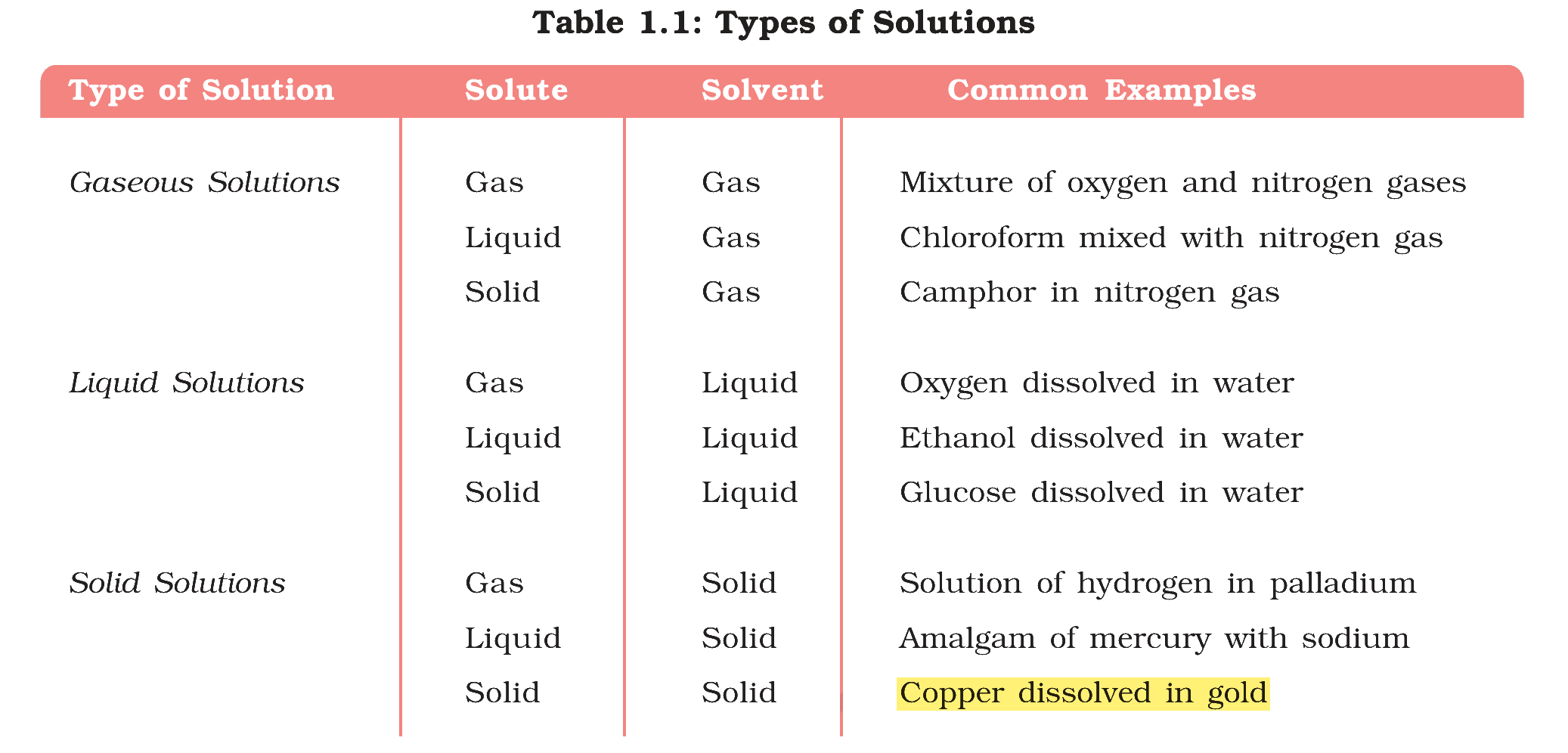
Consider the following statements about solutions.
(A) Solutions are homogeneous mixtures whose composition and properties are uniform throughout the mixture.
(B) Generally, the component that is present in the largest quantity in a solution is known as the solute.
(C) The solvent determines the physical state in which a solution exists.
(D) Copper dissolved in gold is an example of a solution of a solid solute in a liquid solvent.
Which of the statements given above are incorrect? Choose the correct answer from the options given below:
Answer & explanation
Correct answer: option 1
The correct answer is Option (1) → (B) and (D) only
A solution has a solvent, the main component, and one or more solutes. Each of them may be a gas, a liquid or a solid, which gives the different types of solutions.
(A) Solutions are homogeneous mixtures whose composition and properties are uniform throughout the mixture. — Correct statement. This is what homogeneous means for a solution.
(B) Generally, the component that is present in the largest quantity in a solution is known as the solute. — Incorrect statement. The component present in the largest quantity is the solvent; the other components are the solutes.
(C) The solvent determines the physical state in which a solution exists. — Correct statement. For example, oxygen dissolved in water is a liquid solution because water, the solvent, is a liquid.
(D) Copper dissolved in gold is an example of a solution of a solid solute in a liquid solvent. — Incorrect statement. Gold, the solvent, is a solid, so copper in gold is a solid in solid solution.
NCERT (2026-27 edition):
1.1 Types of Solutions – “Solutions are homogeneous mixtures of two or more than two components. By homogenous mixture we mean that its composition and properties are uniform throughout the mixture. Generally, the component that is present in the largest quantity is known as solvent. Solvent determines the physical state in which solution exists. One or more components present in the solution other than solvent are called solutes.”