Match List-I with List-II.
| List-I | List-II |
| (A) Copper chloride | (I) \( \mu_r\gg1 \) |
| (B) Superconductor | (II) \( 0\lt\chi\lt\epsilon \) (\( \epsilon \) a small positive number) |
| (C) Ferromagnetic material | (III) \( 0\le\mu_r\lt 1 \) |
| (D) Water | (IV) Meissner effect |
Choose the correct answer from the options given below:
Answer & explanation
Correct answer: option 1
The correct answer is Option (1) → (A)-(II), (B)-(IV), (C)-(I), (D)-(III)
(A) Copper chloride — This matches (II) \( 0\lt\chi\lt\epsilon \). Copper chloride is paramagnetic. A paramagnetic material has a small positive susceptibility, and \( \epsilon \) is a small positive number.
(B) Superconductor — This matches (IV) Meissner effect. A superconductor is a perfect diamagnet. The field lines are completely expelled from it (\( \chi=-1 \), \( \mu_r=0 \)). This perfect diamagnetism is called the Meissner effect.
(C) Ferromagnetic material — This matches (I) \( \mu_r\gg1 \). A ferromagnetic material has a large positive susceptibility, so its relative permeability \( \mu_r=1+\chi \) is much greater than 1.
(D) Water — This matches (III) \( 0\le\mu_r\lt1 \). Water is diamagnetic. Its susceptibility is negative, so \( \mu_r=1+\chi \) is a little less than 1.
NCERT (2026-27):
Paramagnetism – “Some paramagnetic materials are aluminium, sodium, calcium, oxygen (at STP) and copper chloride.”
Diamagnetism – “The most exotic diamagnetic materials are superconductors. These are metals, cooled to very low temperatures which exhibits both perfect conductivity and perfect diamagnetism. Here the field lines are completely expelled! χ = –1 and μr = 0. … The phenomenon of perfect diamagnetism in superconductors is called the Meissner effect, after the name of its discoverer.”
Diamagnetism – “Some diamagnetic materials are bismuth, copper, lead, silicon, nitrogen (at STP), water and sodium chloride.”
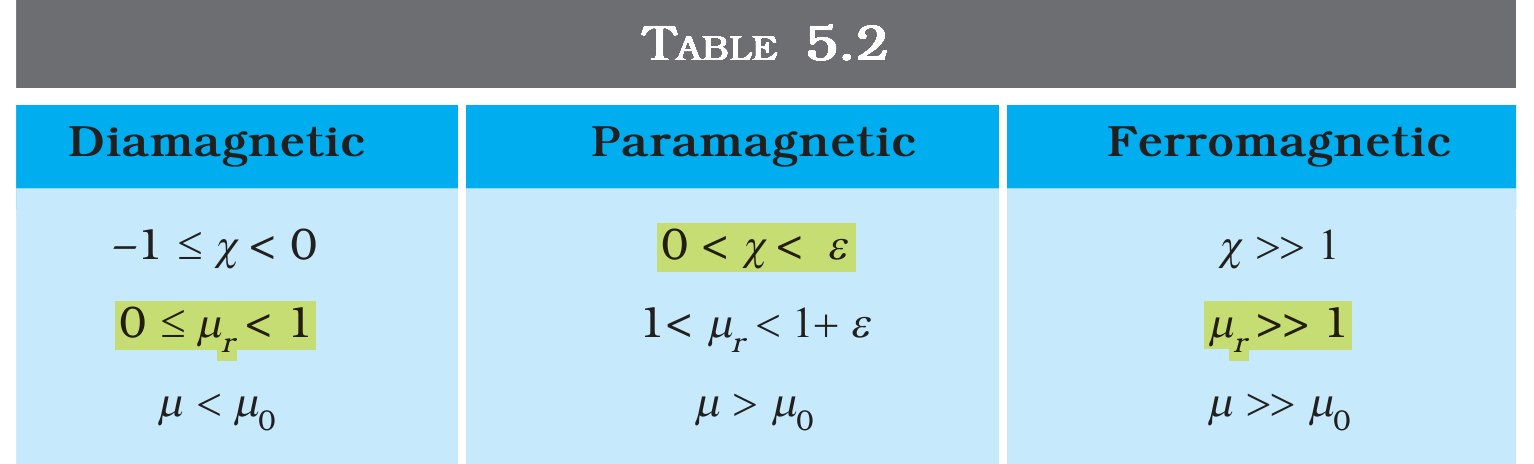
Magnetic Properties of Materials – “The discussion in the previous section helps us to classify materials as diamagnetic, paramagnetic or ferromagnetic. In terms of the susceptibility χ, a material is diamagnetic if χ is negative, para- if χ is positive and small, and ferro- if χ is large and positive.”
“A glance at Table 5.2 gives one a better feeling for these materials. Here ε is a small positive number introduced to quantify paramagnetic materials.”