The units of rate of reaction and rate constant are identical for a
Answer & explanation
Correct answer: option 2
The correct answer is Option (2) → Zero order reaction
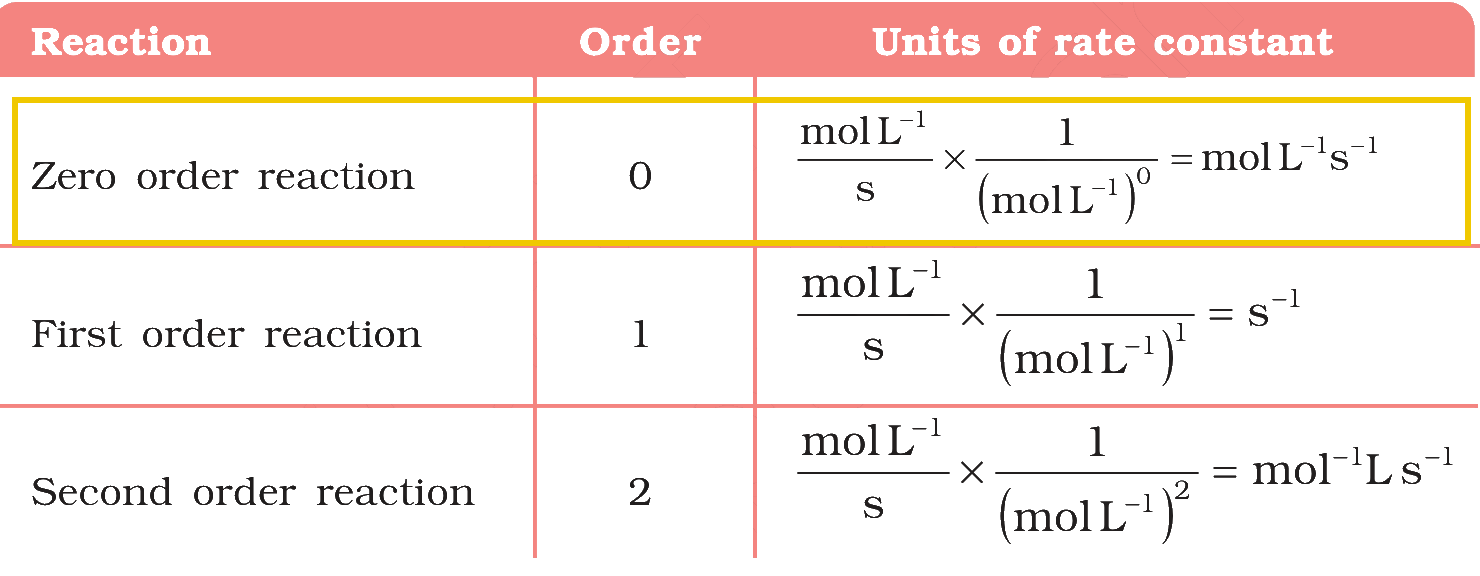
The rate of a reaction is always measured as concentration per unit time, mol L−1 s−1. The unit of the rate constant follows from the rate law, \( \text{Rate} = k[\mathrm{A}]^{n} \):
\( \displaystyle k = \frac{\text{Rate}}{[\mathrm{A}]^{n}} \)
\( \displaystyle \text{unit of } k = \frac{\mathrm{mol\,L^{-1}\,s^{-1}}}{(\mathrm{mol\,L^{-1}})^{n}} = (\mathrm{mol\,L^{-1}})^{1-n}\,\mathrm{s^{-1}} \)
For a fractional order, for example n = 1/2, the unit is \( \mathrm{mol^{1/2}\,L^{-1/2}\,s^{-1}} \).
The two units are identical only when the concentration term disappears from the rate law, that is, for a zero order reaction, where Rate = k.
NCERT (2026-27 edition):
Order of a Reaction – …