Read the passage carefully and answer the questions based on the passage:
Income and the Exchange Rate
When income of a country increases, consumer spending increases. Spending on imported goods is also likely to increase. When imports increase, the demand curve for foreign exchange shifts to the right. There is a depreciation of the domestic currency. If there is an increase in income abroad as well, domestic exports will rise and the supply curve of foreign exchange shifts outward. On balance, the domestic currency may or may not depreciate. What happens will depend on whether exports are growing faster than imports. In general, other things remaining equal, a country whose aggregate demand grows faster than the rest of the world's normally finds its currency depreciating because its imports grow faster than its exports. Its demand curve for foreign currency shifts faster than its supply curve.
If the volume of imports of a country are growing faster than its volume of exports, its gross domestic product _____.
Answer & explanation
Correct answer: option 1
The correct answer is Option (1) → Will Fall.
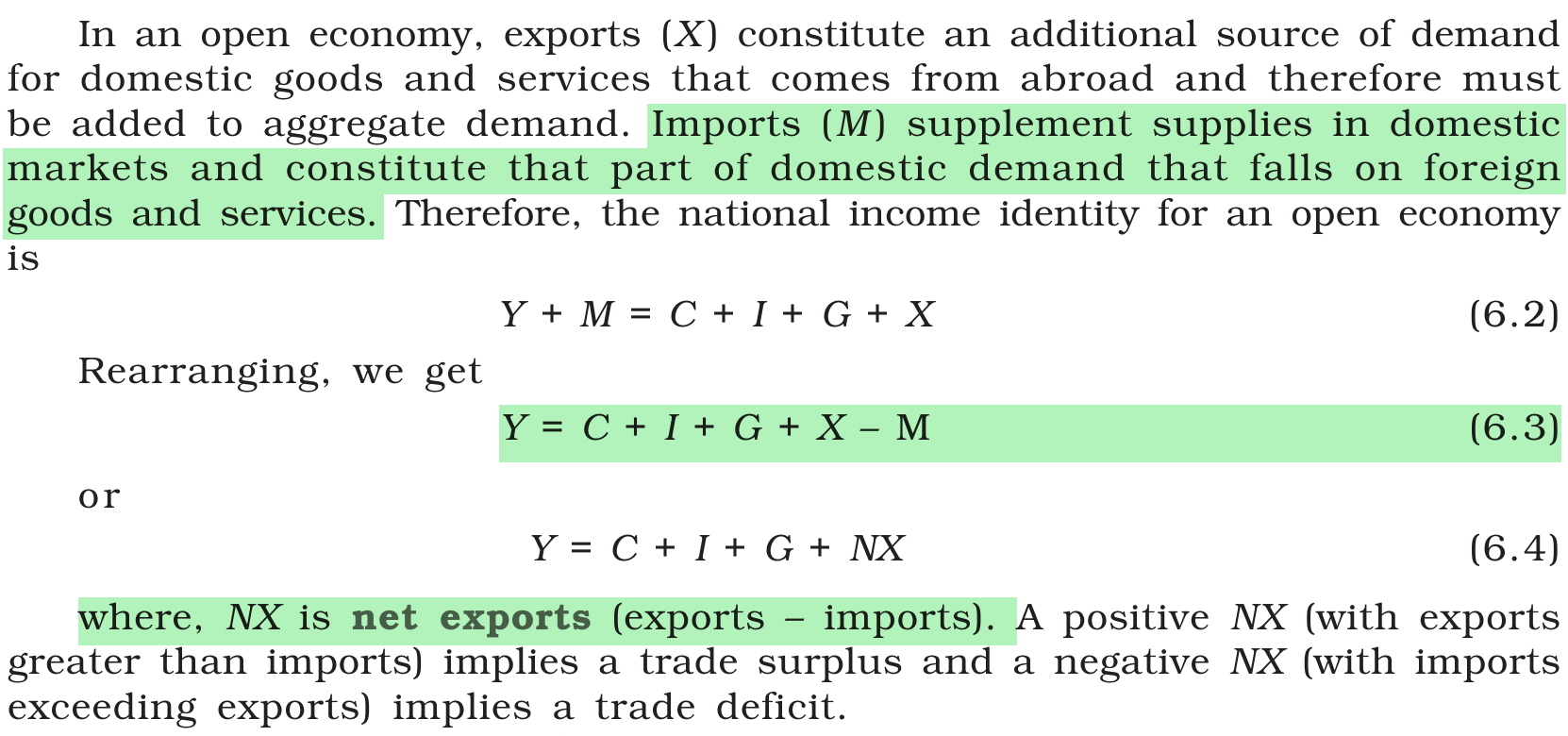
If imports grow faster than exports, net exports fall. So GDP will fall, other things remaining equal.
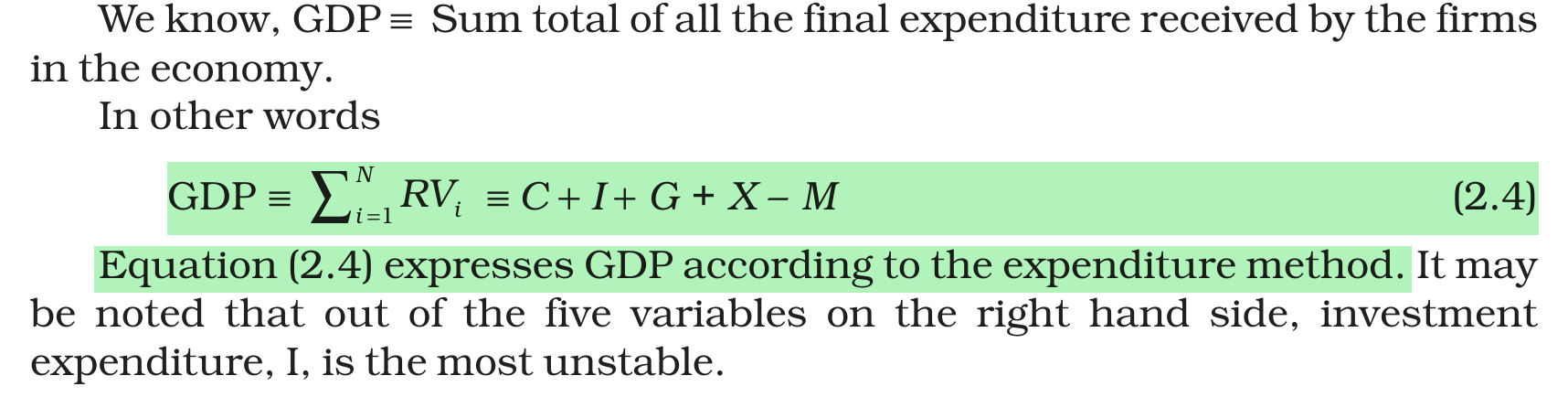
By the expenditure method, GDP = C + I + G + (X − M), where C is consumption, I is investment, G is government spending, and X − M is net exports.
Imports are goods bought from abroad, so spending on them does not create output inside the country. If imports rise by more than exports, more spending goes out of the country than comes in. So demand for goods made in the country falls, and GDP falls.
For example, let C + I + G stay at 100.
Before: exports = 20, imports = 10
GDP = 100 + 20 − 10 = 110
After: exports rise by 5 to 25, imports rise by 10 to 20
GDP = 100 + 25 − 20 = 105
NCERT (2026-27): Introductory Macroeconomics — Chapter 2: National Income Accounting
NCERT (2026-27): Introductory Macroeconomics — Chapter 6: Open Economy Macroeconomics
|