
The pyramid of energy is always upright and can never be inverted. Which of the following is the reason?
Answer & explanation
Correct answer: option 3
The correct answer is Option (3) → Some energy is lost as heat at each step as it flows to the next trophic level
Pyramids of number and biomass can be inverted in some ecosystems, but the pyramid of energy cannot. Energy flows in one direction, and some of it is lost as heat at every step, so each higher level has less energy than the level below.
Option (1) Producers have a larger standing crop than the herbivores that feed on them — Incorrect. The standing crop is not always larger in producers; in the sea the pyramid of biomass is inverted. Yet the energy pyramid stays upright, so standing crop is not the reason.
Option (2) Energy at each trophic level is returned to the producers by the decomposers — Incorrect. Energy is not returned to the producers. It flows one way and is finally lost as heat; decomposers return only nutrients.
Option (3) Some energy is lost as heat at each step as it flows to the next trophic level — Correct. Because some energy is always lost as heat at each transfer, a higher trophic level can never hold more energy than the one below it.
Option (4) The number of individuals decreases at each higher trophic level — Incorrect. Numbers do not always fall at higher levels. Many insects feeding on one big tree give an inverted pyramid of numbers, so numbers cannot decide the shape of the energy pyramid.
NCERT Extract:
Ecological Pyramids – “… In most ecosystems, all the pyramids, of number, of energy and biomass are upright, i.e., producers are more in number and biomass than the herbivores, and herbivores are more in number and biomass than the carnivores. Also energy at a lower trophic level is always more than at a higher level. … The pyramid of biomass in sea is generally inverted because the biomass of fishes far exceeds that of phytoplankton. … Pyramid of energy is always upright, can never be inverted, because when energy flows from a particular trophic level to the next trophic level, some energy is always lost as heat at each step.”
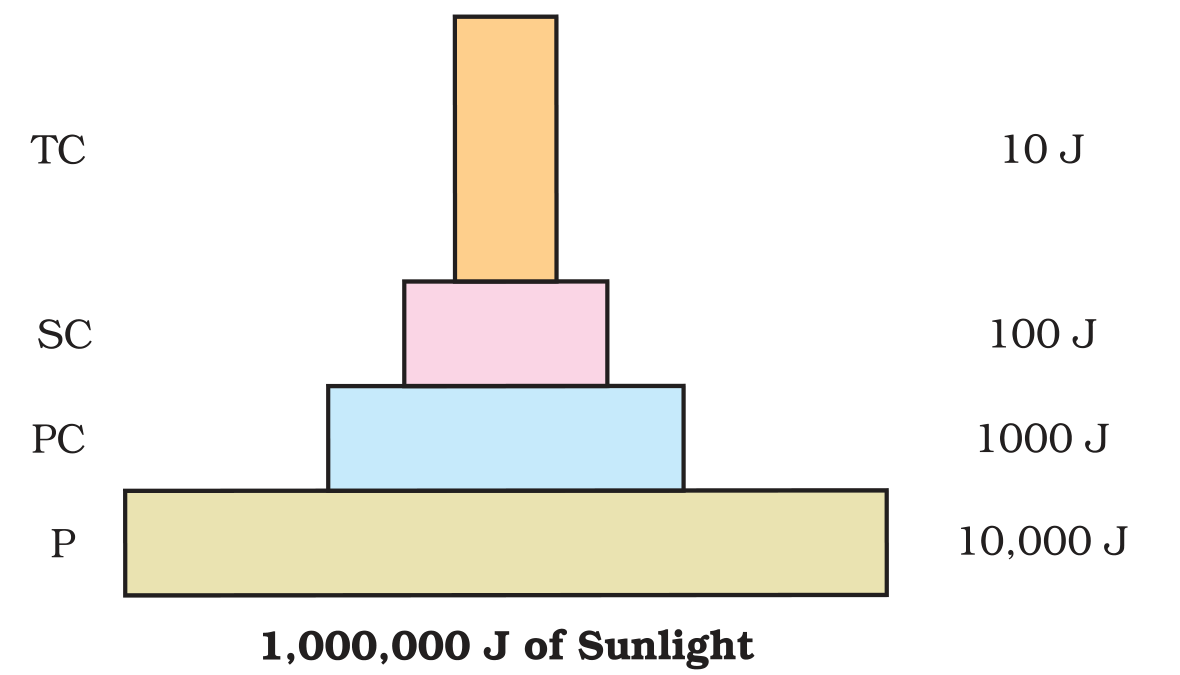
Figure 12.4 (d) An ideal pyramid of energy. Observe that primary producers convert only 1% of the energy in the sunlight available to them into NPP