Statement I: Current stops flowing when \(E_{cell} = 0\).
Statement II: Equilibrium of the cell reaction is attained.
Answer & explanation
Correct answer: option 1
The correct answer is Option (1) → Both Statement I and Statement II are correct and Statement II is the correct explanation of Statement I
In a working Daniell cell the reaction \( \ce{Zn(s) + Cu^2+(aq) -> Zn^2+(aq) + Cu(s)} \) pushes electrons through the outer circuit. As it proceeds, [\( \ce{Zn^2+} \)] rises, [\( \ce{Cu^2+} \)] falls and the cell potential falls.
Statement I: Current stops flowing when Ecell = 0. — True. The cell potential is what drives the electrons; with no potential difference between the electrodes, no current flows.
Statement II: Equilibrium of the cell reaction is attained. — True. When the voltmeter reads zero, the ion concentrations stop changing: the cell reaction has reached equilibrium.
Why Statement II explains Statement I?
At equilibrium there is no net reaction, so no more electrons are released at the zinc electrode or taken up at the copper electrode.
Ecell becomes zero and the current stops because the cell reaction has reached equilibrium.
NCERT (2026-27 edition):
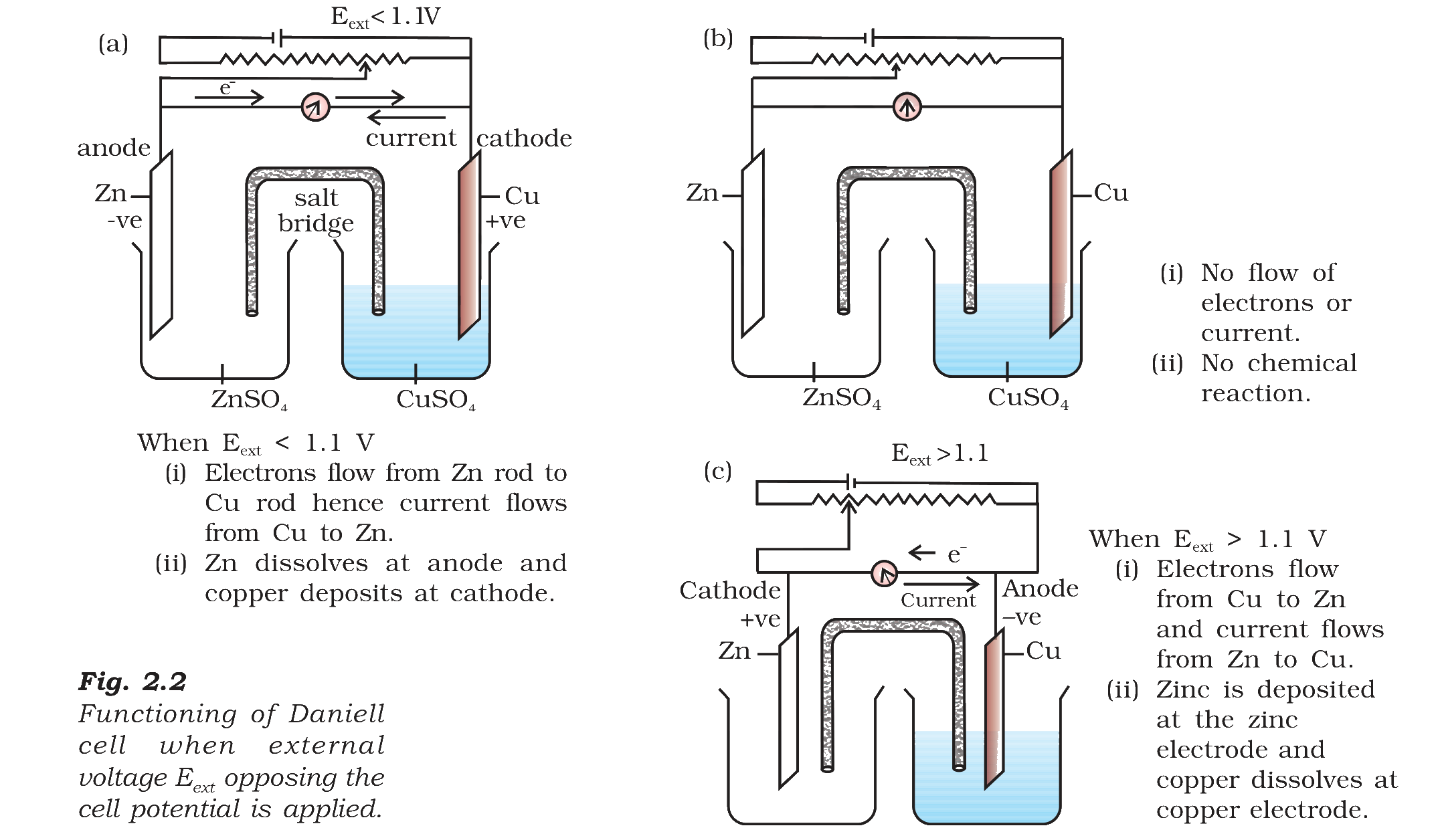
2.1 Electrochemical Cells – “If an external opposite potential is applied in the galvanic cell [Fig. 2.2(a)] and increased slowly, we find that the reaction continues to take place till the opposing voltage reaches the value 1.1 V [Fig. 2.2(b)] when, the reaction stops altogether and no current flows through the cell.”
2.3.1 Equilibrium Constant from Nernst Equation – “… After some time, we shall note that there is no change in the concentration of Cu2+ and Zn2+ ions and at the same time, voltmeter gives zero reading. This indicates that equilibrium has been attained.”