
Which of the following compounds will undergo Aldol condensation reaction ?
(A) 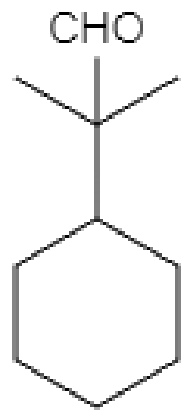
(B) 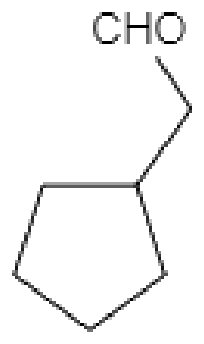
(C) CH3-CH2-C(CH3)2-CH2-CHO
(D) HCHO
Choose the correct answer from the options given below :
Answer & explanation
Correct answer: option 2
The correct answer is Option (2) → (B) and (C) only
In aldol condensation, dilute alkali removes an α-hydrogen (a hydrogen on the carbon next to C=O) to form a carbanion, which adds to the carbonyl group of a second molecule. So an aldehyde or ketone needs at least one α-hydrogen to give this reaction.
(A) 2-cyclohexyl-2-methylpropanal — Incorrect. Its α-carbon carries two methyl groups and the cyclohexyl ring, and no hydrogen.
(B) cyclopentylethanal — Correct. The \( \ce{CH2} \) group next to –CHO has two α-hydrogens.
(C) \( \ce{CH3-CH2-C(CH3)2-CH2-CHO} \) — Correct. The \( \ce{CH2} \) group next to –CHO has two α-hydrogens (the quaternary carbon is further away).
(D) HCHO — Incorrect. Methanal has no α-carbon at all; it gives the Cannizzaro reaction instead.
The aldol formed loses water on heating to give the α,β-unsaturated aldehyde (the condensation product):
\( \displaystyle \ce{2R-CH2-CHO} \xrightarrow{\text{dil. NaOH}} \ce{R-CH2-CH(OH)-CH(R)-CHO} \xrightarrow[-\ce{H2O}]{\Delta} \ce{R-CH2-CH=C(R)-CHO} \)
NCERT (2026-27 edition):
Aldol Condensation
