Arrange the phases of Sherif's summer camp experiment in correct sequence of occurrence.
A. Intergroup Cooperation
B. Friendship Formation
C. Intergroup Competition
D. Ingroup Formation
Choose the correct answer from the options given below:
Answer & explanation
Correct answer: option 1
The correct answer is Option (1) → B, D, C, A
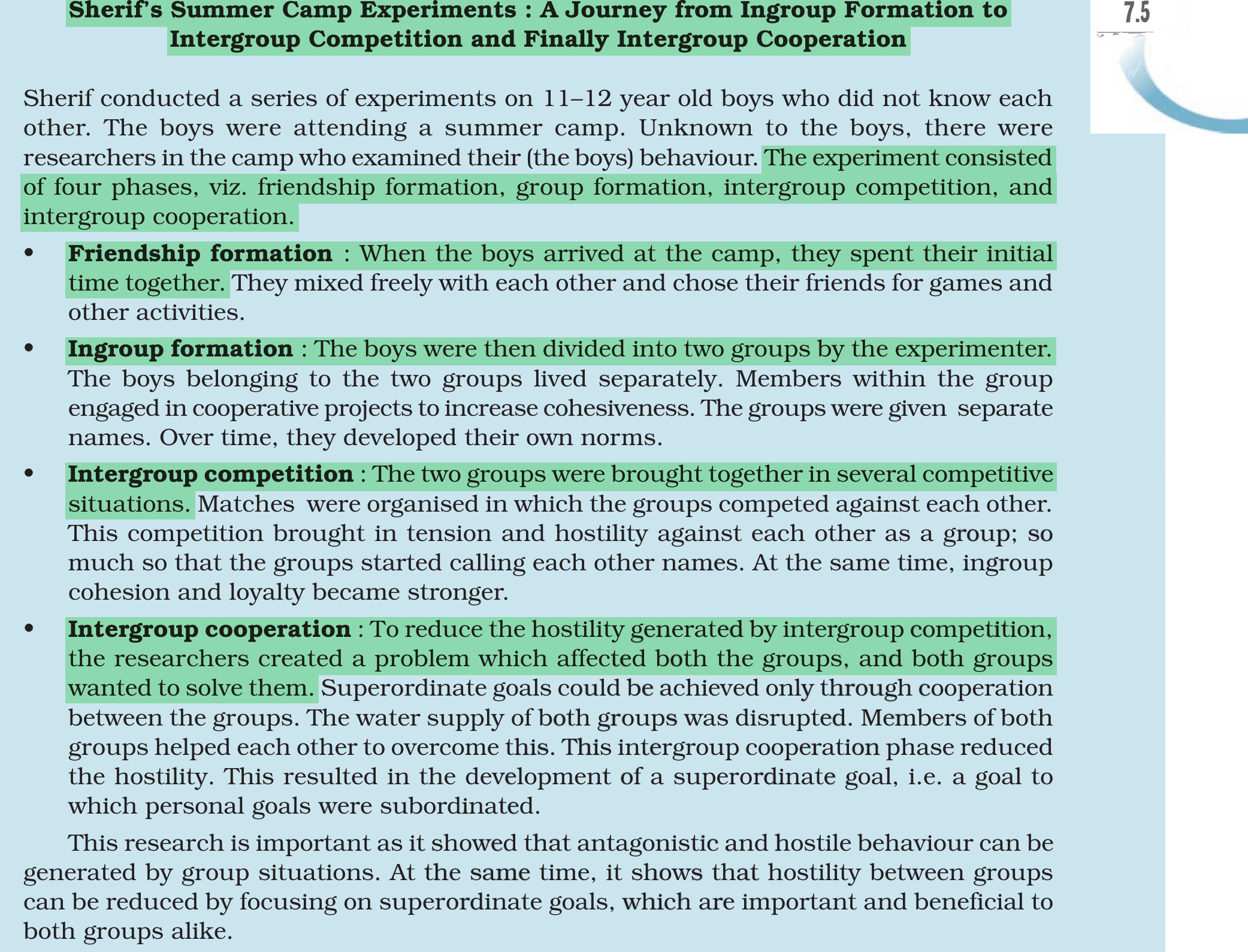
Sherif studied 11–12 year old boys, who did not know each other, at a summer camp. The experiment had four phases.
(B) Friendship Formation — On arriving at the camp the boys spent their initial time together, mixed freely and chose their friends for games and other activities.
(D) Ingroup Formation — The boys were then divided into two groups that lived separately, worked on cooperative projects, got separate names and developed their own norms.
(C) Intergroup Competition — The two groups were brought together in competitive situations such as matches. Tension and hostility grew, so much that the groups called each other names, while loyalty within each group became stronger.
(A) Intergroup Cooperation — To reduce the hostility, the researchers created a problem affecting both groups: the water supply was disrupted, and the groups helped each other to overcome it. Working for this superordinate goal reduced the hostility.
Note: Sherif’s summer camp experiments were there as a box in the chapter ‘Social Influence and Group Processes’ of the pre-rationalised NCERT, which NTA followed in 2023, and are not there in the NCERT book (2025-26). Hence this question has been picked from the pre-rationalised NCERT.
NCERT: Psychology — Chapter 7: Social Influence and Group Processes, Sherif’s Summer Camp Experiments (Box 7.5) (Pre-rationalised)
|