The short run supply curve is represented as?
Answer & explanation
Correct answer: option 2
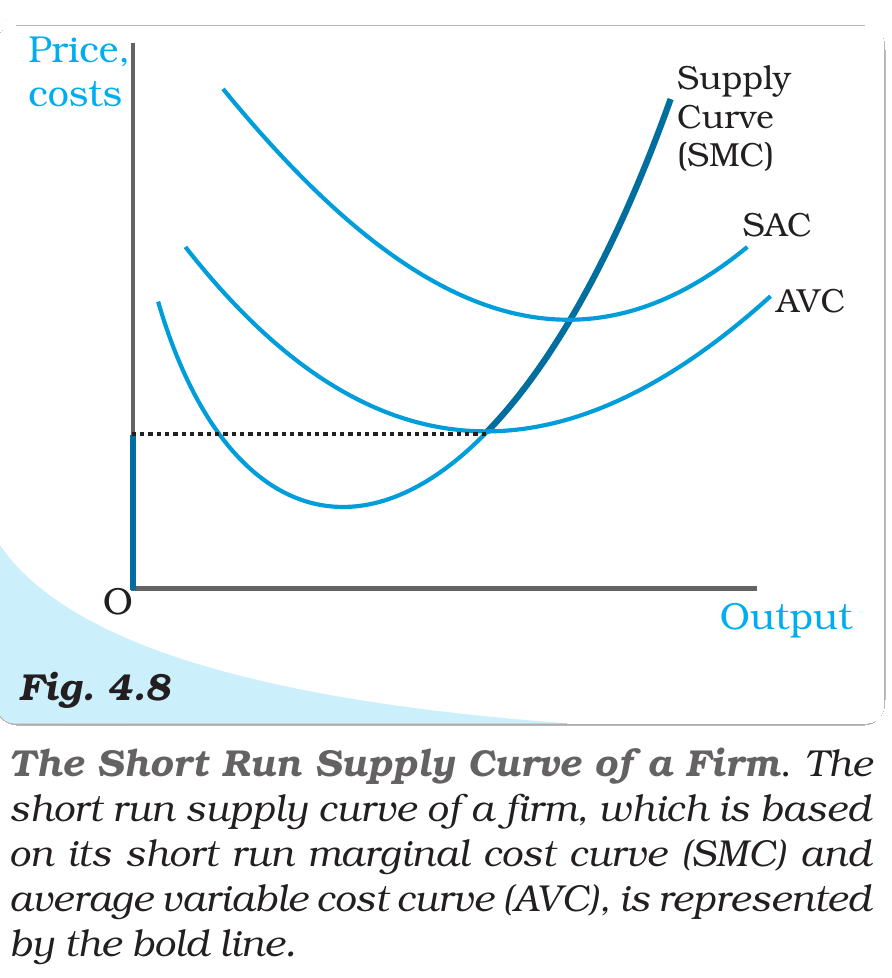
The correct answer is Option (2) → The rising part of the marginal cost curve from and above the minimum average variable cost curve.
A firm’s short run supply curve is a part of its short run marginal cost (SMC) curve. It is the rising part of SMC from and above the minimum average variable cost (AVC). At prices below the minimum AVC, the firm produces nothing.
Option (1) The rising part of the marginal cost curve. — Incorrect. Some of the rising part can lie below the AVC curve. At such a price the firm cannot cover even its variable cost, so its output is zero.
Option (2) The rising part of the marginal cost curve from and above the minimum average variable cost curve. — Correct. The firm produces where price equals SMC on the rising part, as long as the price covers AVC. Minimum AVC is the short run shut down point.
Option (3) The rising part of the marginal cost curve from and above the minimum average cost curve. — Incorrect. Between minimum AVC and minimum average cost, the firm covers its variable cost and part of its fixed cost. So it still produces in the short run.
Option (4) The marginal cost curve. — Incorrect. The whole curve includes its falling part, where profit is not at its highest. The firm never supplies from that part.
NCERT (2026-27): “4.4.1 Short Run Supply Curve of a Firm … Suppose the market price is p1, which exceeds the minimum AVC. We start out by equating p1 with SMC on the rising part of the SMC curve; this leads to the output level q1.… …So, if the market price is p2, the firm produces zero output. Combining cases 1 and 2, we reach an important conclusion. A firm’s short run supply curve is the rising part of the SMC curve from and above the minimum AVC together with zero output for all prices strictly less than the minimum AVC. In figure 4.8, the bold line represents the short run supply curve of the firm.”
|