Read the passage carefully and answer the questions based on the passage:
Short run Costs
In the short run, some of the factors of production cannot be varied. The cost that a firm incurs to employ fixed inputs is called the total fixed cost. Whatever amount of output the firm produces, this cost remains fixed for the firm. To produce any required level of output, the firm, in the short run, can adjust only variable inputs. Accordingly, the cost that a firm incurs to employ these variable inputs is called the total variable cost. Adding the fixed and the variable costs, we get the total cost of a firm. In order to increase the production of output, the firm must employ more of the variable inputs. As a result, the total variable cost and total cost will increase. Therefore, as output increases, the total variable cost and total cost increase. Marginal cost is the increase in total variable cost due to an increase in production of one extra unit of output. For any level of output, the sum of marginal costs up to that level gives us the total variable cost at that level.
When the output is zero in the short run, which of the following costs are undefined?
Answer & explanation
Correct answer: option 1
The correct answer is Option (1) → AVC, AFC and MC.
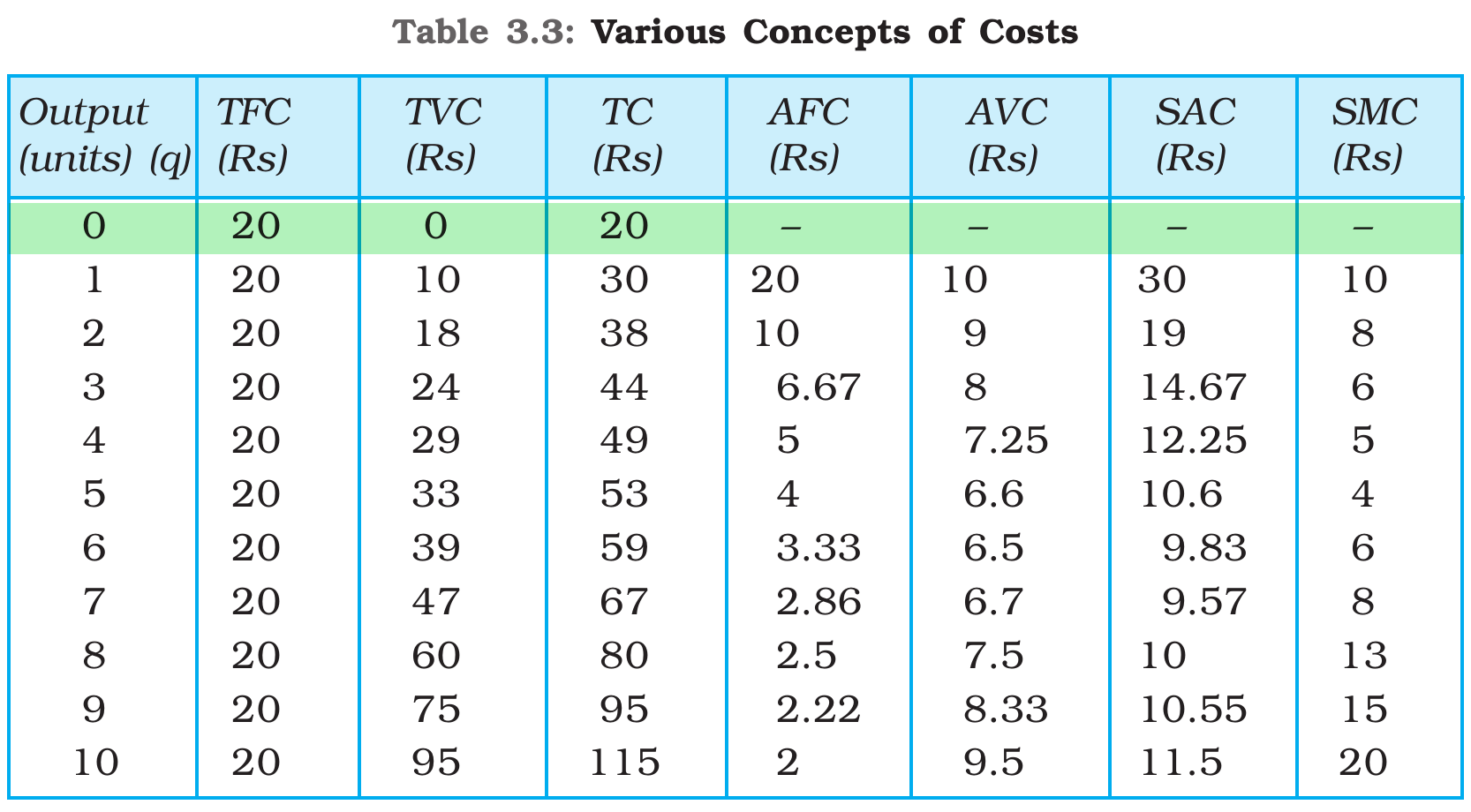
At zero output, average variable cost (AVC), average fixed cost (AFC) and marginal cost (MC) are undefined. Each of them is worked out per unit of output.
AVC is total variable cost divided by output. With zero output there is nothing to divide by.
AFC is total fixed cost divided by output, so it has the same problem.
MC is the change in total cost per unit of change in output. It too is undefined at zero output.
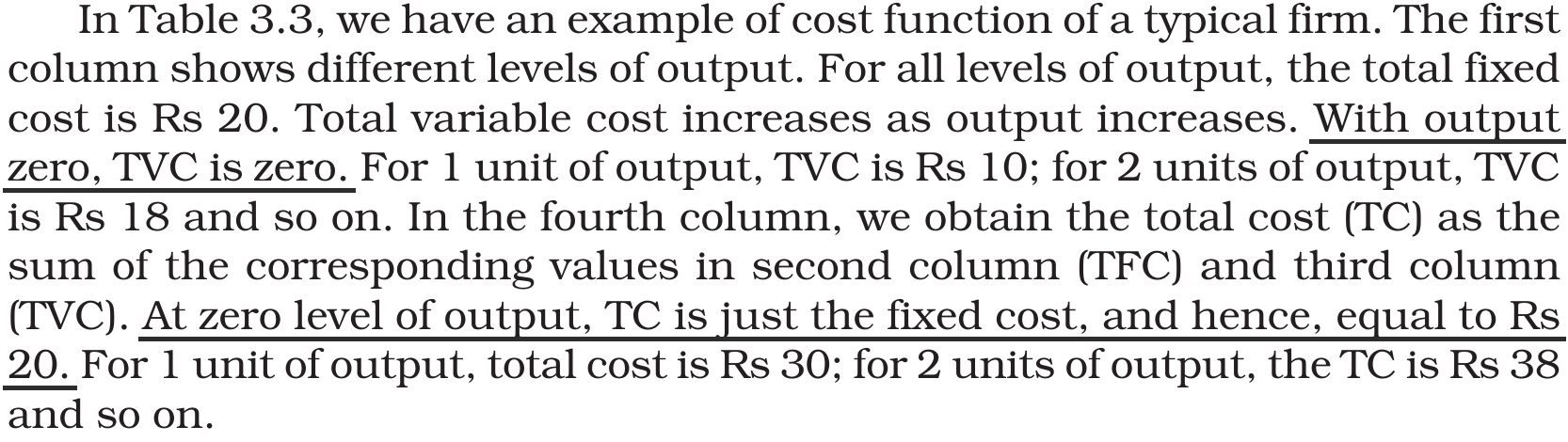
The total costs do have values at zero output. Total fixed cost is the same as at any output, total variable cost is zero, and total cost equals total fixed cost.
NCERT (2026-27): Introductory Microeconomics — Chapter 3: Production and Costs
|