
A plane electromagnetic wave is travelling in vacuum. At a certain instant, the electric field of the wave at a point P is zero. At the same instant, the magnetic field of the wave at P is
Answer & explanation
Correct answer: option 1
The correct answer is Option (1) → zero
In a plane electromagnetic wave the electric and magnetic fields vary with the same phase, \( E=E_0\sin(kz-\omega t) \) and \( B=B_0\sin(kz-\omega t) \). So \( B=E/c \) at every point and instant. The two fields reach their maximum values together and pass through zero together.
Option (1) zero — Correct. At P, \( \sin(kz-\omega t)=0 \) at that instant, which makes both fields zero there. So the magnetic field at P is also zero.
Option (2) at its maximum value — Incorrect. The magnetic field is at its maximum where the electric field is at its maximum. A maximum \( B \) with zero \( E \) would need a phase difference of \( \pi/2 \) between the fields.
Option (3) half of its maximum value — Incorrect. This needs \( \sin(kz-\omega t)=1/2 \). The electric field would then also be \( E_0/2 \), but here it is zero.
Option (4) \( 1/\sqrt{2} \) times its maximum value — Incorrect. This value belongs to the instant when \( \sin(kz-\omega t)=1/\sqrt{2} \). The electric field at P would then be \( E_0/\sqrt{2} \).
NCERT (2026-27):
Nature of Electromagnetic Waves – “… The electric and magnetic fields Ex and By are perpendicular to each other, and to the direction z of propagation. We can write Ex and By as follows:
\( E_x=E_0\sin(kz-\omega t) \)\( \qquad [8.7(a)] \)
\( B_y=B_0\sin(kz-\omega t) \)\( \qquad [8.7(b)] \)”
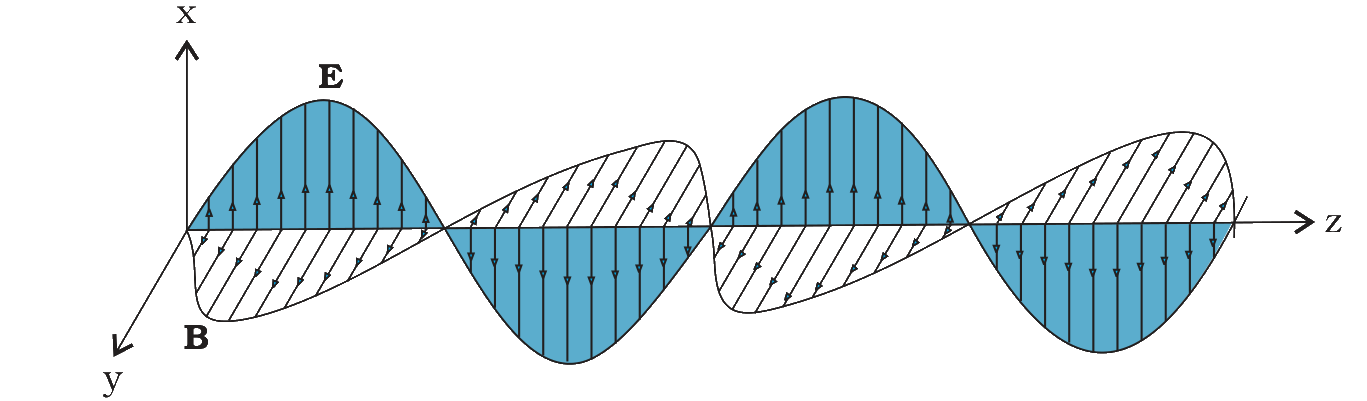
Fig. 8.3: A linearly polarised electromagnetic wave, propagating in the z-direction with the oscillating electric field E along the x-direction and the oscillating magnetic field B along the y-direction.