
The area of the region enclosed between the two circles \(x^2 + y^2 = 1\) and \((x - 1)^2 + y^2 = 1\) is:
Answer & explanation
Correct answer: option 3
The correct answer is Option (3) → \(\left(\displaystyle\frac{2\pi}{3} - \frac{\sqrt{3}}{2}\right)\) sq. units
Both circles have radius 1, with centres (0, 0) and (1, 0). Subtracting one equation from the other gives the common chord:
\(x^2 - (x - 1)^2 = 0\)
\(2x - 1 = 0\)
\( \displaystyle x = \frac{1}{2} \)
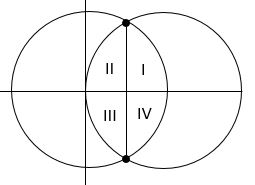
The common region is symmetric about the x-axis and about the chord x = 1/2, so it splits into four equal parts I, II, III and IV. Part I lies under \(y = \sqrt{1 - x^2}\) from x = 1/2 to x = 1:
\( \displaystyle \text{Area} = 4\int_{1/2}^{1}\sqrt{1 - x^2}\,dx \)
Using the standard integral \(\int\sqrt{a^2 - x^2}\,dx = \frac{x}{2}\sqrt{a^2 - x^2} + \frac{a^2}{2}\sin^{-1}\frac{x}{a} + C\) with a = 1:
\( \displaystyle = 4\left[\frac{x}{2}\sqrt{1 - x^2} + \frac{1}{2}\sin^{-1}x\right]_{1/2}^{1} \)
\( \displaystyle = 4\left[\left(0 + \frac{1}{2}\cdot\frac{\pi}{2}\right) - \left(\frac{1}{4}\cdot\frac{\sqrt{3}}{2} + \frac{1}{2}\cdot\frac{\pi}{6}\right)\right] \)
\( \displaystyle = 4\left[\frac{\pi}{4} - \frac{\sqrt{3}}{8} - \frac{\pi}{12}\right] \)
\( \displaystyle = 4\left[\frac{\pi}{6} - \frac{\sqrt{3}}{8}\right] \)
\( \displaystyle = \frac{2\pi}{3} - \frac{\sqrt{3}}{2} \)
So the area is \(\left(\frac{2\pi}{3} - \frac{\sqrt{3}}{2}\right)\) sq. units.