
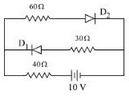
The current in the circuit will be
Answer & explanation
Correct answer: option 4
The correct answer is Option (4) → \( \displaystyle\frac{1}{10}\,\mathrm{A} \)
An ideal p-n junction diode conducts, with zero resistance, when it is forward biased (current along the arrow of its symbol) and does not conduct at all when it is reverse biased. The battery and the diodes are taken as ideal.
The longer plate of the cell symbol is the positive terminal, so the current leaves the battery towards the 40 Ω resistor and reaches the left junction. From there it must cross to the right junction through one of the two other branches.
The branch with \( D_2 \) and 60 Ω: the current goes along the arrow of \( D_2 \), so \( D_2 \) is forward biased and the branch conducts.
The branch with \( D_1 \) and 30 Ω: the current would have to go against the arrow of \( D_1 \), so \( D_1 \) is reverse biased and the branch carries no current.
The circuit is then 40 Ω and 60 Ω in series with the 10 V battery.
\( \displaystyle I = \frac{10\,\mathrm{V}}{40\,\Omega + 60\,\Omega} = \frac{10}{100}\,\mathrm{A} = \frac{1}{10}\,\mathrm{A} \)