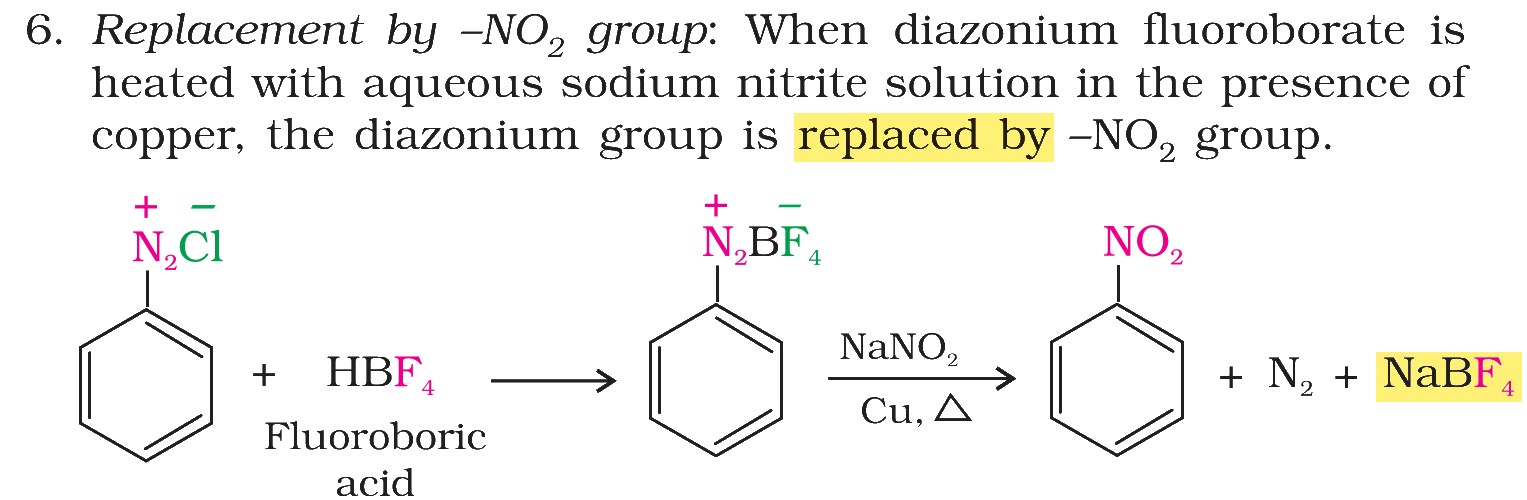
Which of the following is a by-product when benzenediazonium fluoroborate is heated with aqueous sodium nitrite solution in the presence of copper?
Answer & explanation
Correct answer: option 1
The correct answer is Option (1) → NaBF4
Heated with aqueous sodium nitrite in the presence of copper, benzenediazonium fluoroborate loses nitrogen gas and the diazonium group is replaced by the –NO2 group, giving nitrobenzene:
\( \displaystyle \ce{C6H5N2^+BF4^- + NaNO2} \xrightarrow[\Delta]{\ce{Cu}} \ce{C6H5NO2 + N2 ^ + NaBF4} \)
The Na+ ion of the nitrite and the BF4− ion of the diazonium salt are left over and form the by-product sodium fluoroborate, NaBF4.
Why the other options are incorrect
Option (2) HBF4 — Incorrect. Fluoroboric acid is the reagent used earlier, to precipitate the diazonium fluoroborate from the diazonium chloride; no H+ is set free in this step.
Option (3) NaF — Incorrect. The fluorine stays bound to boron in the BF4− ion, which pairs with Na+.
Option (4) NaNO3 — Incorrect. The nitrite is not oxidised; its –NO2 group enters the ring as the nitro group of nitrobenzene.
NCERT (2026-27 edition):
9.9 Chemical Reactions