CUETMOCK
  • Pricing
  • Mentors
Log inStart freeStart free mocks→

First test, then trust

Try a free CUET mock test.

Join 5,00,000+ students who rehearsed exam day on the exact NTA screen before sitting CUET. On the web and on Android.

Start free mocks →Get the Android app
CUETMOCK

India's #1 CUET Mock Test Platform. Original NCERT-based questions on the exact NTA exam screen — trusted by 5,00,000+ students since CUET 2022.

Get it onGoogle PlayScan to download the CUETMOCK app

Mock tests

  • CUET mock test series
  • Browse all papers
  • Commerce mocks
  • Humanities (Arts) mocks
  • Science mocks
  • Languages & GAT mocks
  • Free practice questions
  • Pricing

Resources

  • CUET exam guide
  • CUET syllabus
  • Universities accepting CUET
  • Expert blogs
  • News & notifications
  • Webinars & counselling
  • CUET score calculator
  • How we estimate your rank
  • FAQs

Company

  • About us
  • Our leadership & team
  • Our toppers
  • Mentors
  • For schools
  • Contact us
  • Terms
  • Privacy
  • Refund policy

Talk to us

+91 7696 6630 56info@cuetmock.comWhatsApp us

Our other platforms

  • JEE Mock — For IIT-JEE aspirants
  • NEET Mock — For NEET aspirants

Newsletter

Exam updates, study material and offers — no spam.

© 2026 NYC Ventures Pvt. Ltd.

701-702, Royal Business Park, Zirakpur, Punjab - 140603

  • Terms of use
  • Privacy policy
  • Refund policy
  • Contact us

iCUETMOCK is an independent preparation platform, not affiliated with the National Testing Agency (NTA). Always check exam details on the official NTA website.

  • Home
  • Mock tests
  • CUET guide
  • Pricing
  • Log in
Home/Practice questions/History
HistoryModern India: Mahatma Gandhi and the Nationalist movement

The second session of the Round Table Conference broke down on the qu…

The second session of the Round Table Conference broke down on the question of:

Answer & explanation+

Correct answer: option 4

The correct answer is Option (4) → Separate electorates for the minorities.

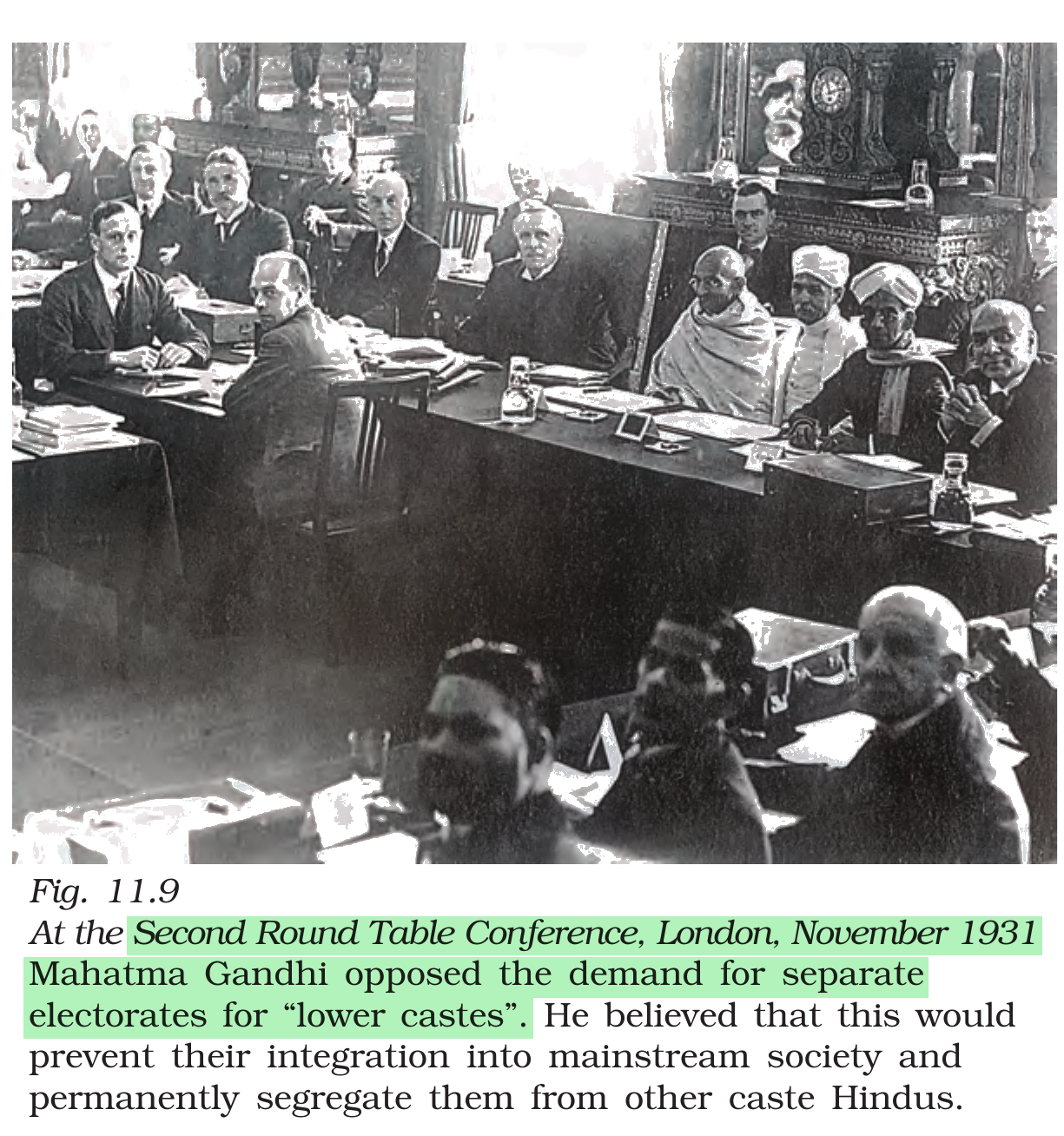
At the second Round Table Conference in London in 1931, Gandhiji claimed that the Congress represented all of India. The claim was challenged by the Muslim League, which spoke for the Muslim minority, by the Princes, and by B.R. Ambedkar, who argued that the Congress did not really represent the lowest castes. Gandhiji opposed the demand for separate electorates for the “lower castes”, and the Conference ended inconclusive.

Option (1) Gandhi’s ‘fast unto death’. — Incorrect. The Conference did not end over a fast by Gandhiji. When it proved inconclusive, he returned to India and resumed civil disobedience.

Option (2) Gandhi not being treated on equal terms. — Incorrect. Gandhiji took part in the Conference as the Congress’s representative. What was disputed was whom the Congress represented, not how Gandhiji was treated.

Option (3) British Government unwilling to release all political prisoners. — Incorrect. The release of prisoners had already been agreed earlier in 1931 in the Gandhi-Irwin Pact, by which civil disobedience would be called off and all prisoners released.

Option (4) Separate electorates for the minorities. — Correct. The Muslim League and Ambedkar spoke for the minorities, and Gandhiji opposed separate electorates for the “lower castes”, believing that they would permanently segregate them from other caste Hindus.

Note: The NCERT book (2026-27) says only that the Conference was inconclusive; it does not state the issue on which it broke down. The delegates could not agree on the representation of the minorities through separate electorates, which Gandhiji opposed, and the British settled the question themselves in 1932 by the Communal Award. This is explained here for the benefit of the students.


NCERT (2026-27): “3.2 Dialogues … Gandhiji was released from jail in January 1931 and the following month had several long meetings with the Viceroy. These culminated in what was called the ‘Gandhi-Irwin Pact’, by the terms of which civil disobedience would be called off, all prisoners released, and salt manufacture allowed along the coast. The pact was criticised by radical nationalists, for Gandhiji was unable to obtain from the Viceroy a commitment to political independence for Indians; he could obtain merely an assurance of talks towards that possible end. A second Round Table Conference was held in London in the latter part of 1931. Here, Gandhiji represented the Congress. However, his claims that his party represented all of India came under challenge from three parties: from the Muslim League, which claimed to stand for the interests of the Muslim minority; from the Princes, who claimed that the Congress had no stake in their territories; and from the brilliant lawyer and thinker B.R. Ambedkar, who argued that Gandhiji and the Congress did not really represent the lowest castes. The Conference in London was inconclusive, so Gandhiji returned to India and resumed civil disobedience.…”

NCERT extract

Advertisement

Practise more on Modern India: Mahatma Gandhi and the Nationalist movement

Chapter-wise mocks on the real NTA exam screen, with solutions and your rank. Your first mocks are free.

Start free mocks →

Advertisement

Next questions

  1. Resistivity ( ρ ) vs temperature graphs of some materials are given below. The graph corresponds to a semiconductor is:Physics · Semiconductors and Electronic Devices
  2. The current in the circuit will bePhysics · Semiconductors and Electronic Devices
  3. If the system of equations x + y + z = 6 2x + ky + 3z = 14 x + 2y + 2z = 9 does not have a unique solution, then the value of k isMaths. Section A · Determinants (Section A)
  4. Who among the following is the brand ambassador of Equitas Small Finance Bank (ESFB)?General Aptitude Test · General Knowledge
  5. If M is the mid-point of the side of ΔABC, and the area of ΔABM is 18 cm2, then the area of ΔABC is :General Aptitude Test · Quantitative Reasoning
  6. Physics · Electromagnetic Waves
  7. HYV seeds were used ?Economics · Indian Economic Development: Indian Economy:1950-1990
  8. Among five person A, B, P, Q and S, B is taller than only one person and Q is taller than B and P. S is taller than Q but shorter than A. W…General Aptitude Test · Verbal Reasoning
  9. Which of the following is a by-product when benzenediazonium fluoroborate is heated with aqueous sodium nitrite solution in the presence of…Chemistry · Organic: Amines
  10. Which fungus is commonly used as a biocontrol agent for treating plant diseases?Biology · Microbes in Human Welfare