
In a sphere of radius $r$, a right circular cone of height $h$ having maximum curved surface area is inscribed. The expression for the square of curved surface of cone is:
Answer & explanation
Correct answer: option 3
The correct answer is Option (3) → $2\pi^2r(2rh^2 - h^3)$ ##
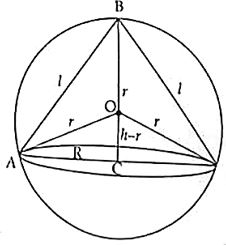
Here, $\text{CSA of cone} = \pi Rl$
$\text{Radius of sphere} = r$
$\text{Height of cone} = h$
In $\triangle AOC$,
$AO^2 = AC^2 + OC^2$
$\Rightarrow r^2 = R^2 + (h - r)^2$
$\Rightarrow R^2 = 2hr - h^2$
$∴\text{Radius of cone, } R = \sqrt{2hr - h^2} \quad \dots(i)$
In $\triangle ABC$,
$AB^2 = AC^2 + BC^2$
$\Rightarrow l^2 = R^2 + h^2$
$\Rightarrow l^2 = 2hr - h^2 + h^2$
$∴\text{Slant height, } l = \sqrt{2hr} \quad \dots(ii)$
$\text{CSA of cone} = \pi Rl$
$= \pi \sqrt{2hr - h^2} \sqrt{2hr}$
$(\text{CSA of cone})^2 = \pi^2 (2hr - h^2)(2hr)$
$= 2\pi^2 hr(2hr - h^2)$
$= 2\pi^2 r(2rh^2 - h^3)$