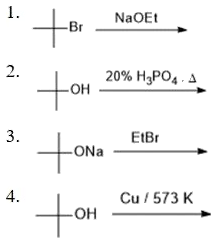
Which of the following reactions does not yield isobutene?
Answer & explanation
Correct answer: option 3
The correct answer is Option (3) → 3
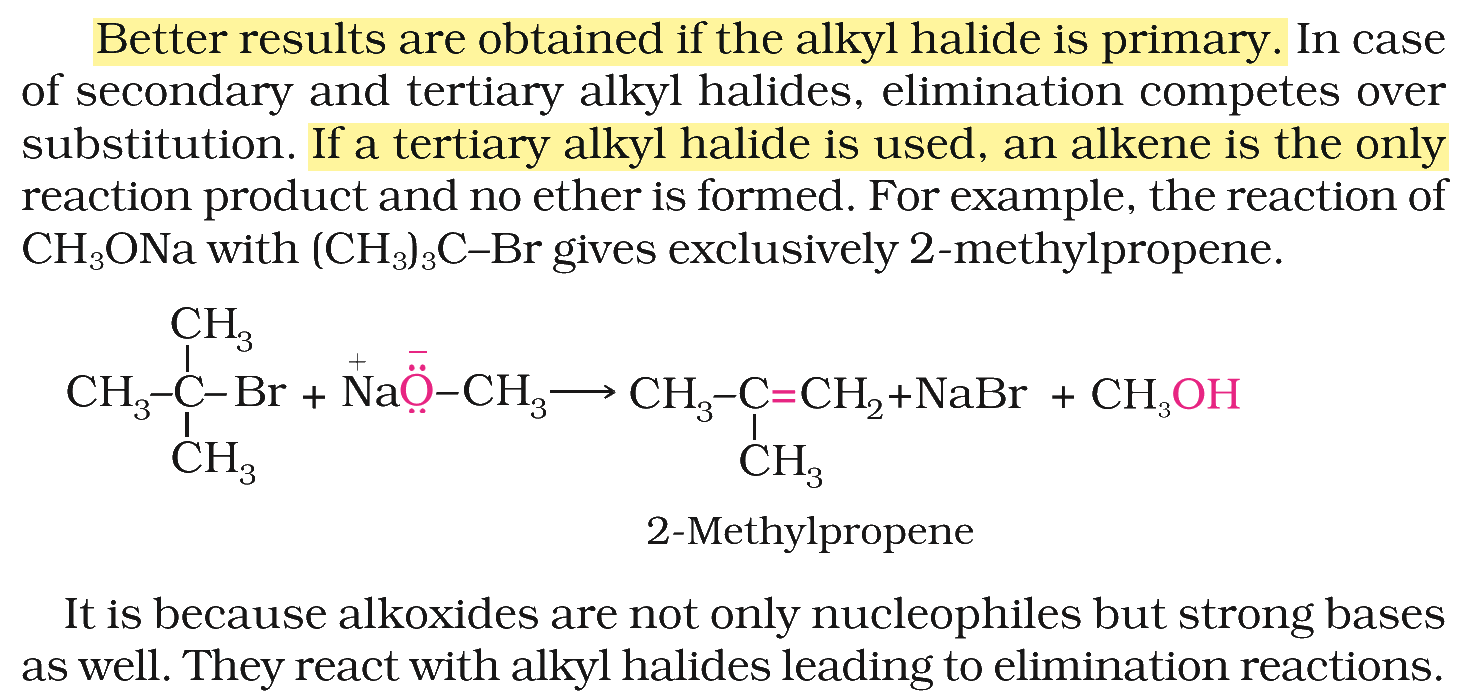
Isobutene, \( \ce{(CH3)2C=CH2} \), is formed from tert-butyl compounds by elimination: a hydrogen and a leaving group are removed from neighbouring carbons. A tertiary carbon is too crowded for SN2 attack, so tert-butyl halides and alcohols readily eliminate. A substitution reaction, on the other hand, keeps the carbon skeleton saturated and gives no alkene.
In reaction 3, the tert-butoxide ion attacks a primary halide, ethyl bromide. A primary carbon is easily attacked, so this is an SN2 substitution, the Williamson ether synthesis:
\( \displaystyle \ce{(CH3)3C-ONa + CH3CH2Br -> (CH3)3C-O-CH2CH3 + NaBr} \)
The product is tert-butyl ethyl ether (2-ethoxy-2-methylpropane), not isobutene.
Option (1) 1 — Yields isobutene. A tertiary halide with a strong base, sodium ethoxide, undergoes elimination (dehydrohalogenation):
\( \displaystyle \ce{(CH3)3C-Br + NaOC2H5 -> (CH3)2C=CH2 + C2H5OH + NaBr} \)
Option (2) 2 — Yields isobutene. A tertiary alcohol is dehydrated easily by warm 20% phosphoric acid:
\( \displaystyle \ce{(CH3)3C-OH} \xrightarrow[\Delta]{\text{20}\%\ \ce{H3PO4}} \ce{(CH3)2C=CH2 + H2O} \)
Option (3) 3 — Does not yield isobutene (gives tert-butyl ethyl ether). The primary halide is attacked by SN2, as shown above.
Option (4) 4 — Yields isobutene. Over hot copper at 573 K a tertiary alcohol, with no hydrogen on the carbon bearing the –OH, is dehydrated instead of dehydrogenated:
\( \displaystyle \ce{(CH3)3C-OH} \xrightarrow{\ce{Cu}, 573\ \mathrm{K}} \ce{(CH3)2C=CH2 + H2O} \)
NCERT (2026-27 edition):
Williamson Synthesis – …