Match List-I with List-II.
| List-I | List-II |
| (A) Human Capital | (I) Technical Progress |
| (B) Physical Capital | (II) Education and Health |
| (C) Human Capital formation | (III) Human well being |
| (D) Human Development | (IV) Growth enhancing |
Choose the correct answer from the options given below :
Answer & explanation
Correct answer: option 4
The correct answer is Option (4) → (A)-(II), (B)-(I), (C)-(IV), (D)-(III)
Human capital and human development both deal with people’s education and health. They differ in why education and health matter: as a means to produce more, or as a goal in themselves.
| List-I | List-II | Reason |
|---|---|---|
| (A) Human Capital | (II) Education and Health | Human capital treats education and health as a means to raise labour productivity. |
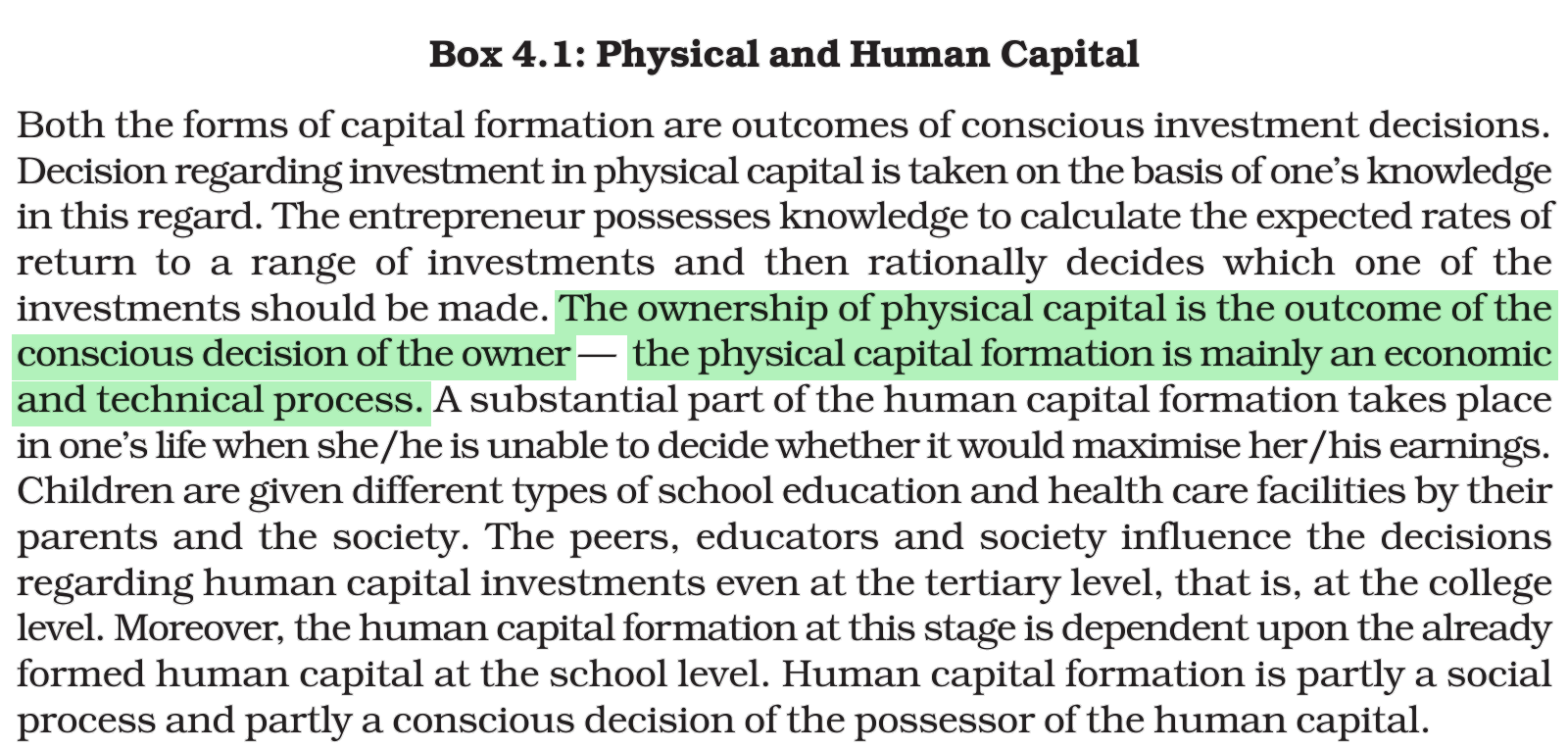
| (B) Physical Capital | (I) Technical Progress | Building physical capital such as machines and factories is mainly an economic and technical process. |
| (C) Human Capital formation | (IV) Growth enhancing | Investment in human capital formation is seen as efficient and growth enhancing. |
| (D) Human Development | (III) Human well being | Human development sees education and health as part of human well-being itself. |
NCERT (2026-27): “4.4 Human Capital and Human Development The two terms sound similar but there is a clear distinction between them. Human capital considers education and health as a means to increase labour productivity. Human development is based on the idea that education and health are integral to human well-being because only when people have the ability to read and write and the ability to lead a long and healthy life, they will be able to make other choices which they value. Human capital treats human beings as a means to an end; the end being the increase in productivity.… Recap …Investment in human capital formation is considered as efficient and growth enhancing.…”
NCERT (2026-27): Indian Economic Development — Chapter 4, Box 4.1: Physical and Human Capital |