20 g of a binary electrolyte (Molecular mass = 100) are dissolved in 500 g of water. The freezing point of the solution is \(-0.93^oC\) and \(k_f\) is \(1.86 \text{ K kg mol}^{-1}\). The degree of ionisation of electrolyte is:
Answer & explanation
Correct answer: option 4
The correct answer is Option (4) → 0.25
Note: NTA dropped this question in the official Answer Key. However, to provide additional question practice to the students, the question has been slightly modified so that the question has one clear answer.
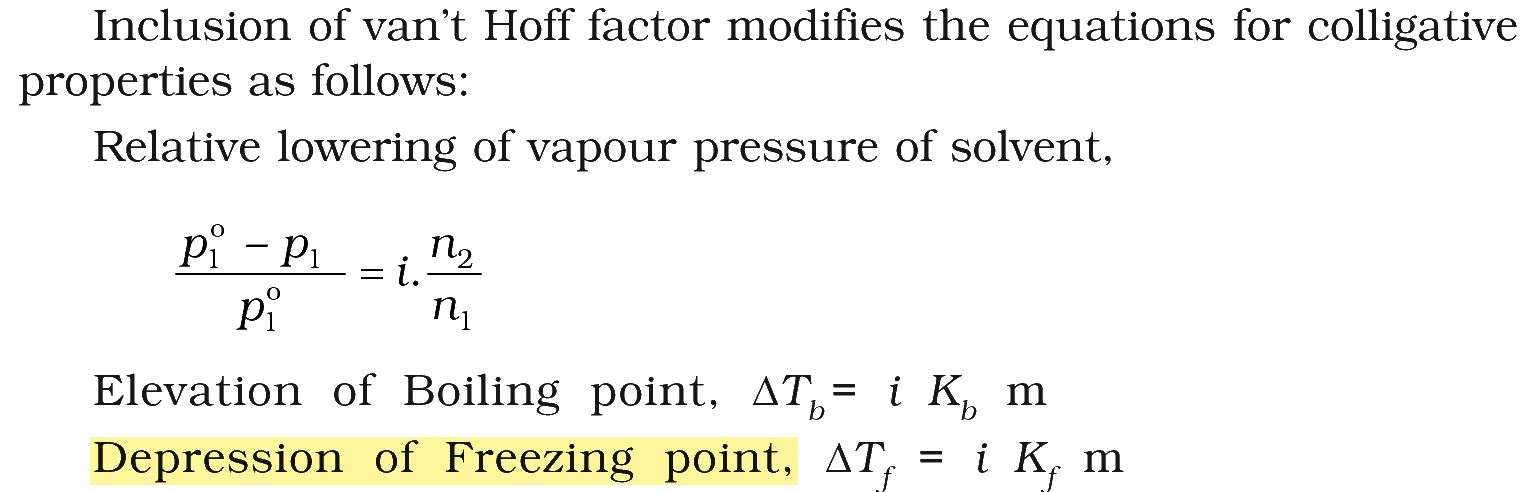
The depression of freezing point gives the van’t Hoff factor i, the ratio of the observed to the expected (no ionisation) value. For a binary electrolyte \( \ce{AB <=> A+ + B-} \) with degree of ionisation α, 1 mol of AB gives (1 − α) mol AB + α mol A+ + α mol B− = (1 + α) mol of particles, so i = 1 + α.
\( \displaystyle m = \frac{20/100\ \text{mol}}{0.5\ \text{kg}} = 0.4\ \mathrm{mol\,kg^{-1}} \)
Expected \( \Delta T_f \) (no ionisation) = \( K_f \times m = 1.86 \times 0.4 = 0.744\ \text{K} \)
Observed \( \Delta T_f = 0 - (-0.93) = 0.93\ \text{K} \)
\( \displaystyle i = \frac{0.93}{0.744} = 1.25 \)
\( \alpha = i - 1 = 1.25 - 1 = \) 0.25
NCERT (2026-27 edition):
Abnormal Molar Masses – …