
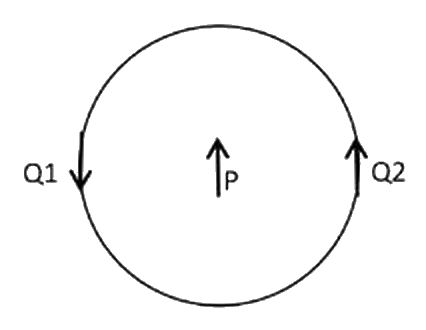
The given figure shows two magnetized needles and a magnet P with their magnetic moments, shown with the arrow sign. Which of the following statements are correct in respect of this configuration?
(A) Q1 is in stable equilibrium
(B) Q2 is in unstable equilibrium
(C) Q1 is in unstable equilibrium
(D) Q2 is in stable equilibrium
Choose the correct answer from the options given below:
Answer & explanation
Correct answer: option 1
The correct answer is Option (1) → (A) and (B) only
The needles Q1 and Q2 lie on the equatorial line of the magnet P. On the equatorial line the magnetic field of a magnet points opposite to its magnetic moment, so here the field of P at Q1 and Q2 points downward, while the moment of P points upward.
A magnetic needle is in stable equilibrium when its moment is along the field, and in unstable equilibrium when its moment is opposite to the field.
(A) Q1 is in stable equilibrium — Correct. The moment of Q1 points downward, along the field of P, so any small turn brings it back.
(B) Q2 is in unstable equilibrium — Correct. The moment of Q2 points upward, opposite to the field of P, so a small turn makes it swing away.
(C) Q1 is in unstable equilibrium — Incorrect. Q1 is along the field, so it is stable.
(D) Q2 is in stable equilibrium — Incorrect. Q2 is opposite to the field, so it is unstable.
Statements (A) and (B) are correct, which is Option (1).
NCERT (2026-27):
The Electrostatic Analog – “… Use the result that the field due to P is given by the expression [Eqs. (5.4) and (5.5)]:
\( \displaystyle \mathbf{B}_P = -\,\frac{\mu_0\,\mathbf{m}_P}{4\pi r^{3}} \qquad \text{(on the normal bisector)} \)
… where mP is the magnetic moment of the dipole P. Equilibrium is stable when mQ is parallel to BP, and unstable when it is anti-parallel to BP.”