Answer the questions based on the following passage:
Sri Lanka has retained democracy since its independence in 1948. But it faced a serious challenge, not from the military or monarchy, but rather from ethnic conflict leading to the demand for secession by one of the regions.
After its independence, politics in Sri Lanka (it was then known as Ceylon) was dominated by forces that represented the interests of the majority Sinhala community. They were hostile to a large number of Tamils who had migrated from India to Sri Lanka and settled there. This migration continued even after independence. The Sinhala nationalists thought that Sri Lanka should not give 'concessions' to the Tamils because Sri Lanka belongs to the Sinhala people only. The neglect of Tamil concerns led to militant Tamil nationalism. From 1983 onward, the Liberation Tigers of Tamil Eelam (LTTE) was fighting an armed struggle with the army of Sri Lanka in pursuit of their demand for a "Tamil Elam" or separate country for the Tamilians of Sri Lanka. At one point in time, the northeastern part of Sri Lanka was controlled by the LTTE.
The government of India has from time to time tried to negotiate with the Sri Lankan government on the Tamil question. But in 1987, the government of India for the first time got directly involved in the Sri Lankan Tamil question. India signed an accord with Sri Lanka and sent troops to stabilize relations between the Sri Lankan government and the Tamils. Eventually, the Indian Army got into a fight with the LTTE. The presence of Indian troops was also not liked much by the Sri Lankans. They saw this as an attempt by India to interfere in the internal affairs of Sri Lanka. In 1989, the Indian Peace Keeping Force (IPKF) pulled out of Sri Lanka without attaining its objective.
Choose the correct answers from the statements given below-
(A) India signed an accord with Sri Lanka and sent troops to stabilize relations between the Sri Lankan government and the Tamils.
(B) In 1989, the Indian Peace Keeping Force (IPKF) pulled out of Sri Lanka without attaining its objective.
(C) The LTTE was vanquished in 2009.
(D) Sri Lanka has retained democracy since its independence in 1947
Answer & explanation
Correct answer: option 2
The correct answer is Option (2) → Only (A), (B) and (C) are correct
(A) India signed an accord with Sri Lanka and sent troops to stabilize relations between the Sri Lankan government and the Tamils. Correct. In 1987 India got directly involved in the Sri Lankan Tamil question for the first time: it signed an accord with Sri Lanka and sent troops to stabilise relations between the government and the Tamils.
(B) In 1989, the Indian Peace Keeping Force (IPKF) pulled out of Sri Lanka without attaining its objective. Correct. The Indian Army got into a fight with the LTTE, and the Sri Lankans did not like the presence of Indian troops; in 1989 the IPKF pulled out without attaining its objective.
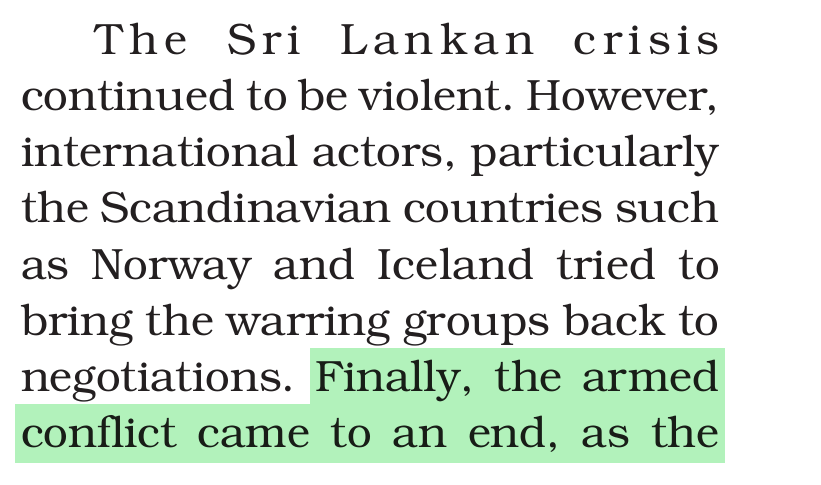
(C) The LTTE was vanquished in 2009. Correct. This is not in the passage, which stops at 1989, but it is part of the same story: the crisis stayed violent, Norway and Iceland tried to bring the warring groups back to talks, and finally the armed conflict came to an end, as the LTTE was vanquished in 2009.
(D) Sri Lanka has retained democracy since its independence in 1947 Incorrect. Sri Lanka has retained democracy since its independence in 1948, not 1947. 1947 is the year India and Pakistan became independent.
NCERT (2026-27): “Ethnic Conflict and Democracy in Sri Lanka … We have already seen that Sri Lanka has retained democracy since its independence in 1948. But it faced a serious challenge, not from the military or monarchy but rather from ethnic conflict leading to the demand for secession by one of the regions.… Ethnic Conflict and Democracy in Sri Lanka … But in 1987, the government of India for the first time got directly involved in the Sri Lankan Tamil question. India signed an accord with Sri Lanka and sent troops to stabilise relations between the Sri Lankan government and the Tamils. Eventually, the Indian Army got into a fight with the LTTE. The presence of Indian troops was also not liked much by the Sri Lankans. They saw this as an attempt by India to interfere in the internal affairs of Sri Lanka. In 1989, the Indian Peace Keeping Force (IPKF) pulled out of Sri Lanka without attaining its objective.…”
|