Consider the following statement related to Aggregate Income
(A) Aggregate revenue received by the firms is paid out to the factors of production it is considered as aggregate income.
(B) Aggregate Income can be calculated by calculating the aggregate value of goods and services produced by the firms.
(C) Income is being spent on the goods and services produced by the firms. It takes the form of aggregate expenditure received by firms.
(D) Aggregate Income can not only be calculated through aggregate expenditure. There are other methods that exist.
Which of the following combination of statements best explains the concept of Aggregate Income?
Answer & explanation
Correct answer: option 3
The correct answer is Option (3) → (A), (B), (C) and (D)
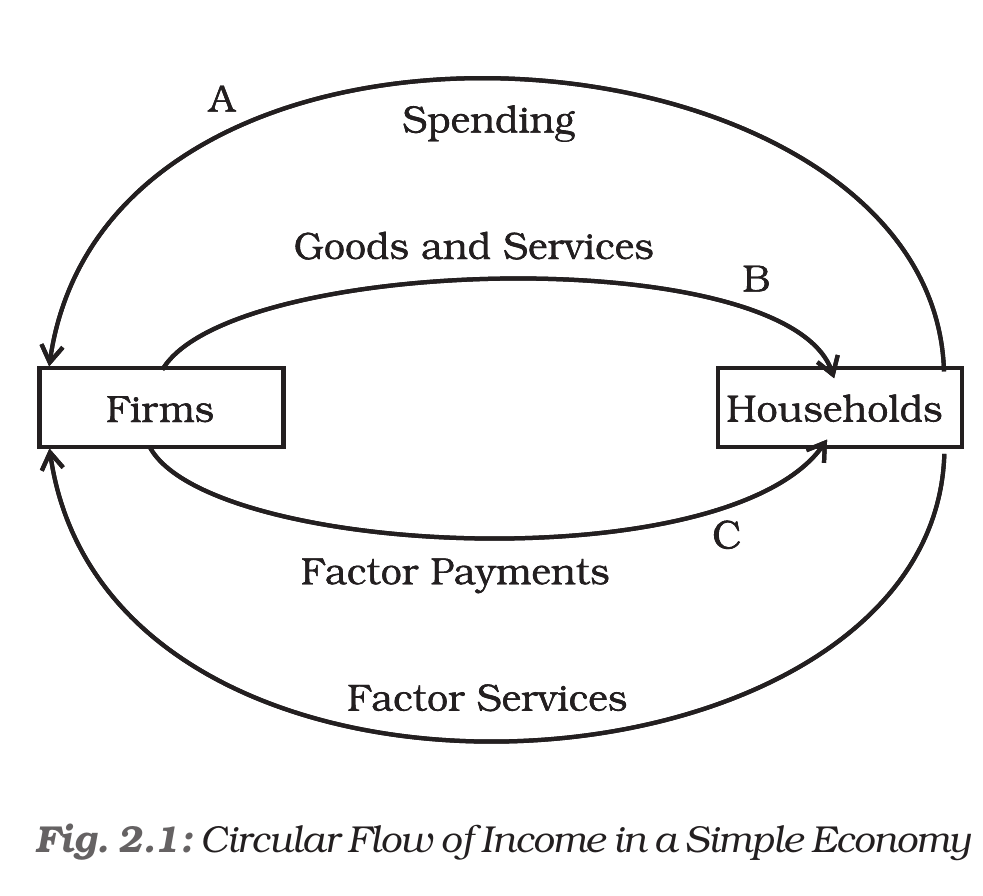
Income moves in a circle: firms pay the factors of production, and households spend this income on what the firms produce. So the same total can be measured at three points of the circle.
(A) Aggregate revenue received by the firms is paid out to the factors of production it is considered as aggregate income. — Correct. Revenue paid out as factor payments takes the form of aggregate income. This is the income method.
(B) Aggregate Income can be calculated by calculating the aggregate value of goods and services produced by the firms. — Correct. The value of expenditure equals the value of goods and services, so income can be measured from output. This is the product method.
(C) Income is being spent on the goods and services produced by the firms. It takes the form of aggregate expenditure received by firms. — Correct. This is the expenditure method. The money spent by households comes back to the firms.
(D) Aggregate Income can not only be calculated through aggregate expenditure. There are other methods that exist. — Correct. National income has three ways of calculation: the product, expenditure and income methods.
NCERT (2026-27): “In the next period the firms will once again produce goods and services and pay remunerations to the factors of production. These remunerations will once again be used to buy the goods and services. Hence year after year we can imagine the aggregate income of the economy going through the two sectors, firms and households, in a circular way. This is represented in Fig. 2.1. When the income is being spent on the goods and services produced by the firms, it takes the form of aggregate expenditure received by the firms. Since the value of expenditure must be equal to the value of goods and services, we can equivalently measure the aggregate income by ‘calculating the aggregate value of goods and services produced by the firms’. When the aggregate revenue received by the firms is paid out to the factors of production it takes the form of aggregate income. … We can measure the uppermost flow (at point A) by measuring the aggregate value of spending that the firms receive for the final goods and services which they produce. This method will be called the expenditure method. If we measure the flow at B by measuring the aggregate value of final goods and services produced by all the firms, it will be called product method. At C, measuring the sum total of all factor payments will be called income method.…”
|