Identify the alkene which undergoes hydration in acidic medium to form 1-methylcyclohexanol?
Answer & explanation
Correct answer: option 1
The correct answer is Option (1) → 1-methylcyclohexene
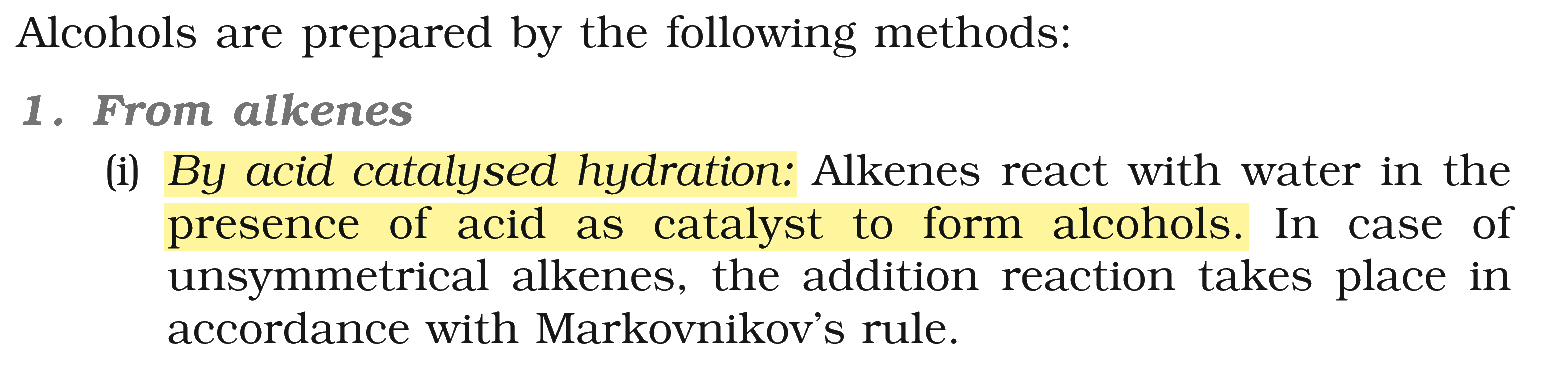
Alkenes react with water in the presence of an acid catalyst to form alcohols. This acid catalysed hydration follows Markovnikov’s rule: the H goes to the double-bond carbon that already has more hydrogens, and the OH goes to the other carbon.
\( \displaystyle \ce{CH3-CH=CH2 + H2O} \xrightarrow{\ce{H+}} \ce{CH3-CH(OH)-CH3} \)
The reaction takes place in three steps:
Protonation: \( \ce{H3O^{+}} \) adds a proton to the alkene, giving the more stable carbocation.
Attack of water: a water molecule attacks the carbocation.
Deprotonation: loss of a proton gives the alcohol.
In 1-methylcyclohexanol, the OH and \( \ce{CH3} \) groups are on the same ring carbon (C-1), and the ring has no double bond. In 1-methylcyclohexene, the proton adds to C-2 and gives a tertiary carbocation at C-1, the carbon carrying the methyl group. Water attacks this carbon, so the product is 1-methylcyclohexanol:
\( \displaystyle \text{1-methylcyclohexene} + \ce{H2O} \xrightarrow{\ce{H+}} \text{1-methylcyclohexanol} \)
Shortcut: Hydration adds only one \( \ce{H2O} \) across one C=C bond. Since 1-methylcyclohexanol is a saturated alcohol, the alkene must have one C=C bond. Only Option (1) has a single double bond.
Why the other options are incorrect
Option (2) 1-methylcyclohexa-1,3-diene — Incorrect. It has two C=C bonds. After hydration of one of them, the product still has a double bond in the ring, so it is a cyclohexenol, not 1-methylcyclohexanol.
Option (3) 3-methylidenecyclohexa-1,4-diene — Incorrect. It has three C=C bonds, so a single hydration cannot give a saturated alcohol.
Option (4) 4-methylidenecyclohexene — Incorrect. Hydration of the exocyclic \( \ce{C=CH2} \) bond gives 1-methylcyclohex-3-en-1-ol, because the double bond in the ring remains.
NCERT (2026-27 edition):
Preparation of Alcohols