
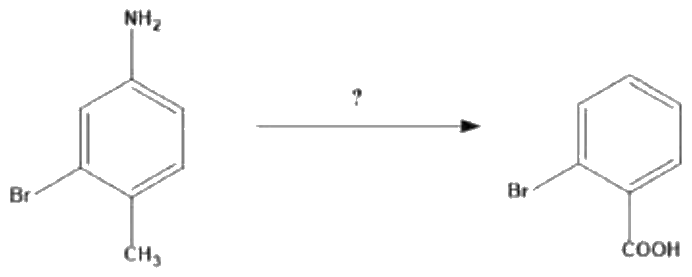
Select the correct set of reagents required for conversion of the following chemical reactions
Answer & explanation
Correct answer: option 1
The correct answer is Option (1) → (i). NaNO2/ HCl, 273-278 K (ii). H3PO4, H2O (iii). KMnO4 and KOH
The starting compound is 3-bromo-4-methylaniline and the product is 2-bromobenzoic acid. Two changes are needed: the –NH2 group must be removed (replaced by H), and the –CH3 group must be oxidised to –COOH. The Br atom, which is next to the \( \ce{CH3} \) group, stays where it is.
Removing –NH2. An amino group cannot be removed directly. It is first converted into a diazonium group with \( \ce{NaNO2} \)/HCl at 273–278 K. The diazonium group is then replaced by hydrogen on warming with hypophosphorous acid (H3PO2) and water:
\( \displaystyle \ce{ArNH2 + NaNO2 + 2HCl} \xrightarrow{\text{273-278 K}} \ce{ArN2^+Cl^- + NaCl + 2H2O} \)
\( \displaystyle \ce{ArN2^+Cl^- + H3PO2 + H2O -> ArH + N2 + H3PO3 + HCl} \)
This gives 2-bromotoluene (1-bromo-2-methylbenzene).
Oxidising –CH3. Alkaline \( \ce{KMnO4} \) oxidises an alkyl side chain on a benzene ring to a carboxylate group; acidification then gives the free acid:
\( \displaystyle \text{2-bromotoluene} \xrightarrow[\text{(ii) }\ce{H3O^+}]{\text{(i) }\ce{KMnO4/KOH},\ \text{heat}} \text{2-bromobenzoic acid} \)
So the correct sequence is diazotisation, reduction of the diazonium salt, then oxidation with KMnO4/KOH.
Why the other options are incorrect
Option (2) (i). NaNO2/HCl (ii). H3PO4 (iii). NaOH/H2O — Incorrect. NaOH cannot oxidise the –\( \ce{CH3} \) group, so the carboxylic acid is never formed.
Option (3) (i). HNO3/H2SO4 (ii). H3PO4 (iii). KMnO4 and KOH — Incorrect. A nitrating mixture does not form a diazonium salt; it attacks the ring (and oxidises the amine), so the –\( \ce{NH2} \) group is not removed.
Option (4) (i). NaNO2/HCl (ii). Sn/HCl (iii). KMnO4 and KOH — Incorrect. Sn/HCl is used to reduce nitro groups to amines; it does not replace the diazonium group by hydrogen.
Note: It seems that there is a mistake in the original NTA paper, which prints H3PO4 (phosphoric acid) in Options (1), (2) and (3) when it should read H3PO2 (hypophosphorous acid).
NCERT (2026-27 edition):
Replacement by H
