Read the passage and answer the questions:
International Trade
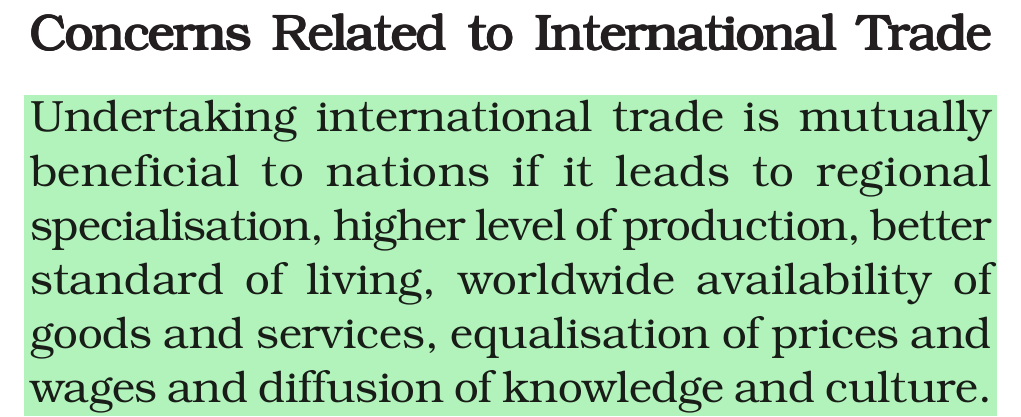
International trade is the result of specialisation in production. It is based on the principle of comparative advantage, complimentarity and transferability of goods and services. Undertaking international trade is mutually beneficial to nations if it leads to regional specialisation, higher level of production, better standard of living, worldwide availability of goods and services, equalisation of prices and wages and diffusion of knowledge and culture.
International trade can prove to be detrimental to nations if it leads to dependence on other countries, uneven levels of development, exploitation, and commercial rivalry leading to wars. Global trade affects many aspects of life; it can impact everything from the environment to health and well-being of the people around the world. As countries compete to trade more, production and the use of natural resources spiral up, resources get used up faster than they can be replenished.
As a result, marine life is also depleting fast, forests are being cut down and river basins sold off to private drinking water companies. Multi-national corporations trading in oil, gas mining, pharmaceuticals and agri-business keep expanding their operations at all costs creating more pollution – their mode of work does not follow the norms of sustainable development. If organisations are geared only towards profit making, and environmental and health concerns are not addressed, then it could lead to serious implications in the future.
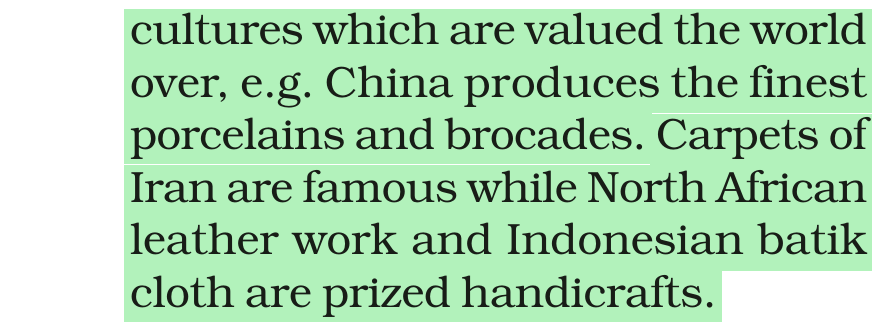
Iranian carpets, Chinese porcelains and brocades are a part of international trade. This trade also contributes in which of the following?
Answer & explanation
Correct answer: option 3
The correct answer is Option (3) → Diffusion of culture
Option (1) Dumping — Incorrect. Dumping is selling a commodity in two countries at prices that differ for reasons not related to costs. Famous handicrafts sold on their quality have nothing to do with it.
Option (2) Balance of trade — Incorrect. Balance of trade only records the value of goods imported and exported. Every traded item enters it; it is not something the carpets and porcelain specially contribute to.
Option (3) Diffusion of culture — Correct. Distinctive forms of art and craft develop in certain cultures and are valued the world over — China’s porcelains and brocades, the carpets of Iran. When such goods travel, the culture behind them travels too, and trade leads to the diffusion of knowledge and culture.
Option (4) Balanced Regional Development — Incorrect. Trade leads to regional specialisation, and it can also cause uneven levels of development, so it pulls regions apart instead of balancing them.
NCERT: Fundamentals of Human Geography — Chapter 8: International Trade, Basis of International Trade; Concerns Related to International Trade (2025-26)
|