Which one is not true for minority group:
Answer & explanation
Correct answer: option 1
The correct answer is Option (1) → Minority is perceived only in terms of religion
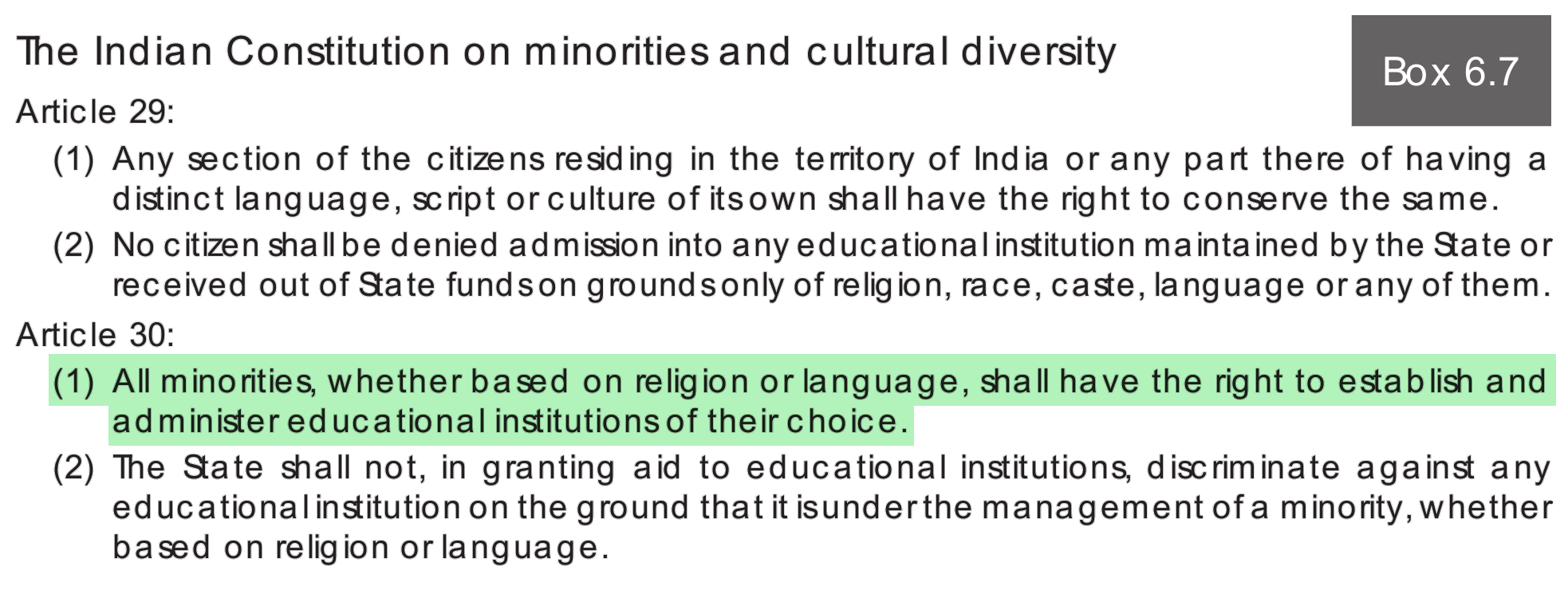
Option (1) Minority is perceived only in terms of religion — False. Religion is only one basis of a minority. The Constitution itself speaks of all minorities, whether based on religion or language, and in sociology the term is used for any relatively small and disadvantaged group that forms a collectivity.
Option (2) They are a disadvantaged group — True. The notion of minority is more than a numerical distinction; it usually involves some sense of relative disadvantage. Very wealthy people are not called a minority without the qualifying word ‘privileged’.
Option (3) They have strong in group solidarity — True. The members of a minority form a collectivity: they have a strong sense of group solidarity, a feeling of togetherness and belonging, which prejudice and discrimination usually heighten.
Option (4) They are numerically less compared to others — True. Used without qualification, minority implies a relatively small but also disadvantaged group.
NCERT (2025-26): “6.3 Religion-related Issues and Identities … The notion of minority groups is widely used in sociology and is more than a merely numerical distinction – it usually involves some sense of relative disadvantage. Thus, privileged minorities such as extremely wealthy people are not usually referred to as minorities; if they are, the term is qualified in some way, as in the phrase ‘privileged minority’. When minority is used without qualification, it generally implies a relatively small but also disadvantaged group. The sociological sense of minority also implies that the members of the minority form a collectivity – that is, they have a strong sense of group solidarity, a feeling of togetherness and belonging. This is linked to disadvantage because the experience of being subjected to prejudice and discrimination usually heightens feelings of intra-group loyalty and interests (Giddens 2001:248).…”
Box 6.7 (NCERT 2025-26) |