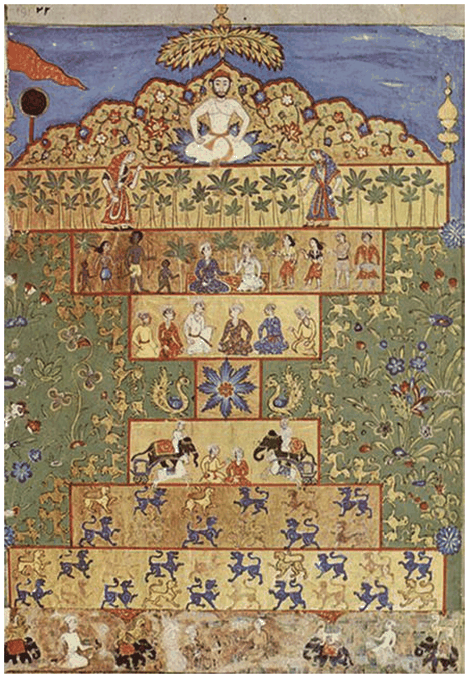
Which of the following is NOT said of The Throne of Prosperity, a Bijapur painting of 1570?
Answer & explanation
Correct answer: option 2
The correct answer is Option (2) → Its basic structures recall the wood carved doorways and facades of Persian homes.
Option (1) Its basic structures may remind us of the temples of the Deccan. — Said of the painting. The structures recall Gujarati homes or perhaps the temples of the Deccan.
Option (2) Its basic structures recall the wood carved doorways and facades of Persian homes. — Not said of the painting. The doorways and facades recalled are those of Gujarati homes, not Persian ones.
Option (3) Its colouring is in the Islamic Persian tradition. — Said of the painting. The Persian link is in its colouring, especially the arabesques on top of the throne.
Option (4) Its stylised plants recall margin decoration in Gujarati manuscripts. — Said of the painting. The plants on either side of the throne refer to margin decoration in early sixteenth-century Gujarati manuscripts.
NCERT (2026-27): “Bijapur School of Painting …The Throne of Prosperity is a symbolic diagram of an auspicious throne of seven stages, each supported by different inhabitants — from elephants and tigers to palm trees, through storeys of peacocks and primitive tribes. The basic structures recall the wood carved doorways and facades of Gujarati homes or perhaps remind us of the temples of the Deccan. The colouring of this page is in Islamic Persian tradition, especially, the arabesques on the top of the throne. …The stylised plants on either side of the throne have visual reference to margin decoration in Gujarati manuscript of say early sixteenth century. There is, thus, a strong Indian visual tradition that structure this miniature.”
Nujum al-Ulum: The Throne of Prosperity, Bijapur, 1570, The Chester Beatty Library, Dublin, Ireland |