
Read the passage given below to answer questions:
Most of haloalkanes and haloarenes react with certain metals to give compound containing carbon metal bonds called organometallic compounds. Grignard reagent is such organomagnesium compound. Grignard reagent can be prepared from halogen derivative of alkanes/arenes with magnesium metal in dry ether. These are highly reactive compounds and react with source of proton to give hydrocarbon. Grignard reagents undergo addition with carbonyl compounds to give corresponding alcohols.
The products formed in the following reaction is:
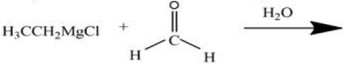
Answer & explanation
Correct answer: option 1
The correct answer is Option (1) → CH3CH2CH2OH (propan-1-ol), MgCl(OH)
The ethyl group of the Grignard reagent adds to the carbonyl carbon of formaldehyde, and the adduct is hydrolysed:
\( \ce{CH3CH2MgCl + HCHO -> CH3CH2CH2OMgCl} \)
\( \ce{CH3CH2CH2OMgCl + H2O -> CH3CH2CH2OH + Mg(OH)Cl} \)
Formaldehyde adds one \( \ce{CH2OH} \) carbon to the alkyl group, so a Grignard reagent and HCHO always give a primary alcohol. Option (1), drawn as \( \ce{H-CH(OH)-CH2CH3} \), is propan-1-ol.
Why the other options are incorrect
Option (2) — Incorrect. The ethyl group and the HCHO carbon join into one three-carbon chain; no two-carbon alcohol and no acid are formed.
Option (3) — Incorrect. Ethane is what the Grignard reagent gives with water alone; here it first adds to HCHO.
Option (4) — Incorrect. Propane has no –OH; the oxygen of formaldehyde stays in the product as –OH.