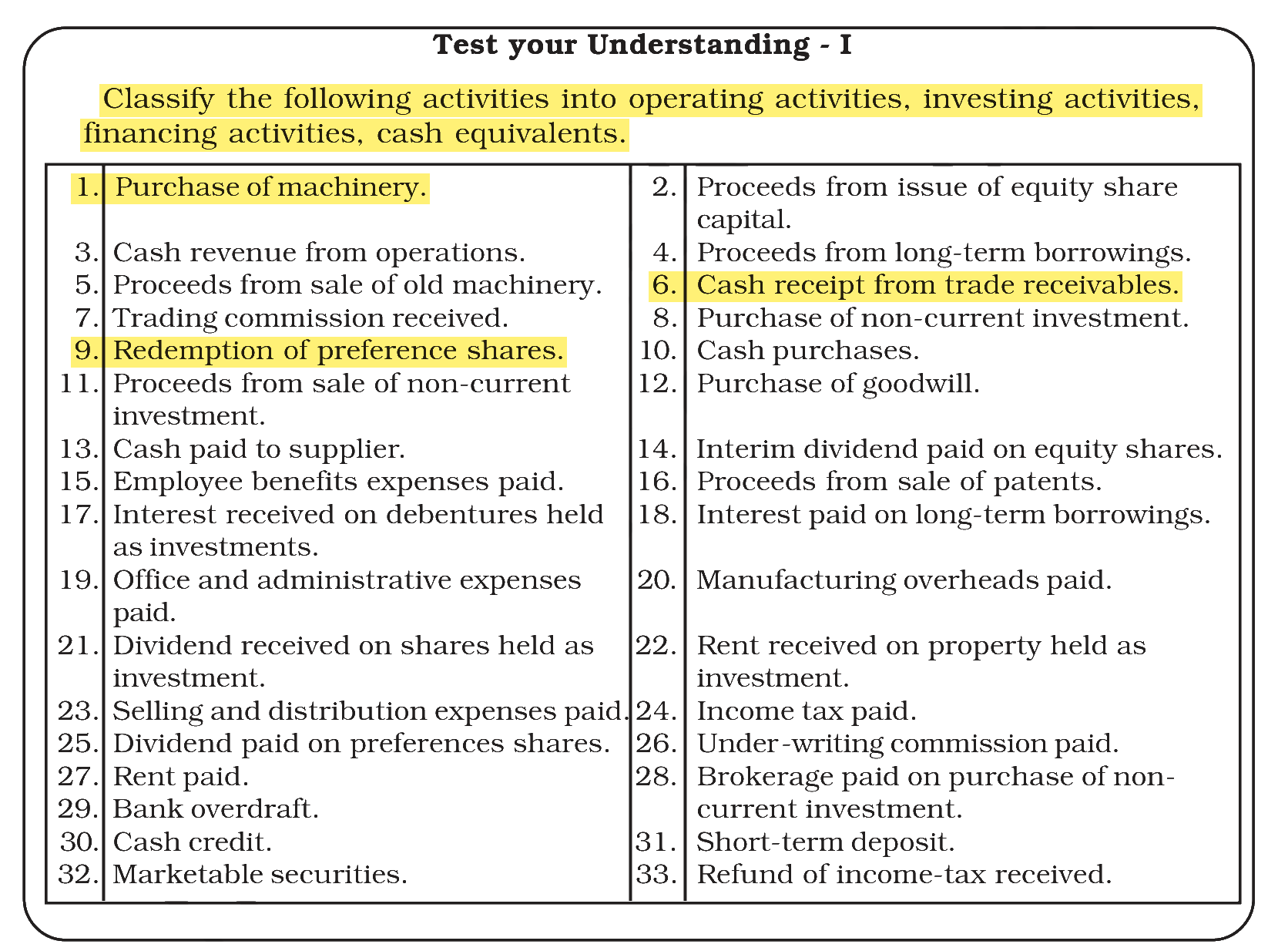
Match List-I with List-II
|
List-I |
List-II |
|
(A) Operating activity |
(I) Bank |
|
(B) Investing activity |
(II) Redemption of preference shares |
|
(C) Financing activity |
(III) Purchase of machinery |
|
(D) Cash equivalents |
(IV) Cash receipt from trade receivables. |
Choose the correct answer from the options given below:
Answer & explanation
Correct answer: option 3
The correct answer is Option (3) → (A)-(IV), (B)-(III), (C)-(II), (D)-(I)
A cash flow statement sorts every cash movement by the activity that caused it: the main business (operating), long-term assets (investing) or long-term funds (financing). Cash and cash equivalents are what is left at the end of all three.
(A) Operating activity — this matches (IV) Cash receipt from trade receivables. Trade receivables arise from selling goods on credit, so the cash collected from them is cash from the sale of goods, the main revenue activity.
(B) Investing activity — this matches (III) Purchase of machinery. Machinery is a fixed asset, and buying a long-term asset is an investing outflow.
(C) Financing activity — this matches (II) Redemption of preference shares. Paying back preference share capital changes the size of the owners’ capital, which is what financing activities cover.
(D) Cash equivalents — this matches (I) Bank. A bank balance is not a flow from any activity; it is part of the cash the statement accounts for, so it is the one List-II item that goes with (D).
Note: Strictly, a bank balance (a demand deposit) is part of cash, not a cash equivalent; cash equivalents are short-term, highly liquid investments. (D) is read as “cash and cash equivalents”, the heading under which a bank balance is shown. Items (II), (III) and (IV) are all cash flows from an activity, so (I) Bank is the only item left for (D) and the match above still holds.
NCERT (2026-27 edition):
NCERT (2026-27 edition):
NCERT (2026-27 edition): |