
CUETMOCK
  • Pricing
  • Mentors
Log inStart freeStart free mocks→

First test, then trust

Try a free CUET mock test.

Join 5,00,000+ students who rehearsed exam day on the exact NTA screen before sitting CUET. On the web and on Android.

Start free mocks →Get the Android app
CUETMOCK

India's #1 CUET Mock Test Platform. Original NCERT-based questions on the exact NTA exam screen — trusted by 5,00,000+ students since CUET 2022.

Get it onGoogle PlayScan to download the CUETMOCK app

Mock tests

  • CUET mock test series
  • Commerce mocks
  • Humanities (Arts) mocks
  • Science mocks
  • Languages & GAT mocks
  • Free practice questions
  • Pricing

Resources

  • CUET exam guide
  • CUET syllabus
  • Universities accepting CUET
  • Expert blogs
  • News & notifications
  • Webinars & counselling
  • CUET score calculator
  • How we estimate your rank
  • FAQs

Company

  • About us
  • Our leadership & team
  • Our toppers
  • Mentors
  • For schools
  • Contact us
  • Terms
  • Privacy
  • Refund policy

Talk to us

+91 7696 6630 56info@cuetmock.comWhatsApp us

Our other platforms

  • JEE Mock — For IIT-JEE aspirants
  • NEET Mock — For NEET aspirants

Newsletter

Exam updates, study material and offers — no spam.

© 2026 NYC Ventures Pvt. Ltd.

701-702, Royal Business Park, Zirakpur, Punjab - 140603

  • Terms of use
  • Privacy policy
  • Refund policy
  • Contact us

iCUETMOCK is an independent preparation platform, not affiliated with the National Testing Agency (NTA). Always check exam details on the official NTA website.

  • Home
  • Mock tests
  • CUET guide
  • Pricing
  • Log in
Home/Practice questions/Chemistry
ChemistryInorganic: D and F Block Elements

Which of the following statements is correct?

Which of the following statements is correct?

Answer & explanation+

Correct answer: option 3

The correct answer is Option (3) → Because of the lanthanoid contraction, the radii of the third-row elements are almost the same as those of the second-row elements

  • The three rows of transition elements are the 3d, 4d and 5d series. Going down a group, radius normally increases because a new shell is added, and it does so from the 3d to the 4d series. Before the 5d series begins, however, the fourteen 4f electrons are filled in (La to Lu). The 4f electrons shield the outer electrons poorly, so the steady rise in nuclear charge pulls the atoms in: this is the lanthanoid contraction.

  • This contraction cancels the size increase expected from the extra shell. The 5d (third-row) elements therefore have almost the same radii as the 4d (second-row) elements of the same group.

Why the other options are incorrect

Option (1) The second-row elements have smaller radii than the corresponding third-row elements — Incorrect. This is the size order expected without the 4f filling. Because of the lanthanoid contraction the two rows are virtually equal in size (Hf is even a little smaller than Zr).

Option (2) Because of lanthanoid contraction, the radii of the third-row elements are almost the same as those of the first-row elements — Incorrect. The 3d (first-row) elements are smaller than both the 4d and the 5d elements; radius rises from the first row to the second, and the contraction only cancels the rise from the second row to the third.

Option (4) Because of the lanthanoid contraction, the separation of second-row elements from one another is easier — Incorrect.

  • The contraction makes no separation easier.

  • It makes a second-row element and the third-row element below it (Zr and Hf) almost identical in size and properties, so they occur together and their separation is difficult, not easier.

NCERT (2026-27 edition):
4.5.2 Atomic and Ionic Sizes – “The cumulative effect of the contraction of the lanthanoid series, known as lanthanoid contraction, causes the radii of the members of the third transition series to be very similar to those of the corresponding members of the second series.”

4.3.2 Variation in Atomic and Ionic Sizes of Transition Metals – “… The curves in Fig. 4.3 show an increase from the first (3d) to the second (4d) series of the elements but the radii of the third (5d) series are virtually the same as those of the corresponding members of the second series. This phenomenon is associated with the intervention of the 4f orbitals which must be filled before the 5d series of elements begin.”
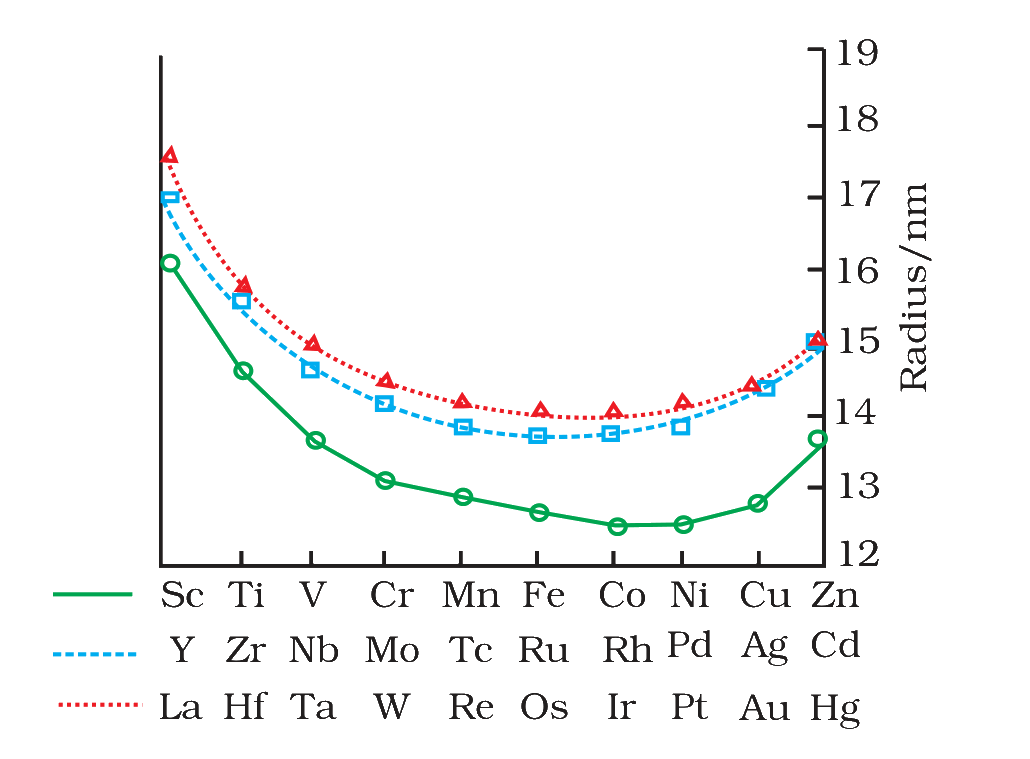
Fig. 4.3

Fig. 4.3: Trends in atomic radii of transition elements

Advertisement

Practise more on Inorganic: D and F Block Elements

Chapter-wise mocks on the real NTA exam screen, with solutions and your rank. Your first mocks are free.

Start free mocks →

Advertisement

Next questions

  1. Choose one alternative which can be substituted for the given words:One of the people who carry the coffin at a funeralEnglish · One Word
  2. Ayesha’s father was 38 years old when she was born, while her mother was 36 years old when her brother, who is four years younger than Ayes…General Aptitude Test · Numerical Ability
  3. B. N. Goswamy is a scholar of the Pahari Schools of Painting. Why does he say that grouping Pahari paintings by region could mislead?Fine Arts · The Pahari Schools of Painting
  4. 'दोहा' और 'रोला' के संयोग से कौन सा छंद बनता है?Hindi · छंद
  5. Which of the following given statements are not correct? I. Every sexually transmitted disease can be entirely cured. II. Surgical methods,…Biology · Reproductive Health
  6. Given below are two statements:Statement I: If the female parent produces unisexual flowers, the female flower buds are bagged after the fl…Biology · Sexual Reproduction in Flowering Plants
  7. Choose the grammatically correct sentence:English · Grammar: Verb
  8. With light of wavelength 600 nm, the first minimum of a single-slit pattern is at an angle of 0.15^° . The same slit is now used with light…Physics · Wave Optics
  9. Which of the following statements regarding the photoemission of electrons is correct?Physics · Dual Nature of Radiation and Matter
  10. Find the odd figure among the four given figures.General Aptitude Test · Non-Verbal Reasoning