
Arrange the following events in the history of genetics in the order in which they took place:
A. Walter Sutton and Theodore Boveri used chromosome movement during meiosis to explain Mendel's laws.
B. de Vries, Correns and von Tschermak independently rediscovered Mendel's results on the inheritance of characters.
C. Henking traced a specific nuclear structure, the X body, all through spermatogenesis in a few insects.
D. Alfred Sturtevant used the frequency of recombination between gene pairs on the same chromosome to map their positions.
Choose the correct answer from the options given below:
Answer & explanation
Correct answer: option 1
The correct answer is Option (1) → C, B, A, D
First – C. Henking traced a specific nuclear structure, the X body, all through spermatogenesis in a few insects. Henking’s work on insects was done in 1891, while Mendel’s work still lay unrecognised.
Second – B. de Vries, Correns and von Tschermak independently rediscovered Mendel's results on the inheritance of characters. This rediscovery came in 1900, and only then did Mendel’s results become widely known.
Third – A. Walter Sutton and Theodore Boveri used chromosome movement during meiosis to explain Mendel's laws. By 1902 the chromosome movement during meiosis had been worked out. Sutton and Boveri then saw that chromosomes behave like genes, which led to the chromosomal theory of inheritance.
Fourth – D. Alfred Sturtevant used the frequency of recombination between gene pairs on the same chromosome to map their positions. Sturtevant was a student of Morgan. His maps were based on the linkage and recombination that Morgan found while verifying the chromosomal theory in Drosophila, so this came last.
NCERT Extract:
Sex Determination – “… Henking (1891) could trace a specific nuclear structure all through spermatogenesis in a few insects, and it was also observed by him that 50 per cent of the sperm received this structure after spermatogenesis, whereas the other 50 per cent sperm did not receive it.”
Chromosomal Theory of Inheritance – “… In 1900, three Scientists (de Vries, Correns and von Tschermak) independently rediscovered Mendel’s results on the inheritance of characters. … By 1902, the chromosome movement during meiosis had been worked out. Walter Sutton and Theodore Boveri noted that the behaviour of chromosomes was parallel to the behaviour of genes and used chromosome movement (Figure 4.8) to explain Mendel’s laws (Table 4.3).”
Linkage and Recombination – “… Morgan and his group also found that even when genes were grouped on the same chromosome, some genes were very tightly linked (showed very low recombination) (Figure 4.11, Cross A) while others were loosely linked (showed higher recombination) (Figure 4.11, Cross B). … His student Alfred Sturtevant used the frequency of recombination between gene pairs on the same chromosome as a measure of the distance between genes and ‘mapped’ their position on the chromosome.”
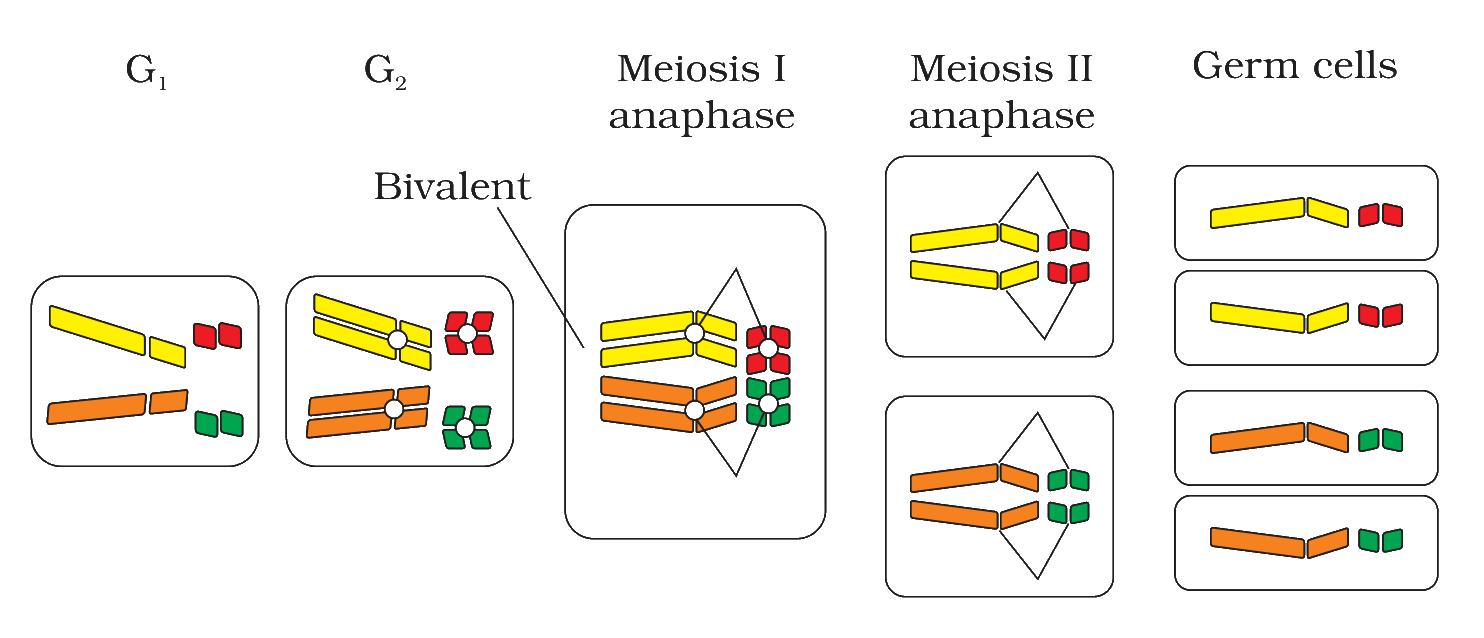
Figure 4.8 Meiosis and germ cell formation in a cell with four chromosomes
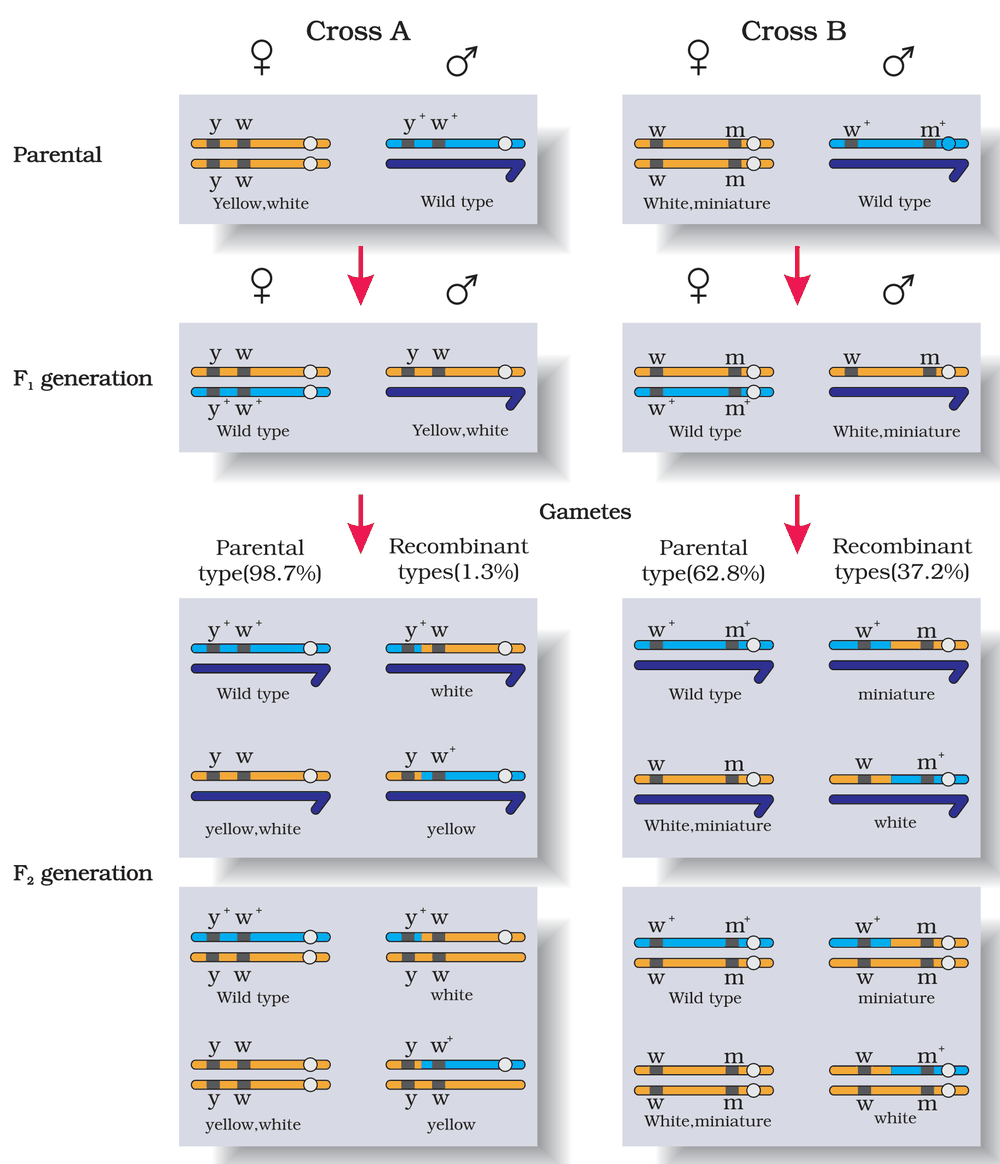
Figure 4.11 Linkage: Results of two dihybrid crosses conducted by Morgan. Cross A shows crossing between gene y and w; Cross B shows crossing between genes w and m. Here dominant wild type alleles are represented with (+) sign in superscript