CUETMOCK
  • Pricing
  • Mentors
Log inStart freeStart free mocks→

First test, then trust

Try a free CUET mock test.

Join 5,00,000+ students who rehearsed exam day on the exact NTA screen before sitting CUET. On the web and on Android.

Start free mocks →Get the Android app
CUETMOCK

India's #1 CUET Mock Test Platform. Original NCERT-based questions on the exact NTA exam screen — trusted by 5,00,000+ students since CUET 2022.

Get it onGoogle PlayScan to download the CUETMOCK app

Mock tests

  • CUET mock test series
  • Browse all papers
  • Commerce mocks
  • Humanities (Arts) mocks
  • Science mocks
  • Languages & GAT mocks
  • Free practice questions
  • Pricing

Resources

  • CUET exam guide
  • CUET syllabus
  • Universities accepting CUET
  • Expert blogs
  • News & notifications
  • Webinars & counselling
  • CUET score calculator
  • How we estimate your rank
  • FAQs

Company

  • About us
  • Our leadership & team
  • Our toppers
  • Mentors
  • For schools
  • Contact us
  • Terms
  • Privacy
  • Refund policy

Talk to us

+91 7696 6630 56info@cuetmock.comWhatsApp us

Our other platforms

  • JEE Mock — For IIT-JEE aspirants
  • NEET Mock — For NEET aspirants

Newsletter

Exam updates, study material and offers — no spam.

© 2026 NYC Ventures Pvt. Ltd.

701-702, Royal Business Park, Zirakpur, Punjab - 140603

  • Terms of use
  • Privacy policy
  • Refund policy
  • Contact us

iCUETMOCK is an independent preparation platform, not affiliated with the National Testing Agency (NTA). Always check exam details on the official NTA website.

  • Home
  • Mock tests
  • CUET guide
  • Pricing
  • Log in
Home/Practice questions/History
HistoryAncient India: Kings, Farmers and Towns

Arrange the following in a chronological order. A. Vedic AgeB. Sixtee…

Arrange the following in a chronological order.

A. Vedic Age
B. Sixteen Mahajanapadas
C. Harappan Civilisation
D. Epic Age

Choose the correct answer from the options given below:

Answer & explanation+

Correct answer: option 3

The correct answer is Option (3) → C, A, B, D

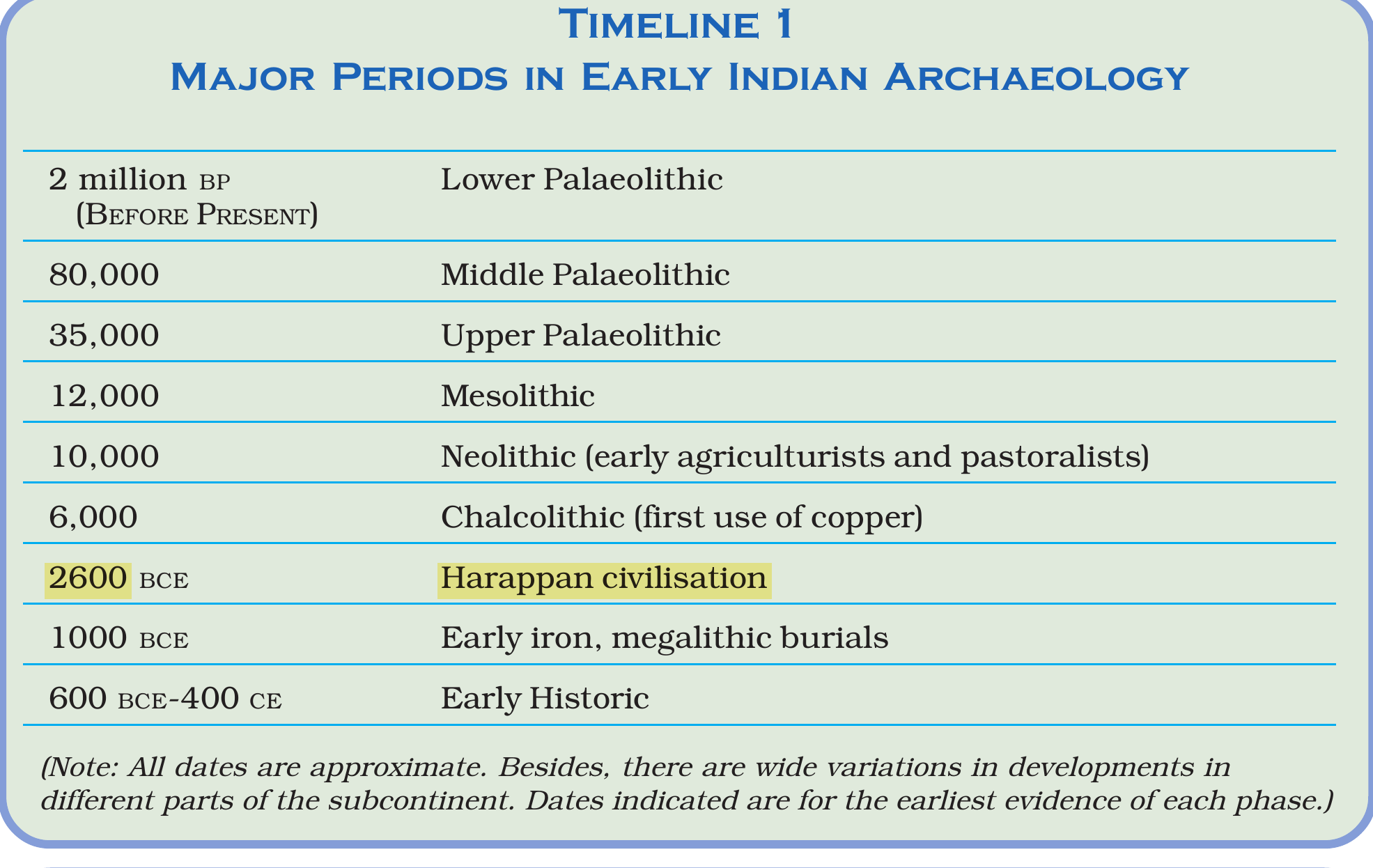
(C) Harappan Civilisation — the earliest of the four: the Harappan civilisation dates to 2600 BCE.

(A) Vedic Age — the Rigveda, the earliest religious text, was compiled c. 1500-1000 BCE.

(B) Sixteen Mahajanapadas — the sixth century BCE, the era of the early states; Buddhist and Jaina texts name sixteen of them, the mahajanapadas.

(D) Epic Age — the Mahabharata, a colossal epic, was composed over a period of about 1,000 years from c. 500 BCE onwards.

Note: The terms ‘Vedic Age’ and ‘Epic Age’ are not used in the NCERT book (2026-27). Here the Vedic Age is taken as the period of the Vedic texts, beginning with the Rigveda (c. 1500-1000 BCE), and the Epic Age as the period in which the epics were composed, which the book dates for the Mahabharata from c. 500 BCE onwards. They are explained here for the benefit of the students.


NCERT (2026-27): “11.2 Problems of interpretation … The earliest religious text, the Rigveda (compiled c. 1500-1000 BCE) mentions a god named Rudra, which is a name used for Shiva in later Puranic traditions (in the first millennium CE; see also Chapter 4). However, unlike Shiva, Rudra in the Rigveda is neither depicted as Pashupati (lord of animals in general and cattle in particular), nor as a yogi.…

2.1 The sixteen mahajanapadas … The sixth century BCE is often regarded as a major turning point in early Indian history. It is an era associated with early states, cities, the growing use of iron, the development of coinage, etc. It also witnessed the growth of diverse systems of thought, including Buddhism and Jainism. Early Buddhist and Jaina texts (see also Chapter 4) mention, amongst other things, sixteen states known as mahajanapadas.…

…In focusing on the Mahabharata, a colossal epic running in its present form into over 100,000 verses with depictions of a wide range of social categories and situations, we draw on one of the richest texts of the subcontinent. It was composed over a period of about 1,000 years (c. 500 BCE onwards), and some of the stories it contains may have been in circulation even earlier.…”

NCERT extract

Advertisement

Practise more on Ancient India: Kings, Farmers and Towns

Chapter-wise mocks on the real NTA exam screen, with solutions and your rank. Your first mocks are free.

Start free mocks →

Advertisement

Next questions

  1. What was the “Open door” Policy of China?Political Science · Contemporary World Politics: Contemporary Centres of power
  2. Gandhiji himself they now saluted as a "Saint" and "Statesman", who was using "Christian acts as a weapon against men with Christian belief…History · Modern India: Mahatma Gandhi and the Nationalist movement
  3. Which country has won the Intercontinental Cup 2023 (held in India) in football?General Aptitude Test · Current Affairs
  4. Jamini Roy studied the pat before working out his own colours. Which of the following is NOT correct about his use of colour and material?Fine Arts · The Bengal School and Cultural Nationalism
  5. Ravens Progressive Matrices (RPM) Test is an example of which test.Psychology · Variations in Psychological Attributes
  6. In which of the following respects do human capital and physical capital differ?I. Nature of depreciationII. Mobility between countriesIII.…Economics · Indian Economic Development: Human Capital Formation in India
  7. Ram loses 121/2 % of his money and after spending 75% of the remainder, is left with ₹630. How much money did Ram have initially ?General Aptitude Test · Numerical Ability
  8. If L denotes x, M denotes +, P denotes ÷ and Q denotes -, then 48 P 12 M 8 Q 8 M 1 L 6 = ?General Aptitude Test · Verbal Reasoning
  9. Match the following Terms in List 1 correctly with their meanings in List 2: List-1 (Terms) List- 2 (Meanings) (A) Agenda 21 (I) Global Com…Political Science · Contemporary World Politics: Environment and Natural Resources
  10. Choose the correct Assertive form of the following Exclamatory sentence:What a pity that the mango tree in our courtyard has stopped bearin…English · Kinds of Sentence