
CUETMOCK
  • Pricing
  • Mentors
Log inStart freeStart free mocks→

First test, then trust

Try a free CUET mock test.

Join 5,00,000+ students who rehearsed exam day on the exact NTA screen before sitting CUET. On the web and on Android.

Start free mocks →Get the Android app
CUETMOCK

India's #1 CUET Mock Test Platform. Original NCERT-based questions on the exact NTA exam screen — trusted by 5,00,000+ students since CUET 2022.

Get it onGoogle PlayScan to download the CUETMOCK app

Mock tests

  • CUET mock test series
  • Commerce mocks
  • Humanities (Arts) mocks
  • Science mocks
  • Languages & GAT mocks
  • Free practice questions
  • Pricing

Resources

  • CUET exam guide
  • CUET syllabus
  • Universities accepting CUET
  • Expert blogs
  • News & notifications
  • Webinars & counselling
  • CUET score calculator
  • How we estimate your rank
  • FAQs

Company

  • About us
  • Our leadership & team
  • Our toppers
  • Mentors
  • For schools
  • Contact us
  • Terms
  • Privacy
  • Refund policy

Talk to us

+91 7696 6630 56info@cuetmock.comWhatsApp us

Our other platforms

  • JEE Mock — For IIT-JEE aspirants
  • NEET Mock — For NEET aspirants

Newsletter

Exam updates, study material and offers — no spam.

© 2026 NYC Ventures Pvt. Ltd.

701-702, Royal Business Park, Zirakpur, Punjab - 140603

  • Terms of use
  • Privacy policy
  • Refund policy
  • Contact us

iCUETMOCK is an independent preparation platform, not affiliated with the National Testing Agency (NTA). Always check exam details on the official NTA website.

  • Home
  • Mock tests
  • CUET guide
  • Pricing
  • Log in
Home/Practice questions/Chemistry
ChemistryPhysical: Chemical Kinetics

Arrange the following rate expressions in decreasing order of their o…

Arrange the following rate expressions in decreasing order of their overall order of reaction:

A. Rate = k[A]3/2[B]1/2

B. Rate = k[A]−1[B]3/2

C. Rate = k[A]1/2[B]1/2

D. Rate = k[A]1/2[B]

Choose the correct answer from the options given below:

Answer & explanation+

Correct answer: option 4

The correct answer is Option (4) → A, D, C, B

The order of a reaction is read from its rate law. For Rate = k[A]x[B]y, x is the order with respect to A and y the order with respect to B. The order of the whole reaction is the sum of the powers, x + y. The powers are found by experiment, so they can be fractions, zero or negative.

Adding the powers for each rate law:

    \( \displaystyle \text{A: Rate}=k[\mathrm{A}]^{3/2}[\mathrm{B}]^{1/2},\quad \text{order}=\frac{3}{2}+\frac{1}{2}=2 \)

    \( \displaystyle \text{B: Rate}=k[\mathrm{A}]^{-1}[\mathrm{B}]^{3/2},\quad \text{order}=-1+\frac{3}{2}=\frac{1}{2} \)

    \( \displaystyle \text{C: Rate}=k[\mathrm{A}]^{1/2}[\mathrm{B}]^{1/2},\quad \text{order}=\frac{1}{2}+\frac{1}{2}=1 \)

    \( \displaystyle \text{D: Rate}=k[\mathrm{A}]^{1/2}[\mathrm{B}],\quad \text{order}=\frac{1}{2}+1=\frac{3}{2} \)

In decreasing order:

    \( \displaystyle 2>\frac{3}{2}>1>\frac{1}{2} \)

    \( \displaystyle \mathrm{A}>\mathrm{D}>\mathrm{C}>\mathrm{B} \)

NCERT (2026-27 edition):
Order of a Reaction – …
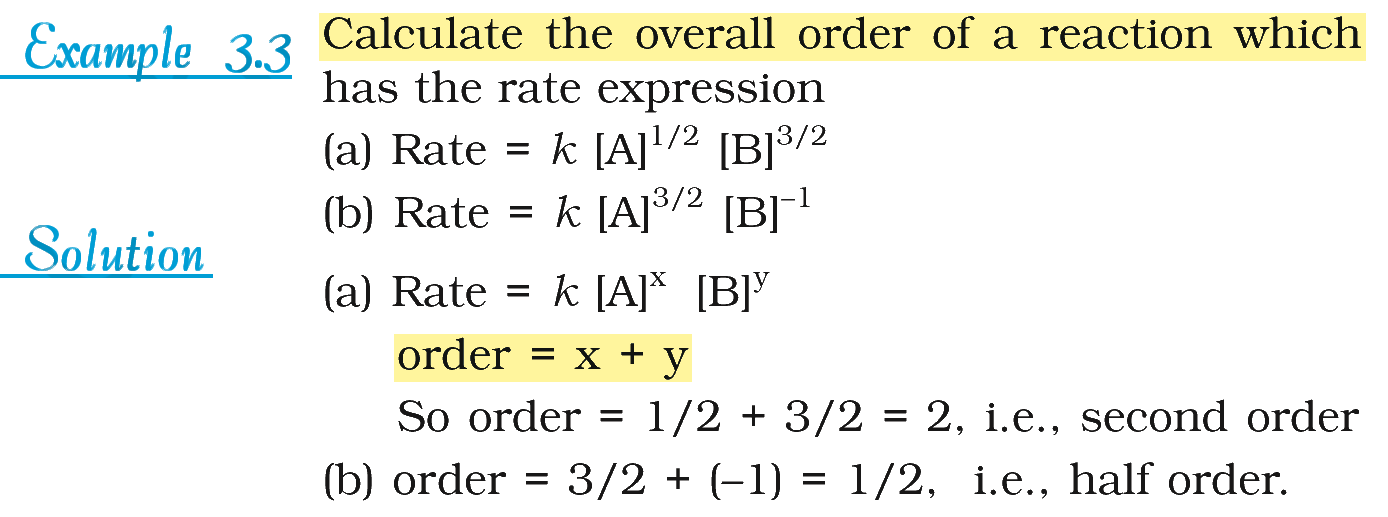
Textbook extract

Advertisement

Practise more on Physical: Chemical Kinetics

Chapter-wise mocks on the real NTA exam screen, with solutions and your rank. Your first mocks are free.

Start free mocks →

Advertisement

Next questions

  1. In a 800 m race, A beats B by 74 m and in a 600 m race, B beats C by 50 m. By how many meters will A beat C in a race of 800 m?Applied Maths. Section B2 · Numbers, Quantification and Numerical Applications
  2. AB is the diameter of a circle with centre O. C and D are two points on the circumference of the circle on either side of AB, such that ∠CA…General Aptitude Test · Quantitative Reasoning
  3. The slope of the tangent to the curve y=∫limits_x^x^2 cos ^-1 t^2 d t text at x=2^-1 / 4, isMaths. Section B1 · Applications of Derivatives
  4. A and B are partners in a firm having capital balances of ₹54,000 and ₹36,000 respectively and share profits in the capital ratio. They adm…Accountancy Part A · Admission of a Partner
  5. f(x)=(sin^3x)/([x/(π)]+1/2), where [·] denotes the greatest integer function is (if x is not integral multiple of π)Maths. Section B1 · Relations and Functions
  6. Which ruler was averse to joining the Constituent Assembly?Political Science · Politics in India Since Independence: Challenges of nation Building
  7. Hanny, Pammy and Sunny are partners sharing profits in the ratio of 3 : 2 : 1. Goodwill is appearing in the books at a value of Rs. 60,000.…Accountancy Part A · Reconstitution of Partnership Firm: Retirement and Death
  8. The solution of dy/dx - y = 1, y(0) = 1 is given byMaths. Section B1 · Differential Equations
  9. How much of the money in circulation became invalid due to demonetization?Business Studies · Business Environment
  10. How is the birth rate of a population calculated?Biology · Organisms and Populations