
Which species is involved in chlorination of benzene using $Cl_2$ in presence of $AlCl_3$?
Answer & explanation
Correct answer: option 2
The correct answer is Option (2) → $Cl^+$
Chlorination of benzene occurs through an electrophilic aromatic substitution reaction.
In the presence of AlCl₃ (Lewis acid catalyst), chlorine molecules become polarized and generate the electrophile required for substitution.
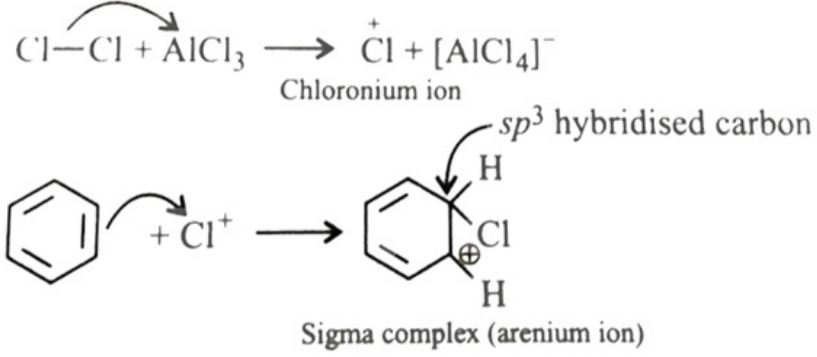
Step 1: Formation of electrophile
Cl₂ + AlCl₃ → Cl⁺ + AlCl₄⁻
Here Cl⁺ (chloronium ion) acts as the electrophile that attacks the benzene ring.
Step 2: Electrophilic attack
The benzene ring donates electrons to Cl⁺, forming a sigma complex (arenium ion).
Step 3: Restoration of aromaticity
A proton is removed from the ring by AlCl₄⁻, forming chlorobenzene and regenerating AlCl₃.
Thus, the species involved as the active electrophile in chlorination of benzene is Cl⁺.
Option A Incorrect. Cl⁻ (chloride ion) is a nucleophile, not an electrophile. Electrophilic aromatic substitution requires a positively charged electrophile, so Cl⁻ cannot attack benzene.
Option B Correct. -- Cl⁺ (chloronium ion) is generated when chlorine reacts with AlCl₃. This positively charged species acts as the electrophile that attacks the benzene ring, initiating chlorination.
Option C Incorrect. AlCl₄⁺ is not formed in this reaction. Instead, the reaction produces AlCl₄⁻, which later helps remove a proton to restore aromaticity.
Option D Incorrect. AlCl₄⁻ is formed during the reaction, but it acts as a base that removes a proton from the sigma complex, not as the electrophile that attacks benzene.