
CUETMOCK
  • Pricing
  • Mentors
Log inStart freeStart free mocks→

First test, then trust

Try a free CUET mock test.

Join 5,00,000+ students who rehearsed exam day on the exact NTA screen before sitting CUET. On the web and on Android.

Start free mocks →Get the Android app
CUETMOCK

India's #1 CUET Mock Test Platform. Original NCERT-based questions on the exact NTA exam screen — trusted by 5,00,000+ students since CUET 2022.

Get it onGoogle PlayScan to download the CUETMOCK app

Mock tests

  • CUET mock test series
  • Browse all papers
  • Commerce mocks
  • Humanities (Arts) mocks
  • Science mocks
  • Languages & GAT mocks
  • Free practice questions
  • Pricing

Resources

  • CUET exam guide
  • CUET syllabus
  • Universities accepting CUET
  • Expert blogs
  • News & notifications
  • Webinars & counselling
  • CUET score calculator
  • How we estimate your rank
  • FAQs

Company

  • About us
  • Our leadership & team
  • Our toppers
  • Mentors
  • For schools
  • Contact us
  • Terms
  • Privacy
  • Refund policy

Talk to us

+91 7696 6630 56info@cuetmock.comWhatsApp us

Our other platforms

  • JEE Mock — For IIT-JEE aspirants
  • NEET Mock — For NEET aspirants

Newsletter

Exam updates, study material and offers — no spam.

© 2026 NYC Ventures Pvt. Ltd.

701-702, Royal Business Park, Zirakpur, Punjab - 140603

  • Terms of use
  • Privacy policy
  • Refund policy
  • Contact us

iCUETMOCK is an independent preparation platform, not affiliated with the National Testing Agency (NTA). Always check exam details on the official NTA website.

  • Home
  • Mock tests
  • CUET guide
  • Pricing
  • Log in
Home/Practice questions/General Aptitude Test
General Aptitude TestVerbal ReasoningSyllogism

Two statements are given followed by two conclusions. You have to con…

Two statements are given followed by two conclusions. You have to consider the statements to be true even if they seem to be at variance from the commonly known facts. You have to decide which of the given conclusions , if any follow from the given statements.                                        

Statements:      

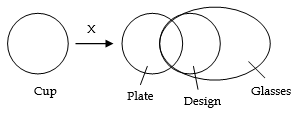
No cup is a plate

Some plates are design

All design are glasses.

Conclusion:

I. Some designs are not cups

II. Some cups are glasses 

Answer & explanation+

Correct answer: option 1

conclusion: I:follow

                   II: not follow
 

Advertisement

Practise more on Verbal Reasoning

Chapter-wise mocks on the real NTA exam screen, with solutions and your rank. Your first mocks are free.

Start free mocks →

Advertisement

Next questions

  1. Ramesh’s family finds little work on the farm in the Rabi season. According to NCERT, in which areas does it become difficult to find gainf…Economics · Indian Economic Development: Rural Development
  2. Inscriptions of the Indus Valley Civilisation were NOT found on:History · Ancient India: Bricks, Beads and Bones
  3. Who has to resign if 'NO-Confidence' Motion is passed in the Lok Sabha?General Aptitude Test · General Knowledge
  4. Who is the mother of Balaram?Fine Arts · The Pahari Schools of Painting
  5. How many princely states existed at the time of independence of India?Political Science · Politics in India Since Independence: Challenges of nation Building
  6. What is the relation of Ramesh with his mother's son-in-law's wife's sister?General Aptitude Test · Verbal Reasoning
  7. Pointing to a lady in a photograph, Vijay said, “Her sister’s mother is the sister of my father’s daughter.” How is the lady related to Vij…General Aptitude Test · Verbal Reasoning
  8. Which of the following statements best describes the policy of Non-Alignment? A. Not joining the military alliances led by the USA or USSR.…Political Science · Contemporary World Politics: The Cold War Era
  9. Select the most appropriate option to fill in the blank. She ______ how the magician had performed the rope trick.English · Fill Blanks
  10. What was the perceived consequence if the illegal Bengali Muslim settlers were not detected and deported, according to the Assam Movement?Political Science · Politics in India Since Independence: Regional Aspirations