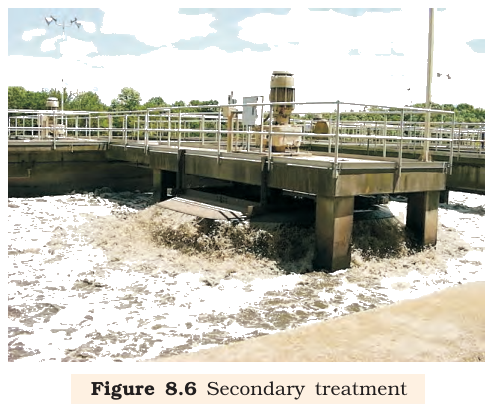
In which stage of sewage treatment, large amount of air is pumped into it?
Answer & explanation
Correct answer: option 3
The correct answer is Option (3) → Only Secondary Treatments
Option (1) Both Primary and Secondary Treatments — Incorrect. Primary treatment is physical: floating debris is removed by sequential filtration, and grit (soil and small pebbles) by sedimentation. No air is pumped in at that stage, so “both” is wrong.
Option (2) Only Primary Treatments — Incorrect. Primary treatment only removes particles; it uses no microbes and needs no air. The solids that settle form the primary sludge.
Option (3) Only Secondary Treatments — Correct. Air is pumped in during secondary (biological) treatment, because the useful microbes there are aerobic. With air they grow into flocs and consume the organic matter, which lowers the BOD of the effluent.
Option (4) After Secondary Treatments — Incorrect. After secondary treatment the effluent is released into rivers and streams. The settled sludge goes to anaerobic sludge digesters, where no air is given.
NCERT Extract:
Microbes in Sewage Treatment – “… Secondary treatment or Biological treatment : The primary effluent is passed into large aeration tanks (Figure 8.6) where it is constantly agitated mechanically and air is pumped into it. This allows vigorous growth of useful aerobic microbes into flocs (masses of bacteria associated with fungal filaments to form mesh like structures). While growing, these microbes consume the major part of the organic matter in the effluent.”