
CUETMOCK
  • Pricing
  • Mentors
Log inStart freeStart free mocks→

First test, then trust

Try a free CUET mock test.

Join 5,00,000+ students who rehearsed exam day on the exact NTA screen before sitting CUET. On the web and on Android.

Start free mocks →Get the Android app
CUETMOCK

India's #1 CUET Mock Test Platform. Original NCERT-based questions on the exact NTA exam screen — trusted by 5,00,000+ students since CUET 2022.

Get it onGoogle PlayScan to download the CUETMOCK app

Mock tests

  • CUET mock test series
  • Browse all papers
  • Commerce mocks
  • Humanities (Arts) mocks
  • Science mocks
  • Languages & GAT mocks
  • Free practice questions
  • Pricing

Resources

  • CUET exam guide
  • CUET syllabus
  • Universities accepting CUET
  • Expert blogs
  • News & notifications
  • Webinars & counselling
  • CUET score calculator
  • How we estimate your rank
  • FAQs

Company

  • About us
  • Our leadership & team
  • Our toppers
  • Mentors
  • For schools
  • Contact us
  • Terms
  • Privacy
  • Refund policy

Talk to us

+91 7696 6630 56info@cuetmock.comWhatsApp us

Our other platforms

  • JEE Mock — For IIT-JEE aspirants
  • NEET Mock — For NEET aspirants

Newsletter

Exam updates, study material and offers — no spam.

© 2026 NYC Ventures Pvt. Ltd.

701-702, Royal Business Park, Zirakpur, Punjab - 140603

  • Terms of use
  • Privacy policy
  • Refund policy
  • Contact us

iCUETMOCK is an independent preparation platform, not affiliated with the National Testing Agency (NTA). Always check exam details on the official NTA website.

  • Home
  • Mock tests
  • CUET guide
  • Pricing
  • Log in
Home/Practice questions/Physics
PhysicsWave Optics

Consider the polaroids P_1 and P_2 kept with axis parallel to the oth…

Consider the polaroids \( P_1 \) and \( P_2 \) kept with axis parallel to the other. Now the polaroid \( P_2 \) is rotated from 0 to \( 2\pi \) with respect to \( P_1 \). The variation of intensity of transmitted light through \( P_2 \) will be shown as
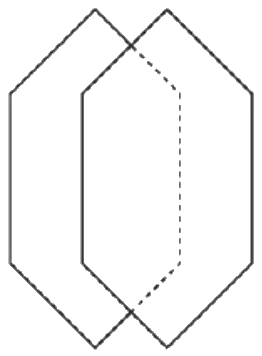
Figure for the question

Answer & explanation+

Correct answer: option 1

The correct answer is Option (1)
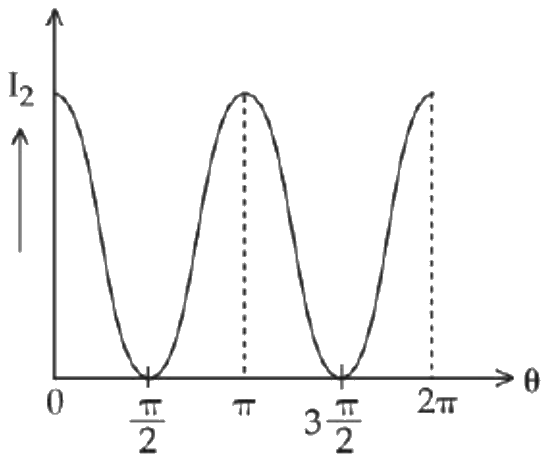
Figure for option 1

The light leaving \( P_1 \) is plane polarised. By Malus' law, the intensity transmitted by \( P_2 \) when its axis makes an angle \( \theta \) with that of \( P_1 \) is

    \( \displaystyle I_2 = I_1\cos^{2}\theta \)

where \( I_1 \) is the intensity of the light leaving \( P_1 \). As \( \theta \) goes from 0 to \( 2\pi \):

    \( \theta = 0:\ I_2 = I_1\ (\text{maximum}) \)
    \( \theta = \pi/2:\ I_2 = 0 \)
    \( \theta = \pi:\ I_2 = I_1 \)
    \( \theta = 3\pi/2:\ I_2 = 0 \)
    \( \theta = 2\pi:\ I_2 = I_1 \)

Since \( \cos^{2}\theta \) is a square, the intensity is never negative. The graph starts at its maximum, falls to zero at \( \pi/2 \) and \( 3\pi/2 \), and has maxima at 0, \( \pi \) and \( 2\pi \). Only Option (1) shows this.

Why the other options are incorrect
  • Figure for option 2

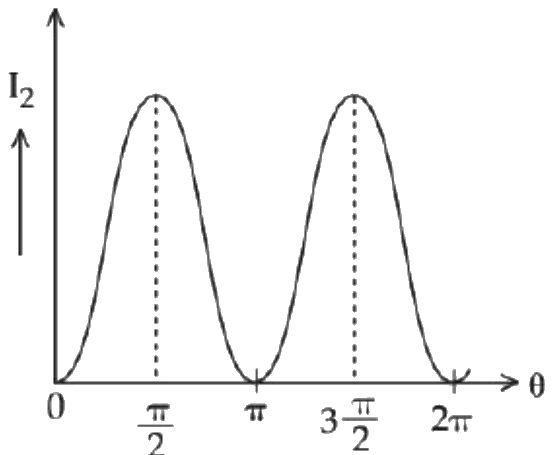
    Option (2) — Incorrect. This is the \( \sin^{2}\theta \) curve: it is zero at \( \theta = 0 \), where parallel axes give the maximum.
  • Figure for option 3

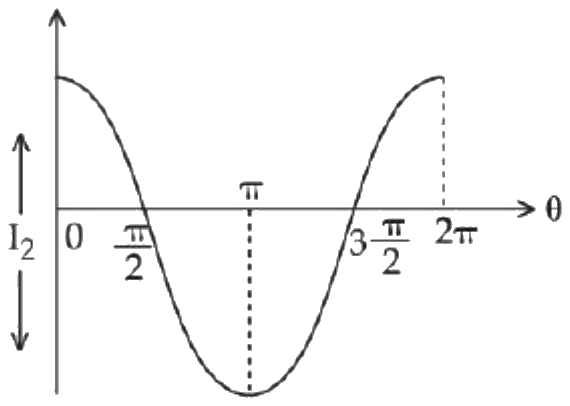
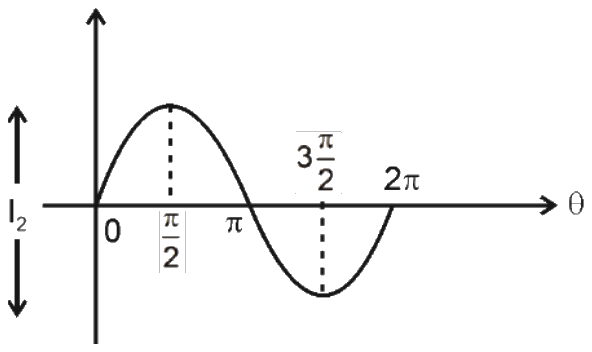
    Option (3) — Incorrect. This \( \cos\theta \) curve goes negative, and an intensity cannot be negative.
  • Figure for option 4

    Option (4) — Incorrect. This \( \sin\theta \) curve starts at zero and goes negative.

NCERT (2026-27):
Polarisation – “… If the pass-axis of P2 makes an angle θ with the pass-axis of P1, then when the polarised beam passes through the polaroid P2, the component E cos θ (along the pass-axis of P2) will pass through P2. Thus, as we rotate the polaroid P1 (or P2), the intensity will vary as:

    \( \displaystyle I = I_0 \cos^2\theta \qquad (10.18) \)

where I0 is the intensity of the polarized light after passing through P1. This is known as Malus’ law.”

Advertisement

Practise more on Wave Optics

Chapter-wise mocks on the real NTA exam screen, with solutions and your rank. Your first mocks are free.

Start free mocks →

Advertisement

Next questions

  1. Which of the following is NOT an example of secondary lymphoid organ?Biology · Human Health and Disease
  2. Select the most appropriate option to fill in the blank. Overindulgence in anything may prove ________ to health.English · Fill Blanks
  3. Consider the following statements about intellectual disability:(A) Persons having IQs below 70 are judged to have sub-average intelligence…Psychology · Variations in Psychological Attributes
  4. Physics · Current Electricity
  5. If P denotes ‘+’, Q denotes ‘×’, R denotes ‘–’ and S denotes ‘÷’, then what is the value of 3 Q 5 P 4 R 15 S 5?General Aptitude Test · Verbal Reasoning
  6. Analysis of the financial statements of a company is beneficial for:Accountancy Part B · Analysis of Financial Statements
  7. When a non-volatile solid is added to pure water then which of the following is a correct statement?Chemistry · Physical: Solutions
  8. The distance between the places H and O is D units. The average speed that gets a person from H to O in a stipulated time is S units. He ta…General Aptitude Test · Numerical Ability
  9. Find the particular solution of the differential equation ≤ft( xe^y/x + y ) dx = x dy, given that y = 1 when x = 1.Maths. Section B1 · Differential Equations
  10. If sin^-1x+sin^-1y=(2π)/3 , then the value of cos^-1x+cos^-1y is:Maths. Section B1 · Inverse Trigonometric Functions